The 5 Silent USMLE Killers: Are These Mistakes Costing You 30+ Points?

Academic Director & USMLE Educator, Dermatology Resident
Preparing for the USMLE isn’t just about how much you study; it’s about how smartly you avoid common pitfalls. Most aspirants fall into the same traps, leading to stagnant scores and exam-day burnout. According to experts at Next Steps USMLE, making these five critical mistakes can cost you 30+ points on your final score.
If you want to move from “passing” to “dominating,” you need to overhaul your strategy today.
1. The “First Aid Only” Trap
Many students treat First Aid as a holy grail to be memorized in isolation. Mistake #1 is failing to supplement First Aid with a high-quality lecture resource. While First Aid is an excellent outline, it often lacks the deep conceptual context required for the most difficult questions. By pairing it with a curated lecture resource, you gain a better understanding and application of complex concepts, turning rote memorization into true clinical mastery.
2. Delaying Your Qbank (The “I’m Not Ready” Myth)
One of the most common errors is doing your Qbank too late in the preparation cycle. Many students wait until they feel they “know enough” to start questions. In reality, you should start questions from the first day of your preparation. Questions aren’t just for testing—they are for learning. The old hierarchy of “Learn → Review → Then Qbank” is a recipe for low retention.
3. Saving NBMEs for “The End”
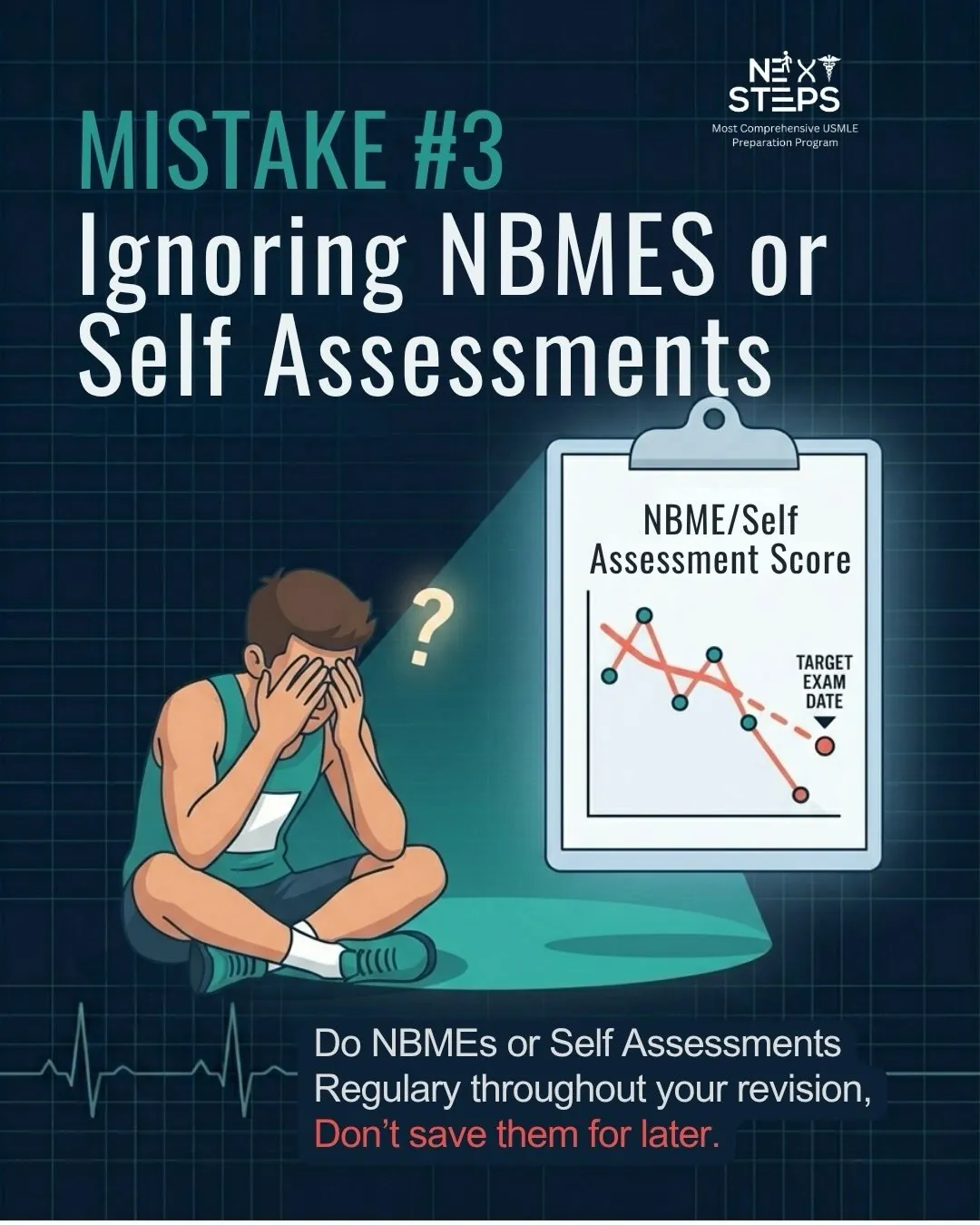
Are you ignoring your NBMEs or Self-Assessments until the final weeks? This is Mistake #3. Saving self-assessments for the end prevents you from identifying and fixing weak points early. You should do NBMEs or Self-Assessments regularly throughout your revision to track your progress against a target exam date and adjust your study plan in real time.
4. Ignoring the Science of Memory (Spaced Repetition)
Without a system for spaced repetition, your memory retention drops off a cliff within days. Research shows that “memory without spaced repetition” follows a steep decay curve, whereas using Anki cards and crash-course lectures lets you build a “staircase” of retention that peaks right at your exam date. If you aren’t using flashcards, you are effectively relearning the same material every week.
5. The 10-Hour “Burnout” Grind
Perhaps the most dangerous mistake is studying 10 hours a day with no rest. The image of the exhausted student surrounded by coffee and candles is a symbol of failure, not success. To perform at your peak, you must maintain a study vs. rest balance. The mantra for USMLE success isn’t “Study More”—it’s “Eat. Sleep. Study Well.”
The Next Steps Advantage: A Differentiated Strategy
At Next Steps USMLE, our educators don’t just provide materials; we curate a roadmap that differentiates our students from the average test-taker. Below is a comparison of generic advice versus the Next Steps curated method.
| Feature | Generic USMLE Advice | Next Steps Curated Strategy |
|---|---|---|
| First Aid use | Memorize the book in isolation. | Supplement with lectures for conceptual application. |
| Qbank timing | Start after you “know the content.” | Day-1 integration to build active recall. |
| Assessment | Use NBMEs as a final “predictor.” | Regular diagnostics to fix weak points early. |
| Retention | Passive re-reading and highlighting. | Spaced-repetition staircase (Anki + crash courses). |
| Wellness | “Grind until you drop” mentality. | Regulated study-rest balance (cognitive recovery). |
Your Retention Map: The USMLE Search Index
To help you retain this information, use these keywords as a mental map for your study plan. Think of these as “tags” to index your progress:
- Concept bridge: always link your First Aid reading to a lecture resource to ensure understanding.
- Active start: start your Qbank today—no matter where you are in your reading.
- Data-driven fix: use NBMEs as a compass to navigate your revision.
- Recall staircase: use Anki and crash courses to stop the memory decay curve.
- Peak performance: remember—“Eat. Sleep. Study Well.”
Next step
Step 1 & Step 2 CK Prep
Structured modules, 1-on-1 mentorship, and a 100-day plan to clear the boards.