Do MBBS Marks Affect Your USMLE Score or the Match? (2026)

Academic Director & USMLE Educator, Dermatology Resident
The short answer
No. MBBS marks do not predict USMLE performance, and US residency programmes rarely use them to screen. They test different skills. Average students clear the USMLE every year, and toppers fail it every year.
This question usually carries real anxiety behind it, from students who did not top their class and assume the door is closed. It is not, and it is worth understanding exactly why.
Why the two do not correlate
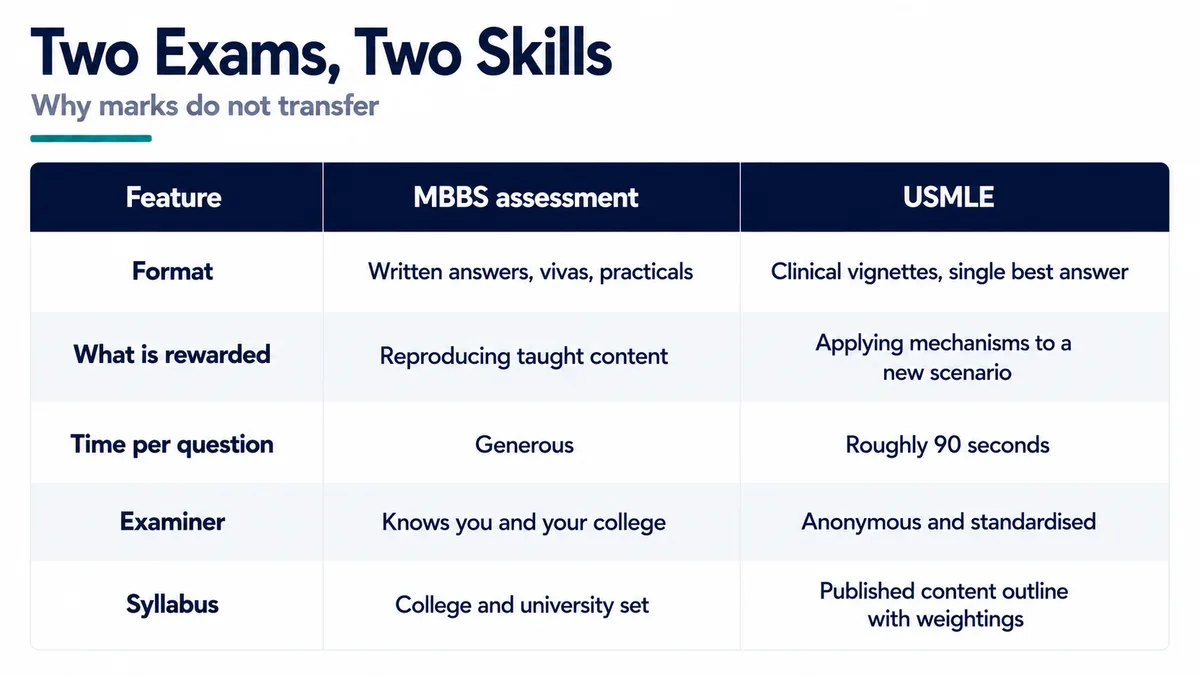
| MBBS assessment | USMLE | |
|---|---|---|
| Format | Written answers, vivas, practicals | Clinical vignettes, single best answer |
| What is rewarded | Reproducing taught content | Applying mechanisms to a new scenario |
| Time per question | Generous | Roughly 90 seconds |
| Examiner | Knows you and your college | Anonymous and standardised |
| Syllabus | College and university set | Published content outline with weightings |
The skill that actually transfers
Not how much you memorised, but whether you can decide quickly between options that all look plausible. That is trainable, and it is trained by doing questions and reviewing them properly, which is why preparation method predicts outcomes better than prior ranking.
What programmes actually screen on
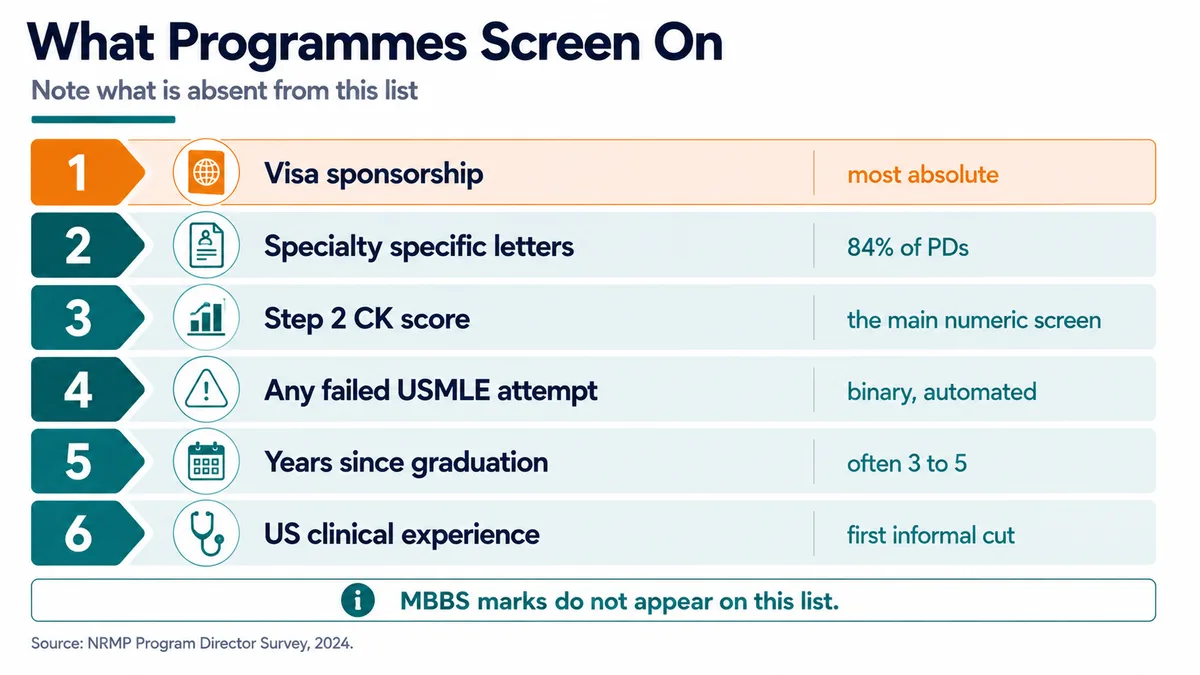
When a programme filters applications, these are the levers. Note what is absent.
- Visa sponsorship. The most common and most absolute filter.
- Specialty specific letters of recommendation. Cited by 84% of programme directors as a key interview factor.
- Step 2 CK score. The main numeric screen now that Step 1 is pass or fail.
- Any failed USMLE attempt. Binary, and frequently automated.
- Years since graduation. Commonly three to five years.
- US clinical experience. Often the first informal cut.
MBBS marks are not on that list
US programme directors generally cannot interpret an Indian university transcript, because marking varies by university and there is no equivalent of a US class rank they can read. So it rarely functions as a screening tool at all.
Where your marks do matter
They are not irrelevant, they are just relevant somewhere other than where students fear.
- Backlogs and delays. Failing subjects delays graduation, internship, ECFMG certification and your application cycle. This is the genuine risk, and it is about timing rather than the number.
- Some universities and observership hosts ask for transcripts as an administrative requirement.
- Distinctions and gold medals are a small positive in a CV, but nowhere near the weight of a US letter or a Step 2 CK score.
- Research and academic references are easier to obtain if faculty regard you well, which marks contribute to indirectly.
If your marks are low
What to build instead
Everything programmes actually screen on is still fully open to you: a strong Step 2 CK score, hands on US clinical experience, US based letters, and a clean first attempt record. None of these ask what you scored in second year pathology.
- Protect your first attempt. A pass at 75% odds beats a retake at 54%, and this matters far more than any transcript line.
- Aim high on Step 2 CK. It is the number that replaces every other number.
- Get hands on USCE, and turn it into a specific letter.
- Do not explain your marks in your personal statement unless directly asked. It draws attention to something that was not being screened.
Where the belief comes from
The assumption that marks carry over is reasonable, it is just built on how Indian selection works rather than how US selection works.
| Indian system | US residency selection |
|---|---|
| Entrance rank decides placement | No central ranking of applicants |
| Marks decide postgraduate seats | Programmes review whole applications |
| One number determines outcomes | Several signals, weighted differently by programme |
| Academic record is the credential | Letters, clinical exposure and scores are the credential |
The mental shift
In India, your record largely determines your options. In the US Match, what you build after the record determines them. That is genuinely good news if your marks were average, and it is a warning if you assumed high marks alone would carry you.
What actually predicts USMLE performance
- Question volume with proper review. The strongest single predictor, and entirely within your control.
- Consistency over months. Forty questions daily for a year beats bursts of two hundred.
- Using self assessments early. Calibration prevents the most expensive mistake, which is booking too soon.
- Studying mechanisms rather than facts. Step 1 spends 60 to 70% of questions on applying foundational science.
- Timing practice. At roughly 90 seconds per question, pacing is a trainable skill of its own.
Notice that none of these are fixed at the point you finish MBBS. Every one is a decision available to you now.
If your marks are high
A warning that is easy to miss
Toppers fail the USMLE more often than they expect, because the study method that produced high MBBS marks, thorough reading and reproduction, is exactly the method that underperforms on an applied, time pressured exam. High marks can create false confidence about readiness. Use self assessments the same way an average student would.
What to do with the time instead
| Instead of worrying about | Build |
|---|---|
| Your MBBS percentage | A clean first attempt record |
| Class rank | A strong Step 2 CK score |
| College reputation | Hands on US clinical experience |
| Comparisons with batchmates | Two to three US based letters |
| Whether you are "good enough" | Consistency, measured in questions per week |
The honest summary
Your MBBS marks are already fixed and are among the least important inputs to this process. Everything programmes screen on is still fully open to you, and the students who succeed are the ones who spend their energy there rather than on a transcript nobody is reading.
Sources
- NRMP Program Director Survey, 2024: specialty specific letters cited by 84% of programme directors.
- USMLE Performance Data, 2025 pass rates by Step.
Figures verified July 2026.
Next step
Step 1 & Step 2 CK Prep
Structured modules, 1-on-1 mentorship, and a 100-day plan to clear the boards.