Is It Too Late to Start the USMLE? Age and YOG Rules (2026)

Academic Director & USMLE Educator, Dermatology Resident
If you are asking whether you have aged out of the USMLE, here is the answer before anything else: there is no age limit, and there is no published cut-off on your year of graduation. The USMLE eligibility requirements turn entirely on where you studied and whether you graduated — age does not appear in them at all.
What does exist is a small set of real deadlines that almost nobody explains correctly, and a folk rule about “five years since graduation” that, when you go looking for its source, turns out not to have one. This guide separates the two. If you are a 28-year-old MBBS graduate with three years of NEET-PG attempts behind you, wondering whether to begin USMLE preparation at all, this is written for you — not for the hypothetical 50-year-old career changer most articles on this topic quietly assume.
- No age limit exists — eligibility depends on your medical school and graduation status, nothing else.
- NRMP does not measure your year of graduation. Its IMG report tracks ten measures; that is not one of them.
- The real deadlines are the ECFMG seven-year window, the state licensure seven-year norm, and Pathways expiration.
- The hard wall is four attempts at a Step, not your birthday.
- An Indian MD/MS/DNB rarely shortens US residency — it is a CV asset, not a time credit.
- What program directors are surveyed on is visa status, and on having overcome significant obstacles.
Is There a USMLE Age Limit?
No. To sit Step 1 or Step 2 CK you must be a student or graduate of a medical school listed in the World Directory of Medical Schools as meeting ECFMG eligibility requirements. That is the whole test. There is no birth-date clause, no upper bound, and no separate rule for applicants in their thirties or forties. Our guide to who is eligible for the USMLE walks through the categories in detail.
The confusion usually comes from mixing up eligibility with competitiveness. Nothing stops you registering. The fair question is what happens to your application once it reaches a program — and that is where the evidence gets interesting.
Where the “Five-Year Rule” Actually Comes From
It is not published by NRMP. Search this topic and you will be told, confidently and repeatedly, that programs filter out anyone more than five (or seven) years from graduation — stated as fact, page after page, and never with a source. Check the two documents that would have to contain such a rule, and it is in neither of them.
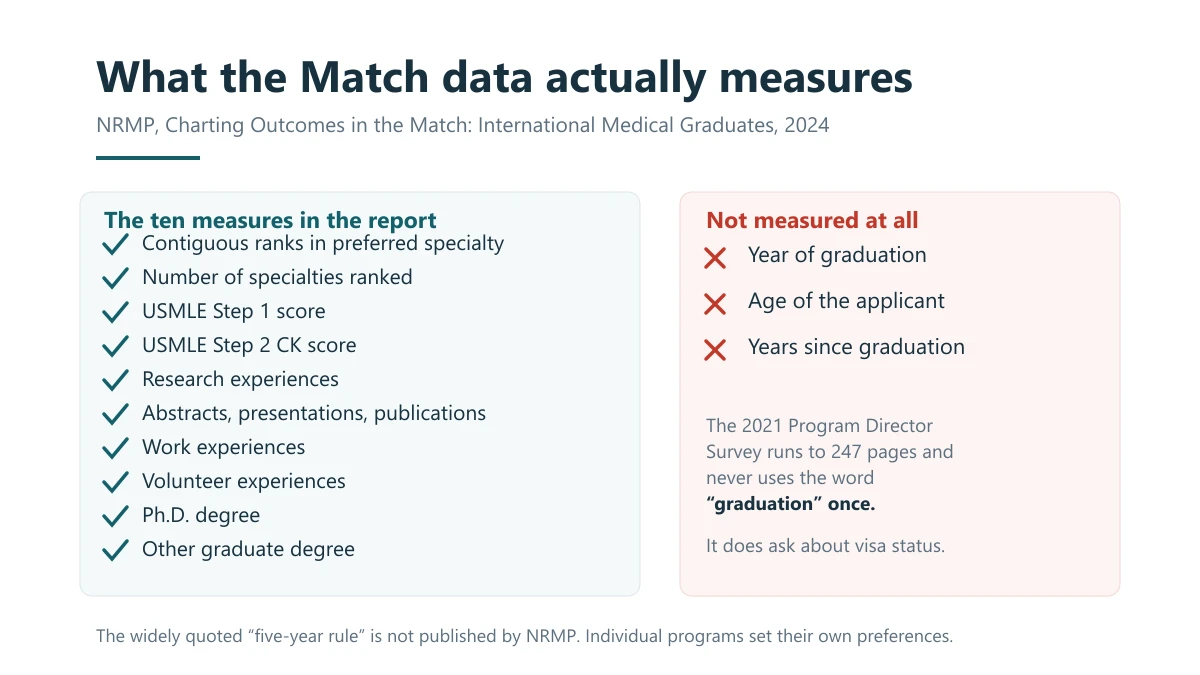
NRMP’s Charting Outcomes in the Match: International Medical Graduates states plainly that “ten measures are incorporated in this report.” Those ten are contiguous ranks, specialties ranked, Step 1 and Step 2 CK scores, research experiences, abstracts and publications, work experiences, volunteer experiences, a Ph.D., and other graduate degrees. Years since graduation is not among them. An earlier 2013 edition, produced jointly with ECFMG, did draw on some ECFMG-supplied variables; from the 2014 Match onward NRMP switched to its own applicant registration data, and the measure disappeared.
The Program Director Survey is the other place such a number would live. The comprehensive 2021 edition runs to 247 pages and does not use the word “graduation” a single time. Age never appears either. What the survey does ask about is visa status — 35.5 per cent of program directors cited the ability to work legally without a visa, and 33.4 per cent cited visa status, among the personal characteristics they weigh when deciding whom to interview.
Put the two together and the position is simple: neither of the two documents that would have to contain a year-of-graduation rule contains one. NRMP’s Charting Outcomes does not measure years since graduation, and the Program Director Survey does not ask about it. The rule is folklore that has been repeated until it sounded official.
It does not mean no program cares. Some programs publish a preferred graduation window on their own eligibility pages, and those are real. It means the specific national “five-year rule” everyone quotes has no published basis — so check the eligibility page of each program on your list instead of self-rejecting against a number nobody can source.
The Deadlines That Are Real
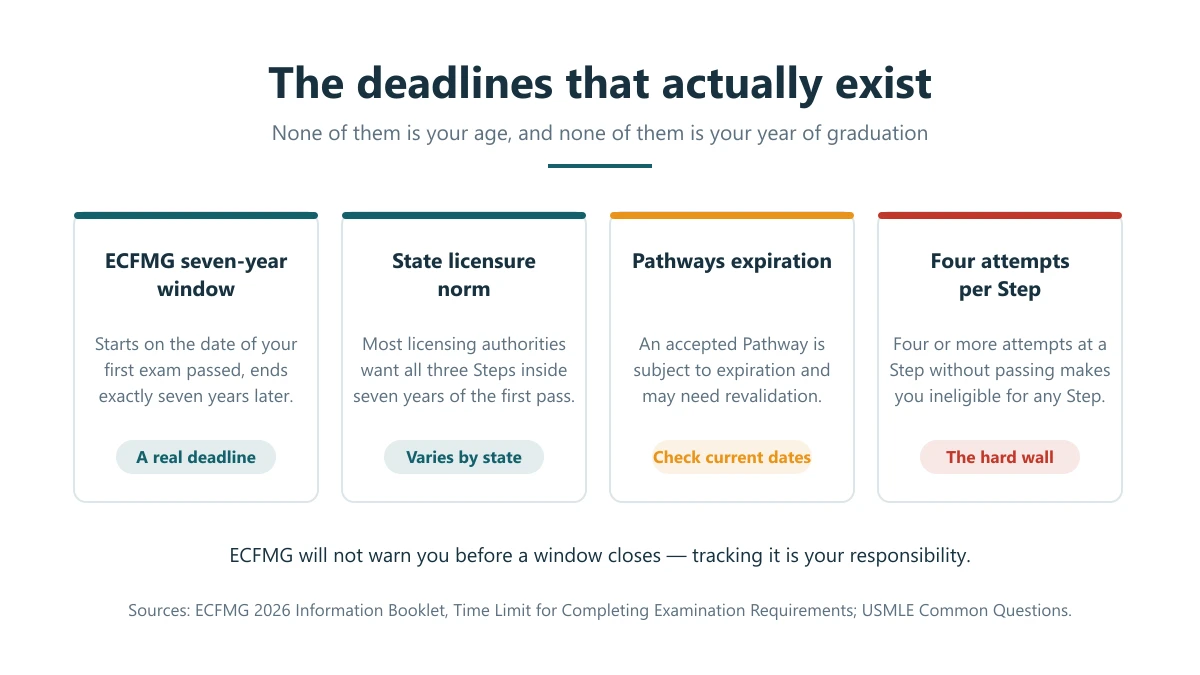
Three different things get called “the seven-year rule,” and conflating them is the single most common mistake in this topic.
| Which rule | What it governs | When the clock starts |
|---|---|---|
| ECFMG seven-year window | Certification. Miss it and your earliest passing performance stops counting for ECFMG Certification. | The date of your first exam passed, ending exactly seven years later. |
| State licensure norm | Licensure, not certification. Most boards want all three Steps inside seven years; some do not apply it. | When you pass your first Step. |
| Pathways expiration | An accepted Pathway expires for other purposes and may need revalidation. | Separate from the seven-year window — check ECFMG for current dates. |
ECFMG is explicit that your Pathways application must be accepted inside the seven-year window, and equally explicit about whose job it is to watch the calendar: it “will not notify you of upcoming deadlines… and will not notify you if one (or more) of your passing performances becomes invalid.” For the full mechanics and a worked example, see our guide to how long the USMLE stays valid, and our breakdown of the ECFMG Pathways.
What Actually Ends a USMLE Journey
Not age. Attempts. USMLE states that the total number of attempts allowed per Step is four, that incomplete attempts count, and that anyone who has attempted a Step four or more times without passing is ineligible to apply for USMLE Steps — not just that Step, the sequence. You also may not take the same exam more than three times in a 12-month period.
This reframes the whole question. In our experience mentoring IMGs, a graduate from 2016 with a clean first-attempt record is in a far stronger position than a 2023 graduate with three fails. If you are weighing a retake, read what happens if you fail Step 1 before booking anything.
Does an Indian MD, MS or DNB Shorten US Residency?
Almost never. If you are asking whether to do the USMLE after a PG in India, this deserves a straight answer, because the entire internet dodges it.
ECFMG certifies you on your MBBS. A postgraduate degree earns no exemption there. Credit for prior training is decided later, by the relevant US specialty board, and the policies vary enormously:
- American Board of Surgery — may grant up to two years of credit (PGY-1 and PGY-2) if you demonstrate competence at or above PGY-3 level. The conditions are heavy:
- Your program director must request it, not you.
- Only after a mandatory six-month observation period inside the US program.
- Approval is “not automatic nor guaranteed.”
- No credit for PGY-4 or PGY-5, and the final two years must be completed in the same ACGME-accredited program.
- Credit does not transfer if you move programs.
- American Board of Emergency Medicine — training completed in ACGME-International approved programs “cannot be used to fulfill any residency training requirements” for certification, and no equivalent credit at all is allowed for less than 12 months of prior training.
Plan on repeating residency in full. The Indian PG still earns its keep — clinical maturity, procedural volume, and better letters — but budget your timeline as though it buys you nothing, because usually it does. If you are still deciding when to start, see whether to take the USMLE straight after MBBS.
What Your Gap Actually Looks Like to a Program Director
A gap is not one thing. What matters is whether the time reads as drift or as direction. Notably, the same Program Director Survey that never mentions graduation year found 75.5 per cent of program directors citing “having overcome significant obstacles” among the characteristics they consider — and 79.5 per cent citing perceived commitment to the specialty.
| Your gap | How it reads unaddressed | How to give it direction |
|---|---|---|
| NEET-PG attempts | Years of silence on the CV | Name it plainly; pair it with recent USCE and a current Step 2 CK score |
| Indian PG completed or in progress | Ambiguous — are you committed to the US? | State the specialty logic; convert the training into research output and letters |
| Service or rural bond | Unexplained absence | Quantify the clinical volume; it is genuine patient-care experience |
| Non-clinical work | Left medicine | Show a deliberate return: recent hands-on USCE outweighs the detour |
| Family or health reasons | Unclear | One honest line; do not over-explain, then pivot to current activity |
The common thread is recency. In our experience, clinical contact in the last 6–12 months does more for an older application than any amount of apologising for the years before it — which is why finding strong US clinical experience is the highest-leverage move available to you. If your file is already out and silent, our post on why IMGs do not get interviews covers the other screening filters.
Too Expensive? Too Hard?
These are the other two objections that stop people before they start, and both have their own answer. On cost, the fees are real and worth planning properly — we break the whole thing down in what the USMLE actually costs in total. On difficulty, the exam is demanding but the pass rates for well-prepared Indian graduates are better than the folklore suggests; see is the USMLE tough for Indian students.
For context on the odds themselves: in the 2026 Main Residency Match, non-US-citizen IMGs matched at 56.4 per cent, a five-year low. Within that, IMGs requiring visa sponsorship matched at 54.4 per cent against 67.9 per cent for those not requiring sponsorship. Our full 2026 NRMP data breakdown has the specialty-level detail.
- Self-rejecting against a five-year rule that nobody can source.
- Confusing the three seven-year rules and missing the one that actually binds.
- Assuming an Indian PG buys time credit — then discovering it does not, mid-application.
- Burning attempts on an unprepared retake; four is the real wall.
- Letting USCE go stale — recency matters more than the calendar year on your diploma.
- Hiding the gap instead of giving it a direction.
When It Genuinely Is Hard
An honest guide has to say this. The combination that really does make matching difficult is not age on its own — it is a long gap with no clinical activity in it, multiple failed attempts, no US clinical experience, a need for visa sponsorship, and a competitive surgical target all at once. Any one of those is workable. Stacked together, they are a genuinely steep climb, and you deserve to hear that before you spend the money.
If that describes you, the answer is usually not “give up” but “change the plan”: widen the specialty list, front-load recent hands-on USCE, and protect your remaining attempts rather than spending them.
Frequently Asked Questions
Is there an age limit for the USMLE?
No. The USMLE Bulletin defines eligibility purely by your enrollment or graduation status at a medical school listed in the World Directory of Medical Schools as meeting ECFMG eligibility requirements. Age is not mentioned anywhere in the eligibility requirements, and there is no upper age cut-off for taking any Step or for entering the Match.
Does your year of graduation disqualify you from the Match?
Not as a rule. NRMP does not publish a year-of-graduation cut-off. Its Charting Outcomes report for international medical graduates analyses ten measures, and years since graduation is not one of them. Individual residency programs may set their own preferences, so check each program's eligibility page rather than trusting a general figure.
Where does the five-year rule for IMGs come from?
It is not published by NRMP. The 2021 Program Director Survey runs to 247 pages and never uses the word graduation, and the Charting Outcomes IMG report does not measure years since graduation. Some individual programs do state a preferred graduation window on their own websites, and that program-level preference is what has been repeated until it sounded like a national rule.
What are the real USMLE deadlines?
Three matter. ECFMG requires you to satisfy all examination requirements for certification within a seven-year period that starts on the date of your first exam passed. Most state licensing authorities want all three Steps completed within seven years of your first pass. And an accepted Pathway is subject to expiration, so it may need revalidation.
How many times can you attempt a USMLE Step?
Four. USMLE states that the total number of attempts allowed per Step is four, including incomplete attempts, and that examinees who have attempted any Step four or more times without passing are ineligible to apply for USMLE Steps. You may also take the same exam no more than three times within a 12-month period.
Does an Indian MD, MS or DNB shorten US residency?
Almost never. ECFMG certification is based on your MBBS, so a postgraduate degree earns no exemption. Credit for prior training is decided by the relevant US specialty board. The American Board of Surgery may grant up to two years, but only after a six-month observation period inside the US program, never for PGY-4 or PGY-5, and the credit does not transfer if you change programs. The American Board of Emergency Medicine grants none at all for ACGME-International training. Treat an Indian PG as a CV asset, not a time credit.
Do program directors screen on age or visa status?
The NRMP Program Director Survey asks about visa status, not age or graduation year. In the 2021 survey, 35.5 percent of program directors cited the ability to work legally without a visa and 33.4 percent cited visa status among the personal characteristics they consider when deciding whom to interview. Neither age nor year of graduation appears on that list.
The Honest Conclusion
Your graduation year is a fact on a form. Your attempts, your ECFMG window, your recent clinical contact and your Step 2 CK score are the things that move the needle — and every one of them is still in front of you. The applicants who struggle are rarely the oldest ones; they are the ones who let the calendar decide for them.
We run a free USMLE awareness session every Sunday, covering exactly these objections — cost, timing, and difficulty — with time for your own situation. Request a seat and we will send you the joining link — before you rule yourself out.
If you would rather map the whole route first, start with our Step 1 & Step 2 CK program, or read the success stories of IMGs who began later than they thought was allowed.
Next step
Step 1 & Step 2 CK Prep
Structured modules, 1-on-1 mentorship, and a 100-day plan to clear the boards.