What Is the USMLE? The 3 Steps, Scoring & Cost (2026)

Academic Director & USMLE Educator, Dermatology Resident

If you are a medical student or international medical graduate (IMG) aiming to practice in the United States, the USMLE is the gateway you cannot go around. It is the single licensing examination every physician (US or international) must pass to be licensed to practice medicine in the US. Understanding what it is, how its three Steps fit together, and how each is scored is the first move in any serious USMLE preparation plan.
This guide gives you the complete map: what the USMLE is, what each Step tests, how scoring works in 2026, what it costs, who is eligible, and the order to take them in. Once the structure is clear, the rest of your prep has something to hang on.
- The USMLE is a three-Step exam for US medical licensure.
- Step 1: basic sciences, now pass/fail.
- Step 2 CK: clinical knowledge, scored, and the number that matters most for the Match.
- Step 3: taken during residency; the final licensing Step.
- IMGs must also obtain ECFMG certification.
What Is the USMLE?
The United States Medical Licensing Examination (USMLE) is a three-part standardized exam, co-sponsored by the Federation of State Medical Boards (FSMB) and the National Board of Medical Examiners (NBME), that assesses a physician’s ability to apply knowledge, concepts, and skills essential for safe and effective patient care. Passing all three Steps is required for medical licensure in the US, regardless of where you went to medical school.
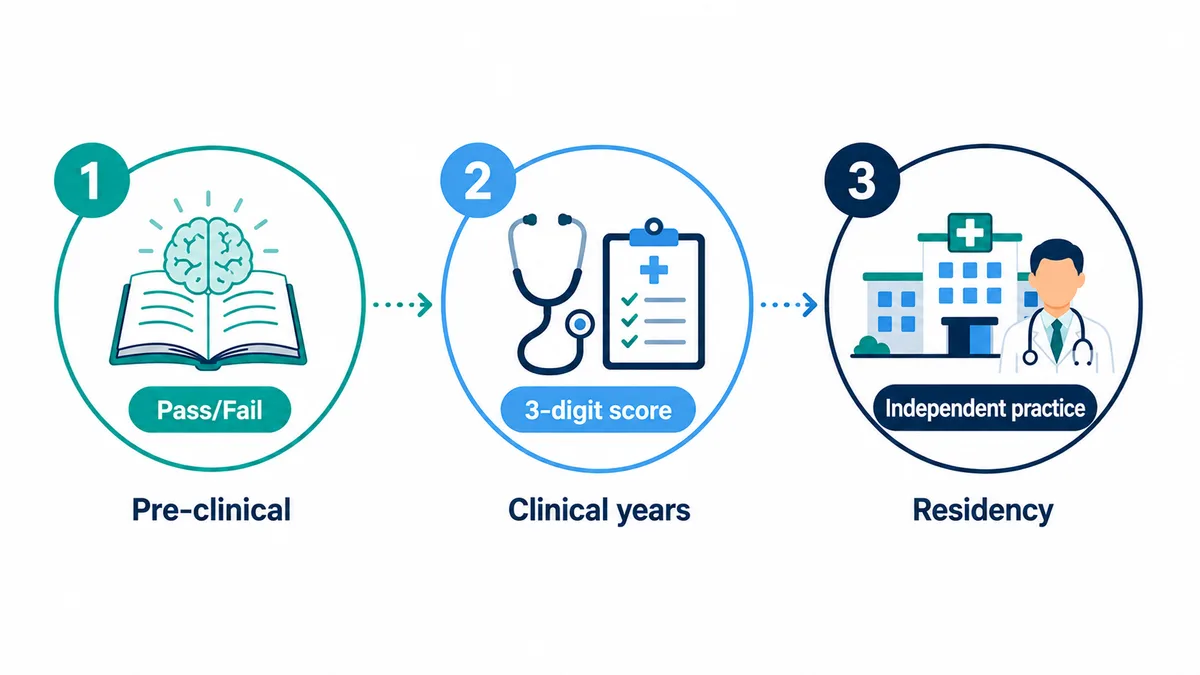
The Three Steps at a Glance
| Step | What it tests | When you take it | Scoring |
|---|---|---|---|
| Step 1 | Basic sciences & foundational mechanisms | After pre-clinical years | Pass/Fail |
| Step 2 CK | Clinical knowledge & patient management | During/after clinical years | 3-digit score |
| Step 3 | Independent practice readiness | During residency (usually intern year) | 3-digit score |
Step 1: The Foundation
Step 1 tests the basic sciences: anatomy, physiology, pharmacology, pathology, microbiology, biochemistry, and the mechanisms behind disease. It is a one-day exam of up to 280 questions across seven 60-minute blocks. Since January 2022 it has been pass/fail: you need to pass, but there is no score to chase. That shift moved the competitive weight onto Step 2 CK. Plan it with our Step 1 study-schedule guide and our breakdown of the typical Step 1 preparation time.
Step 2 CK: The Score That Now Matters Most
Step 2 Clinical Knowledge (CK) tests how you apply medical knowledge to patient care across the major specialties. It is a one-day, roughly 9-hour exam of up to 318 questions in sixteen 30-minute blocks, and it is scored on the three-digit scale. With Step 1 pass/fail, program directors now lean on the Step 2 CK score as the primary numerical screen, which is why a strong score is so valuable. Our 12-week Step 2 CK study plan is built to push that number into competitive territory.
Step 3: The Final Step
Step 3 is the last Step and the only one taken after medical school, usually during the first year of residency. It is a two-day exam assessing whether you can practice medicine independently, including multiple-choice questions and computer-based case simulations (CCS). It is scored, but the stakes are lower than Step 2 CK since most takers have already matched.
How the USMLE Is Scored (2026)
Two Steps carry three-digit scores; Step 1 is pass/fail. The minimum passing marks for 2026:
| Step | Scoring | Passing (2026) |
|---|---|---|
| Step 1 | Pass / Fail | Pass |
| Step 2 CK | 3-digit score | 218 |
| Step 3 | 3-digit score | ~198 |
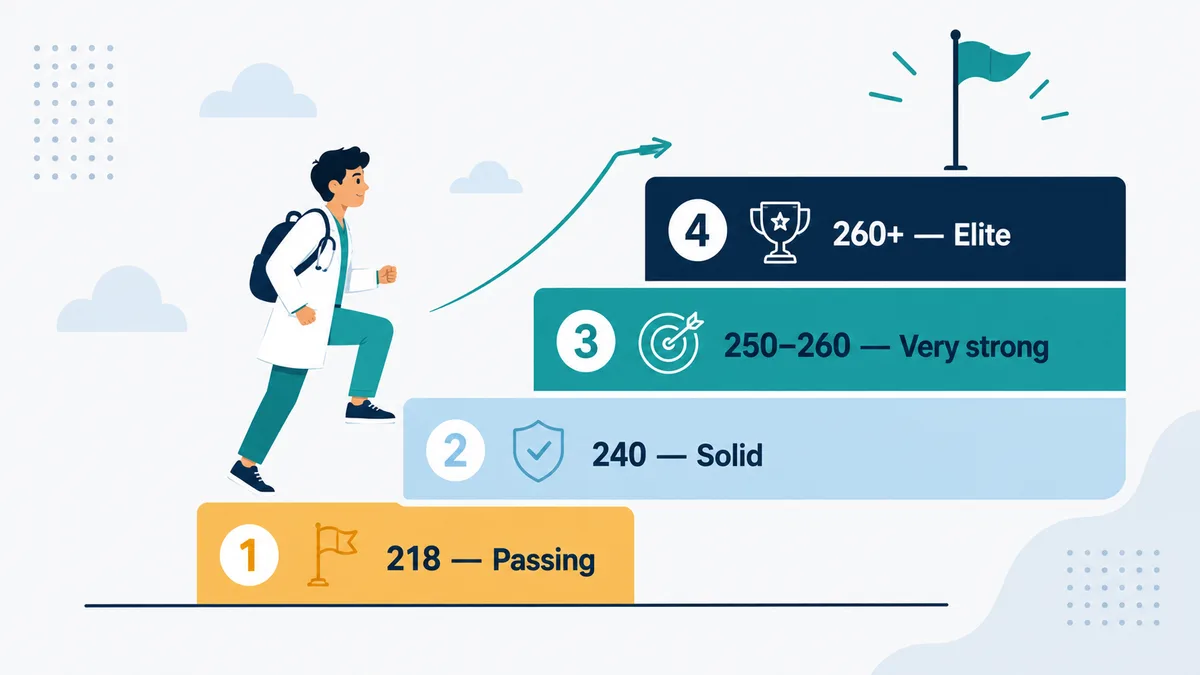
For Step 2 CK, passing is 218, but competitive is higher: around 240 is solid, 250–260 is very strong, and 260+ is elite. Aim well above the floor for competitive specialties.
What Does the USMLE Cost?
Fees change yearly (always confirm on the official sites), but the approximate 2026 picture is:
| Step | Approx. fee (USD) | IMG note |
|---|---|---|
| Step 1 | ~$1,045 | Registered via ECFMG; international surcharge may apply |
| Step 2 CK | ~$1,045 | Registered via ECFMG; international surcharge may apply |
| Step 3 | ~$915 | Registered via FSMB (after ECFMG certification) |
IMGs also pay ECFMG certification fees on top, and testing outside the US/Canada can add a regional surcharge. Budget for prep resources (Qbanks, review books) as a separate, significant cost.
Who Is Eligible?
Eligibility depends on where you trained:
- US/Canadian students: enrolled at, or graduated from, an LCME- or AOA-accredited medical school.
- IMGs: enrolled at, or graduated from, a medical school listed in the World Directory of Medical Schools, and registered through ECFMG.
For IMGs, ECFMG certification is the credential that lets you sit the exam and, later, enter US residency. It runs in parallel with your Step exams.
In What Order Should You Take Them?
The standard sequence is Step 1 → Step 2 CK → Step 3. Most students take Step 1 after their pre-clinical years, Step 2 CK during or after clinical rotations (and before applying to residency, so the score is on the application), and Step 3 during intern year. Because Step 2 CK now carries the score weight, many applicants plan their timeline specifically to have a strong CK score ready for ERAS. A complete, residency-ready USMLE CV ties all of this together.
Frequently Asked Questions
How many Steps are in the USMLE?
Three: Step 1 (basic sciences, pass/fail), Step 2 CK (clinical knowledge, scored), and Step 3 (independent-practice readiness, taken during residency). Step 2 CS was discontinued in 2021.
Is USMLE Step 1 still scored?
No. Since January 2022, Step 1 is reported as Pass/Fail only. You must pass, but there is no three-digit score, which is why Step 2 CK now carries the competitive weight.
What is the Step 2 CK passing score in 2026?
The 2026 passing score is 218. But passing is the floor. Around 240 is solid and 250–260 is very strong for competitive specialties.
How much does the USMLE cost?
Roughly $1,045 each for Step 1 and Step 2 CK and about $915 for Step 3, plus ECFMG certification fees for IMGs and a possible international testing surcharge. Confirm current fees on the official USMLE/ECFMG sites, and budget separately for prep resources.
Can IMGs take the USMLE?
Yes. IMGs from a school listed in the World Directory of Medical Schools register through ECFMG. ECFMG certification runs alongside your Step exams and is required to enter US residency.
In what order should I take the USMLE Steps?
Step 1, then Step 2 CK, then Step 3. Take Step 1 after pre-clinical years, Step 2 CK during or after rotations (and before ERAS so the score is on your application), and Step 3 during intern year.
Conclusion
The USMLE is the three-Step path to US licensure: Step 1 to prove your foundations, Step 2 CK to prove your clinical judgment (and earn the score that drives your Match), and Step 3 to prove you can practice independently. Know the structure, plan the order around a strong Step 2 CK, and, if you are an IMG, run ECFMG certification in parallel.
Ready to build a real plan? Explore our USMLE Step 1 & Step 2 CK preparation program and see how our students have matched into U.S. residency.
Next step
Step 1 & Step 2 CK Prep
Structured modules, 1-on-1 mentorship, and a 100-day plan to clear the boards.