How Many Indians Pass the USMLE Each Year? (2024 Data)

Academic Director & USMLE Educator, Dermatology Resident
The short answer
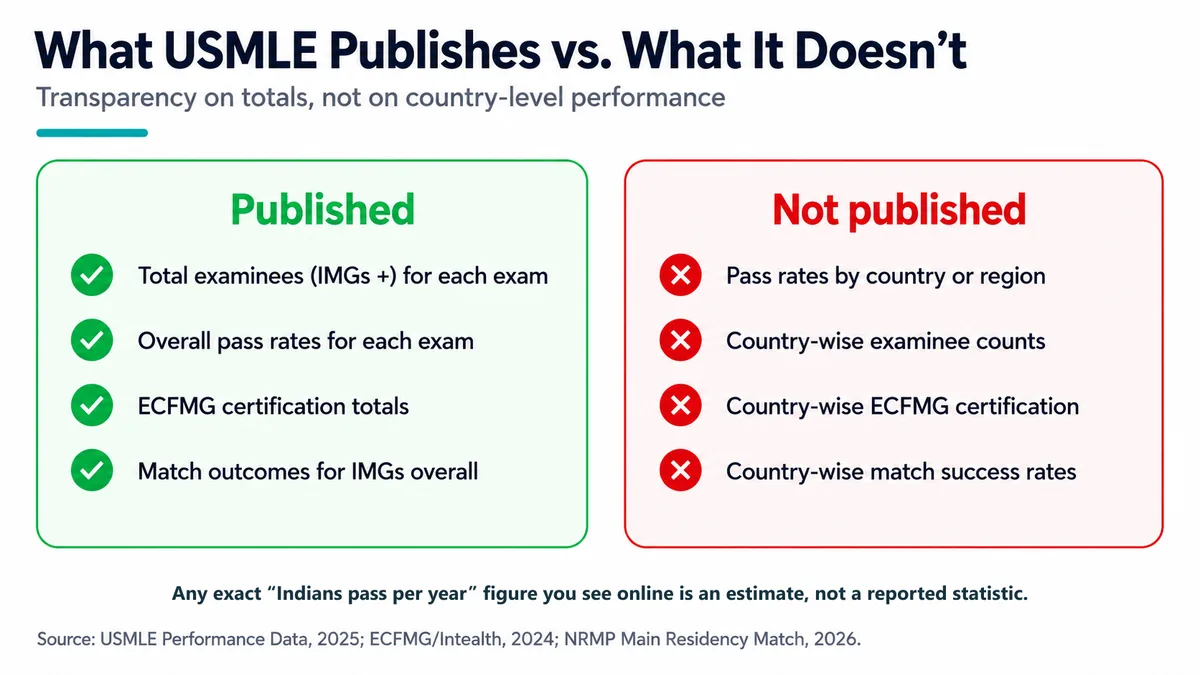
Nobody publishes it. Neither ECFMG nor the USMLE releases pass counts by country, so an exact "Indians who passed" figure does not exist in any official dataset. What we can say from real data: roughly 13,431 doctors from all countries earned ECFMG certification in 2024, India is consistently one of the top two countries of citizenship among them, and IMG first-time pass rates in 2024 ran 73% for Step 1 and 89% for Step 2 CK.
This is one of the most-asked questions among Indian medical students, and almost every answer you will find online quotes a confident number with no source attached. We went to the primary data instead. Here is what is actually published, what is not, and what a defensible estimate looks like.
Why there is no official Indian pass count
Three organisations publish data on this journey, and each of them stops short of a country-level breakdown:
- The USMLE publishes pass rates split only into two buckets: examinees from US/Canadian schools, and everyone else.
- ECFMG (a division of Intealth) publishes the total number of certificates issued each year and a top-five countries of citizenship chart, but not per-country counts.
- The NRMP publishes Match outcomes for "non-US citizen IMGs" as a single group.
Read numbers critically
If a website gives you an exact figure for Indian USMLE passes without naming a source, treat it as a guess. That includes the figure this article used to carry before it was rewritten.
What the data does show: IMG pass rates in 2024
These are the real numbers, covering every examinee from a non-US medical school. Indian graduates are the single largest component of this pool.
| Exam | First-time takers | Pass rate | Repeat pass rate |
|---|---|---|---|
| Step 1 | 22,713 | 73% | 52% |
| Step 2 CK | 15,064 | 89% | 61% |
| Step 3 | 12,134 | 89% | 64% |
Source: USMLE Performance Data, 2024. Examinees from Canadian schools were grouped with US examinees in 2024 reporting; from 2025 onward they are grouped with the non-US cohort instead.
The number that should worry you
Step 1 is where IMG journeys end. More than one in four first-time takers fails, and repeaters pass only 52% of the time. A first-attempt fail does not just cost you months; it permanently marks your application in a Match where programmes filter on exactly that.
From exam hall to residency: the full funnel
Passing is not the finish line. The number that actually matters is how many IMGs end up in a US residency post, and that is a much smaller figure. Here is that same population followed stage by stage, all from 2024 reporting:
| Stage | Count (2024) | Note |
|---|---|---|
| Took Step 1 | 26,634 | non-US schools, all attempts |
| Passed Step 1 | 18,644 | 70% overall pass rate |
| Took Step 2 CK | 16,637 | non-US schools, 2023-2024 cycle |
| Passed Step 2 CK | 14,474 | 87% overall pass rate |
| ECFMG certified | 13,431 | all countries |
| Registered for the Match | 12,787 | non-US citizen IMGs |
| Matched to a PGY-1 post | 5,864 | 58.5% match rate among active applicants |
In the 2024 Main Residency Match, 12,787 non-US citizen IMGs registered and 5,864 matched to a PGY-1 position, a match rate of 58.5% among active applicants.
What this means in practice
Clearing the USMLE is common. Matching is not. Just over half of non-US citizen IMGs who apply get a PGY-1 position, which is why your CV, US clinical experience and letters do as much work as your score does.
So what is a realistic estimate for India?
We can bracket it honestly rather than invent a number. Here is the reasoning, with every assumption stated:
- ECFMG certified 13,431 physicians in 2024, drawn from 1,628 medical schools across 146 countries.
- India appears consistently in ECFMG's top-five countries of citizenship for certificants, and is the largest single source among non-US citizens.
- That places the annual Indian figure in the low thousands: the commonly repeated 2,500–3,000 range is plausible, but it is an inference from the totals, not a reported statistic.
The more useful question
"How many Indians pass?" is the wrong thing to optimise for. The number you control is your own first-attempt pass probability, and at a 73% Step 1 first-time rate versus 52% on a retake, the single highest-value decision you make is not sitting the exam until you are genuinely ready.
Why Indian graduates perform well
- English-medium training. The entire MBBS curriculum is delivered in English, so USMLE materials need no translation step and the OET/communication requirement is rarely a barrier.
- Curriculum overlap. Indian MBBS covers basic sciences in depth, which maps closely onto Step 1's foundational focus.
- Clinical volume. Indian teaching hospitals expose students to a case load and disease variety that builds strong clinical reasoning for Step 2 CK.
- Long preparation runways. Many Indian candidates begin during MBBS rather than after graduating, giving them years rather than months.
Where Indian applicants lose ground
- US clinical experience. This is the biggest single gap. Programmes weight hands-on USCE and US-based letters heavily, and both are harder to arrange from India.
- Visa sponsorship. Many programmes do not sponsor, which quietly removes a large share of the list before you apply.
- Cost. Exams, ECFMG fees, travel, ERAS and interviews add up to a substantial multi-year commitment.
- Late starts. Candidates who begin after internship compress preparation and are the group most likely to need a retake.
How to be in the group that passes, and matches
- Do not sit Step 1 until your NBME self-assessments say you are ready. The 73%-versus-52% gap between first takers and repeaters is the most consequential statistic on this page.
- Score high on Step 2 CK. With Step 1 pass/fail, Step 2 CK is the number programmes screen on.
- Secure hands-on USCE early. Electives and externships beat observerships because they generate stronger letters.
- Build the application in parallel, not afterwards. Research, case reports and letters take months to mature.
- Filter for visa-sponsoring programmes before you spend money applying.
Sources
- USMLE Performance Data: Step 1, Step 2 CK and Step 3 pass rates, 2024.
- Intealth / ECFMG data: certificates issued and top countries of citizenship, 2024.
- NRMP 2024 Main Residency Match results: applicant counts and match rates.
Figures verified August 2026, all drawn from 2024 reporting: 2024 USMLE performance data, 2024 ECFMG certification figures (the latest year Intealth has published) and the 2024 NRMP Main Residency Match. Pass rates and Match outcomes are updated annually by the issuing bodies.
Next step
Step 1 & Step 2 CK Prep
Structured modules, 1-on-1 mentorship, and a 100-day plan to clear the boards.