How Long Is the USMLE Valid? The Seven Year Rule Explained (2026)

Academic Director & USMLE Educator, Dermatology Resident
The short answer
Individual USMLE scores do not expire. What has a deadline is the seven year window: most state licensing authorities require you to complete Steps 1, 2 CK and 3 within seven years, and the clock starts when you pass your first Step, not when you graduate.
This is one of the most misunderstood rules in the whole process, and misunderstanding it can cost you an exam you already passed.
How the seven year rule works
- The window opens on the date you pass your first Step, not the date you first sit one.
- All three Steps must be completed within that window.
- If it expires before you finish, some boards require you to retake the earliest Step.
- The rule is set by state medical boards, not by the USMLE, so the detail varies by state.
The trap for early starters
Students who pass Step 1 in second year of MBBS, then take years over graduation, internship and applications, can find several years gone before Step 3. Passing Step 1 very early is not free. It starts a clock.
Worked example
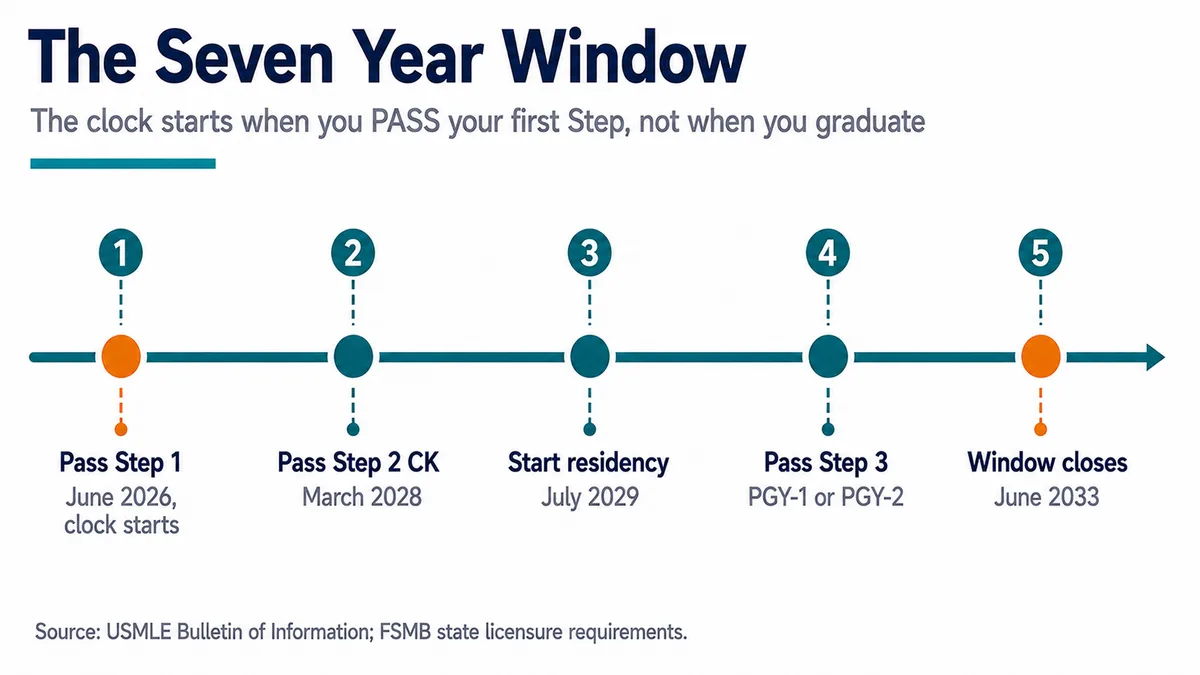
| Event | Date | Window remaining |
|---|---|---|
| Pass Step 1 | June 2026 | Clock starts, expires June 2033 |
| Pass Step 2 CK | March 2028 | 5 years 3 months left |
| Start residency | July 2029 | 3 years 11 months left |
| Pass Step 3 | During PGY-1 or PGY-2 | Comfortable |
The window is generous if you keep moving. It becomes tight when there are long gaps between graduation and matching, which is common for IMGs who apply across several cycles.
Where the exceptions are
Check your specific state
Some boards allow exceptions, most often for candidates holding a combined degree such as MD and PhD, and some apply a different window. Because the rule is state level, the only reliable answer comes from the board where you intend to be licensed.
ECFMG certification is different
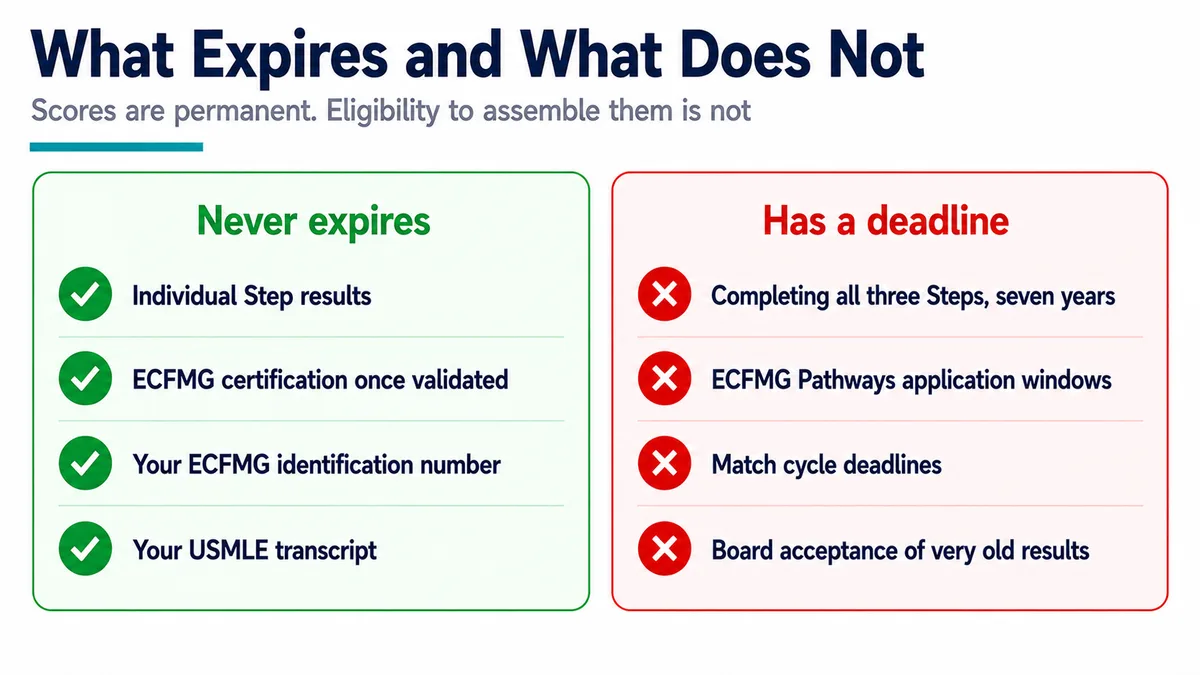
People conflate these two constantly. They are separate:
| USMLE scores | ECFMG certification | |
|---|---|---|
| Do they expire | No, scores are permanent | No, once permanently validated |
| What has a deadline | The seven year completion window | Pathway and application deadlines within a Match cycle |
| Who sets the rule | State medical boards | ECFMG, a division of Intealth |
A useful way to hold it
Your scores are permanent. Your eligibility to assemble them into a licence is time limited. Nobody takes a passed exam away from you, but a board can decline to accept a very old one as part of a licensing application.
Practical planning rules
- Do not pass Step 1 years before you can realistically apply. Early is good, but excessively early starts the clock for no benefit.
- Take Step 3 during residency. Most residents take it in PGY-1 or PGY-2, comfortably inside the window.
- Count your window if you are reapplying. Applicants who go through several Match cycles are the group most at risk.
- Confirm the rule in your target state before assuming seven years applies to you.
Why this rule exists
The seven year window is a licensing safeguard rather than an examination rule. Medicine changes, and a state board asked to grant a licence wants reasonable assurance that the three examinations behind it represent a coherent, reasonably current body of knowledge rather than assessments taken a decade apart.
This is why the rule sits with state medical boards and not with the USMLE. The USMLE administers and scores the exams. Boards decide what combination of results they will accept for licensure.
A distinction that resolves most confusion
Nobody can take a passed exam away from you. Your transcript is permanent. What a board can do is decline to accept an old result as part of a current licence application, which in practice means retaking it.
Who actually gets caught by this
The rule is generous for anyone moving steadily. These are the groups where it becomes a genuine risk:
- Very early starters. Passing Step 1 in second year of MBBS, then spending three years finishing the degree and internship, consumes a large part of the window before applications begin.
- Repeat applicants. Each additional Match cycle is another year. Applicants in a third or fourth cycle should be counting explicitly.
- Long gaps between Steps. Candidates who pass Step 1, work for several years, then return to Step 2 CK.
- Delayed Step 3. Step 3 is the one most often deferred, and it is the one that closes the window.
Note that this window is about exam timing, not about how long ago you graduated — those are different things, and only one of them is a real rule. If you are worried that your graduation year has already closed the door, see whether it is too late to start the USMLE.
The most expensive version of this mistake
Passing Step 1 early, matching after two or three application cycles, then discovering during residency that the window closes before you have taken Step 3. Retaking Step 1 as a resident, while working full time, is a genuinely difficult position and it is entirely avoidable by counting.
How to count your own window
| Step | What to record |
|---|---|
| 1 | The date you passed your first Step, not the date you sat it |
| 2 | Add seven years. That is your provisional deadline |
| 3 | Mark your realistic Step 3 date, usually PGY-1 or PGY-2 |
| 4 | Count the application cycles you may need in between |
| 5 | Confirm the rule with the board in your target state |
What does not expire
- Individual Step results. A pass is permanent and appears on your transcript indefinitely.
- ECFMG certification, once permanently validated. This is separate from the seven year rule and does not lapse.
- Your ECFMG identification number. Permanent.
Do not confuse these with Pathways deadlines
ECFMG Pathways requirements operate within a given Match cycle and have their own application windows. Those deadlines are real but they are unrelated to both the seven year licensing rule and to the permanence of your certification.
Practical guidance by situation
| Your situation | What to do |
|---|---|
| Still in MBBS, planning Step 1 | Time it so graduation, internship and two application cycles fit inside seven years |
| Passed Step 1, applying soon | No action needed, but note the deadline date somewhere permanent |
| Passed Step 1 more than three years ago | Count carefully and prioritise Step 2 CK |
| In residency, Step 3 not taken | Take it in PGY-1 or PGY-2 rather than deferring further |
| Window closing before Step 3 | Contact your target state board directly before assuming the outcome |
Sources
- USMLE Bulletin of Information, eligibility and completion requirements.
- FSMB state specific requirements for initial medical licensure.
Verified July 2026. Licensing rules are set at state level and change, so confirm with your target board.
Next step
Step 1 & Step 2 CK Prep
Structured modules, 1-on-1 mentorship, and a 100-day plan to clear the boards.