How to Prepare for the USMLE During MBBS Without Failing Your Exams
Academic Director & USMLE Educator, Dermatology Resident
The short answer
Do not run two syllabuses. Run one, and take it deeper. Roughly 70% of Step 1 content already overlaps your MBBS subjects, so the work is changing how you study material you are covering anyway, not adding a second full workload.
Most students who try this fail at both, because they treat USMLE preparation as a separate parallel course. It does not have to be, and for the first two years it should not be.
What actually overlaps
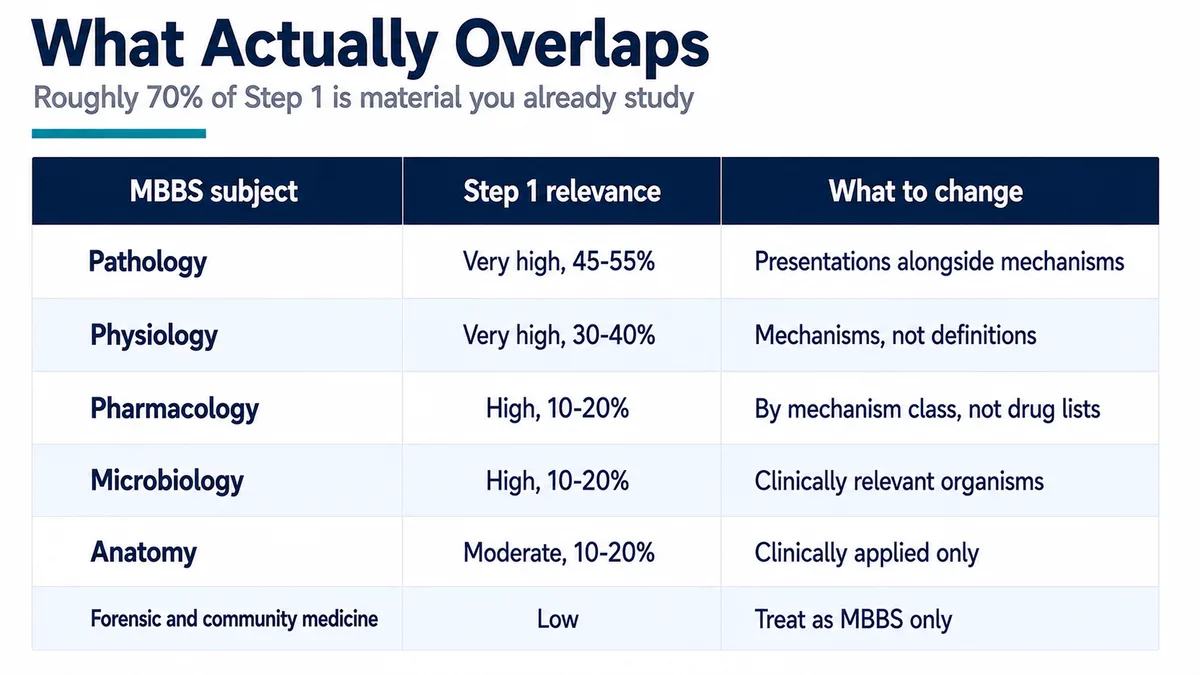
| MBBS subject | Step 1 relevance | What to change |
|---|---|---|
| Physiology | Very high, 30 to 40% of Step 1 | Study mechanisms, not definitions |
| Pathology | Very high, 45 to 55% of Step 1 | Learn presentations alongside mechanisms |
| Pharmacology | High, 10 to 20% | Learn by mechanism class, not by drug lists |
| Microbiology | High, 10 to 20% | Focus on clinically relevant organisms |
| Anatomy | Moderate, 10 to 20% | Clinically applied anatomy only |
| Biochemistry | Moderate, 5 to 15% | Pathway defects rather than full pathways |
| Forensic medicine, community medicine | Low | Treat as MBBS only, do not force a link |
The core move
When your college covers a system, cover the same system in your USMLE resource that week. You are not adding a subject, you are adding a second pass at the subject you are already sitting in lectures for.
Realistic hours
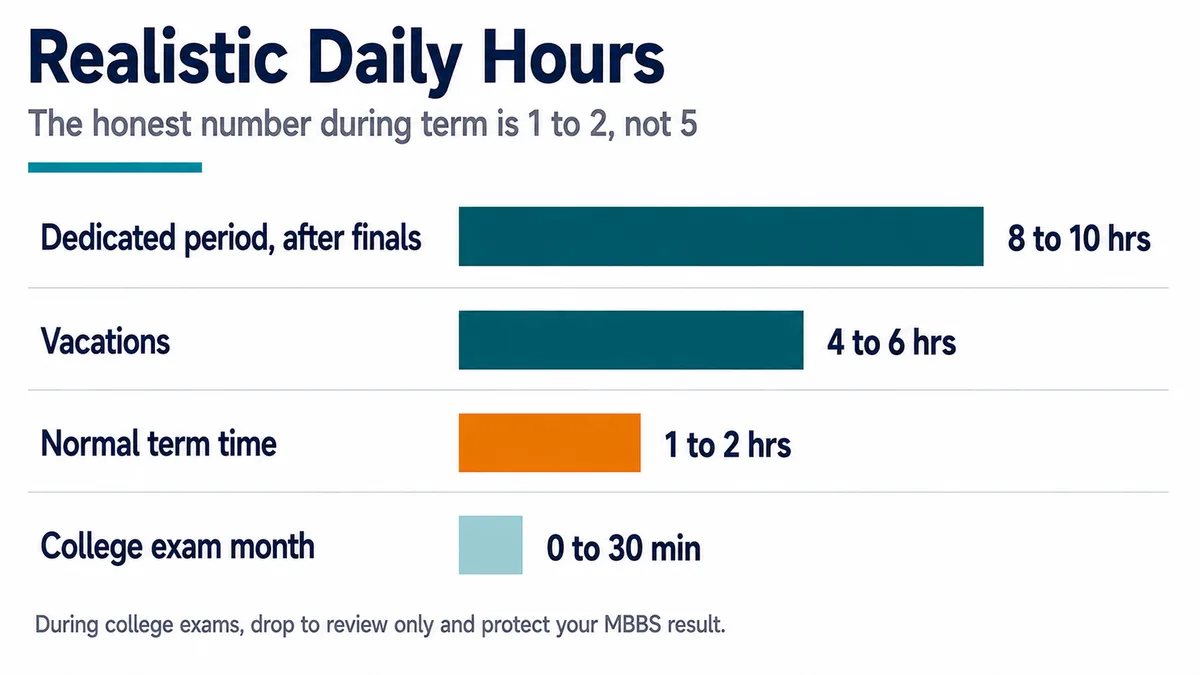
The honest number during term time is 1 to 2 hours a day, not 5. Anyone promising more while you have clinical postings and college exams is describing a schedule that collapses in three weeks.
| Period | Daily USMLE time | Focus |
|---|---|---|
| Normal term time | 1 to 2 hours | Questions on the current system |
| College exam month | 0 to 30 minutes | Anki review only, protect your MBBS result |
| Vacations | 4 to 6 hours | Catch up and consolidate |
| Dedicated period | 8 to 10 hours | Full time, after MBBS finals |
Protect the MBBS result
Failing college exams to chase the USMLE is a bad trade. Backlogs delay your degree, your internship and your eligibility. During exam month, drop USMLE work to maintenance and accept the pause.
Year by year
| Year | Target |
|---|---|
| First year | Build the habit. Physiology and biochemistry alongside college. No question bank pressure |
| Second year | The highest value year. Pathology, pharmacology and microbiology map almost directly onto Step 1 |
| Third year | Start a question bank properly. Begin spaced repetition seriously |
| Final year | Shift towards Step 2 CK material, which overlaps your clinical postings |
| Internship | Dedicated preparation and exam scheduling |
The mistakes that wreck both
- Running two separate syllabuses. The single biggest cause of burnout. Integrate or you will drop one.
- Starting a question bank in first year. Questions before foundations produce demoralising scores and wasted questions.
- Studying USMLE material for systems your college is not covering. You lose the reinforcement that makes this workable.
- Skipping college clinical postings. Those postings are what make Step 2 CK straightforward later.
- Measuring in hours rather than questions. Four distracted hours are worth less than one focused block.
The compounding advantage
Twenty questions a day through second and third year is roughly 14,000 questions before you begin dedicated preparation. That is not a small head start, it is a different starting line entirely.
A weekly structure that survives term time
Plans fail because they assume every week is a normal week. This one assumes the opposite.
| Day | USMLE work | Notes |
|---|---|---|
| Monday to Friday | 20 to 30 questions on the current system | Done after college, in one focused block |
| Daily | 15 to 20 minutes of spaced repetition review | Non negotiable, this is what makes the rest stick |
| Saturday | Review the week's wrong answers properly | Reviewing matters more than answering |
| Sunday | Rest, or catch up if the week collapsed | A planned buffer prevents guilt spirals |
Why the buffer day matters
Every realistic term has weeks where clinical postings, college tests or illness destroy the schedule. A plan with no slack turns one bad week into abandoning the whole system. A plan with a built in catch up day absorbs it.
How to study the same topic twice without doubling the work
The integration is the whole method, so it is worth being concrete about what it looks like.
- Attend the college lecture as normal. Take whatever notes your exams require.
- That evening, read the same topic in your USMLE resource. Twenty to thirty minutes, focused on mechanism.
- Do questions on that topic the same week. This is where the second pass converts into retention.
- Add cards only for what you got wrong. Making cards for everything is how review time becomes unmanageable by month three.
- Let the college exam be your revision deadline. You are revising for both at once, which is the entire point.
The compounding effect
This is not two workloads. It is one topic studied twice, at different depths, a few days apart. That spacing is itself one of the most effective learning structures available, so the method is more efficient than studying either syllabus alone.
Handling clinical postings
Postings are often treated as dead time for USMLE preparation. For Step 2 CK they are the opposite.
- Follow the patients you see. A case you clerked is worth more than a case you read about, and it stays.
- Ask what happens next. Step 2 CK is about management order, which is exactly what ward rounds demonstrate.
- Do Step 2 CK questions on the specialty you are posted in. The reinforcement is immediate.
- Accept that Step 1 work slows during heavy postings. Maintain review and continue when the posting lightens.
Warning signs you are overreaching
| Sign | What to do |
|---|---|
| College marks falling | Cut USMLE work to review only until they recover |
| Skipping postings to study | Stop. Postings are Step 2 CK preparation and degree progress at once |
| Question accuracy falling over weeks | Usually fatigue rather than knowledge loss. Reduce volume, protect sleep |
| Study time rising, retention flat | The method is passive. Shift towards retrieval and questions |
| Dreading opening the Qbank | Early burnout. Take several days off, then restart at lower volume |
The trade that is never worth it
Sacrificing MBBS progress for USMLE speed. A backlog delays your degree, your internship, your ECFMG certification and your application cycle. There is no USMLE gain that compensates for losing a year of eligibility.
Sources
- USMLE Step 1 content outline, discipline weightings used for the overlap table.
Weightings verified July 2026.
Next step
Step 1 & Step 2 CK Prep
Structured modules, 1-on-1 mentorship, and a 100-day plan to clear the boards.