USMLE Step 1 Study Schedule: A Winning 8-Week Plan (2026)

Academic Director & USMLE Educator, Dermatology Resident

USMLE Step 1 is pass/fail now. But do not mistake that for “easy.” You still have to absorb an enormous volume of basic science and clear the passing bar with confidence, and the students who struggle are almost always the ones who studied hard without studying to a plan. A schedule is what turns an overwhelming mountain of material into a sequence of manageable daily steps.
This guide shows you how to build a winning Step 1 study schedule from scratch: the resources to line up first, the two phases of prep, what a realistic study day looks like, a sample week-by-week dedicated plan, when to take your NBMEs, and how to peak in the final two weeks. Adapt the framework to your own timeline and it will carry you to a comfortable pass.
- Gather your core resources before day one.
- Split prep into pre-dedicated (alongside classes) and dedicated phases.
- Build each day around questions → deep review → spaced repetition.
- Take NBME self-assessments on a schedule to track readiness.
- Taper and rest in the final days. Do not cram.
Before You Build the Schedule: Gather Your Resources
A schedule is only as good as the tools it organizes. Have these ready before your plan starts so you are never assembling resources mid-prep:
| Resource type | Purpose |
|---|---|
| Primary Qbank (e.g. UWorld) | Your core engine, the daily question practice |
| A review text (e.g. First Aid) | The high-yield reference you annotate as you go |
| Video/concept resources | Pathophysiology & weak-topic explanations |
| Spaced repetition (Anki) | Locking high-yield facts into long-term memory |
| NBME self-assessments | Your most accurate readiness predictors |
The Two Phases: Pre-Dedicated vs Dedicated
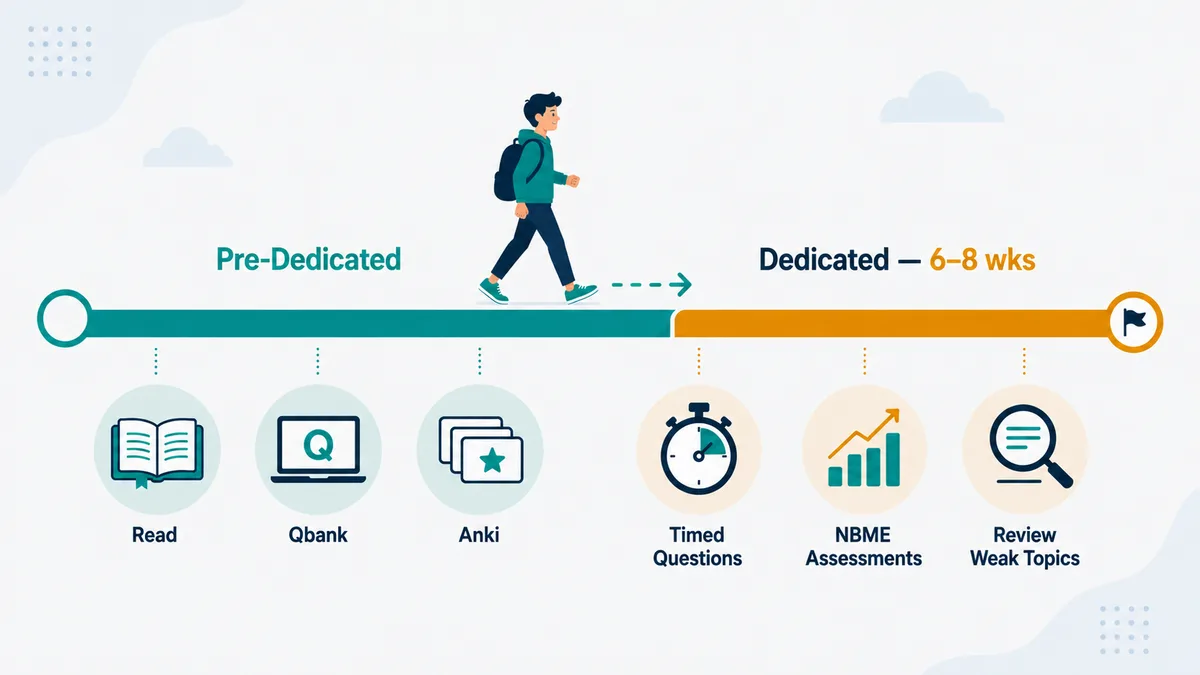
Strong schedules separate learning the material from consolidating it for the exam:
- Pre-dedicated phase: runs alongside your coursework. Build foundations system by system, start light Qbank work in tutor mode, and begin your Anki habit. This is where the breadth gets covered.
- Dedicated phase: a focused block (commonly 6–8 weeks) of full-time prep: heavy timed Qbank, targeted review of weak areas, and regular practice exams. This is where the score (or, now, a confident pass) is built.
How long your runway should be depends on your foundation; see our breakdown of the typical Step 1 preparation time.
What a Realistic Step 1 Study Day Looks Like
Execution beats theory. Here is a sustainable dedicated-phase day. Consistency matters more than marathon hours that lead to burnout.
| Time block | Activity |
|---|---|
| Morning | Two timed, random Qbank blocks (40 Qs each) |
| Midday | Deep review of every explanation, right and wrong |
| Afternoon | Weak-system focused study + video/First Aid |
| Evening | Anki reviews + annotate weak topics |
For why deep review matters more than raw question count, see how to review a Qbank block the right way.
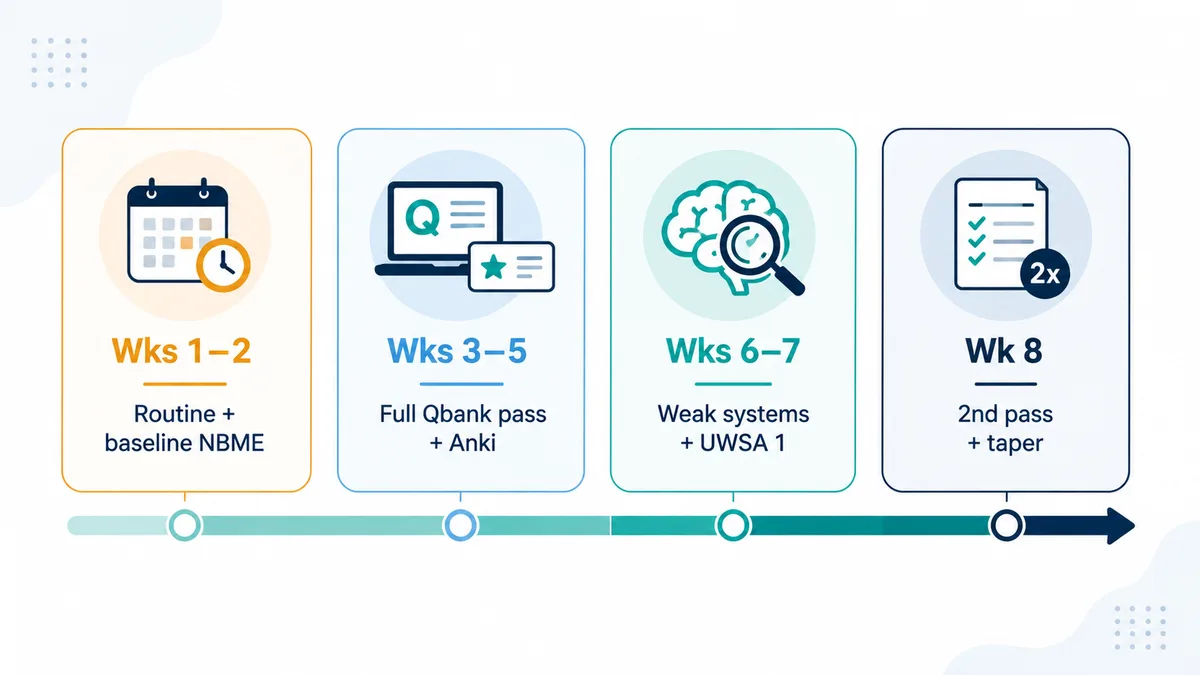
A Sample 8-Week Dedicated Schedule
| Weeks | Focus |
|---|---|
| 1–2 | Establish routine; subject-wise Qbank in tutor mode; baseline NBME |
| 3–5 | Full Qbank first pass, timed & random; daily Anki; weekly NBME |
| 6–7 | Target weak systems; back-to-back blocks for endurance; UWSA 1 |
| 8 | Second pass of incorrects; UWSA 2 / Free 120; taper |
Schedule Your NBMEs and Practice Tests
Self-assessments are your readiness gauge. Skipping them leaves you blind. Build them into the calendar from the start and track the trend, not a single score.
- Baseline NBME: start of the dedicated phase, to set your starting point.
- NBME forms every 7–10 days: to watch the trend.
- UWSA 1 & 2: mid and late, your most predictive checks.
- USMLE Free 120: final week, for the real interface.
The Final Two Weeks: How to Peak
The last stretch is about refinement and rest, not new material. Do a second pass of your incorrects, take your last practice exam to confirm readiness, and, like an athlete before a race, taper. Cramming in the final 48 hours invites fatigue and careless errors. Protect your sleep; it is when memory consolidates.
Adjusting the Schedule to Your Timeline
This 8-week template is a starting point, not a rule. With a stronger foundation you may compress to 5–6 weeks; balancing heavy coursework, you may want a longer pre-dedicated runway. If you have a six-month runway, follow our 6-month Step 1 blueprint for a month-by-month version. The phases and the daily question-review-recall loop stay the same. Only the length changes. Avoid the silent mistakes that derail otherwise solid plans.
Common Scheduling Mistakes to Avoid
- No timed practice: you must be comfortable with exam pacing.
- Skipping NBMEs: you need the data to know you are ready.
- Passive review: re-reading is not active recall.
- Neglecting weak areas in favor of what you already know.
- No rest days: burnout sinks more schedules than laziness.
Frequently Asked Questions
Since Step 1 is pass/fail, do I still need a study schedule?
Yes. The content volume is the same, and a structured plan is the most reliable way to clear the passing bar comfortably while building the foundation you will need for Step 2 CK. Pass/fail lowers the score pressure, not the workload.
How many hours a day should I study for Step 1?
In the dedicated phase, most students do a focused 8–10 hours with real breaks: quality over marathon sessions. Consistency across weeks matters far more than occasional long days that lead to burnout.
How long should my dedicated period be?
A dedicated block of 6–8 weeks suits most students, adjusted up or down for your foundation. Use your baseline NBME and practice-test trend to decide whether you need more runway.
When should I take my first NBME?
Take a baseline NBME at the start of your dedicated phase to establish your true starting point, then a form every 7–10 days to track the trend, with UWSA 1 & 2 as your most predictive late checks.
Should I do UWorld once or twice for Step 1?
One deeply reviewed pass beats two rushed ones. If time allows, a focused second pass of your incorrects is high-yield, but only after you have truly learned the concepts from the first pass.
Conclusion
A winning Step 1 schedule is not about studying longer. It is about studying in the right order: gather your resources, move through a pre-dedicated and dedicated phase, build every day around questions and active recall, track your NBMEs, and taper before exam day. Hold that structure and a confident pass follows.
Want a plan built around you? Explore our USMLE Step 1 & Step 2 CK preparation program and see how our students have matched into U.S. residency.
Next step
Step 1 & Step 2 CK Prep
Structured modules, 1-on-1 mentorship, and a 100-day plan to clear the boards.