Is the USMLE Tough for Indian Students? An Honest 2026 Answer
Academic Director & USMLE Educator, Dermatology Resident
The short answer
The exam itself is demanding but very passable: 75% of IMG first time takers passed Step 1 in 2025 and 90% passed Step 2 CK. The genuinely hard part is not the exam. It is everything after it, where only 56.4% of non-US citizen IMGs matched into a residency post in 2026.
Indian students usually ask this question expecting an answer about exam difficulty. That framing is the problem. The data shows the exam is the most survivable stage of the journey.
What the pass rates actually say
| Exam | IMG first time takers | Pass rate | Repeat pass rate |
|---|---|---|---|
| Step 1 | 22,066 | 75% | 54% |
| Step 2 CK | 16,186 | 90% | 64% |
| Step 3 | 12,480 | 88% | 63% |
India specific pass rates are not published. Neither the USMLE nor ECFMG releases country level data, so anyone quoting an exact Indian pass rate is estimating.
The number that should shape your plan
Step 1 first time 75%, repeat 54%. Nothing else you control moves your odds as much as not sitting the exam before you are ready.
Where Indian students have a genuine advantage
- English medium training. The entire MBBS curriculum is taught in English, so no translation step is needed and the communication requirement is rarely a barrier.
- Basic science depth. Indian MBBS covers physiology, pathology and pharmacology in more depth than many curricula, which maps directly onto Step 1.
- Clinical volume. Indian teaching hospitals expose students to a case load and disease variety that builds genuine clinical reasoning for Step 2 CK.
- Time. Students who start during MBBS get years of runway rather than months.
Where it genuinely gets hard
The real bottleneck
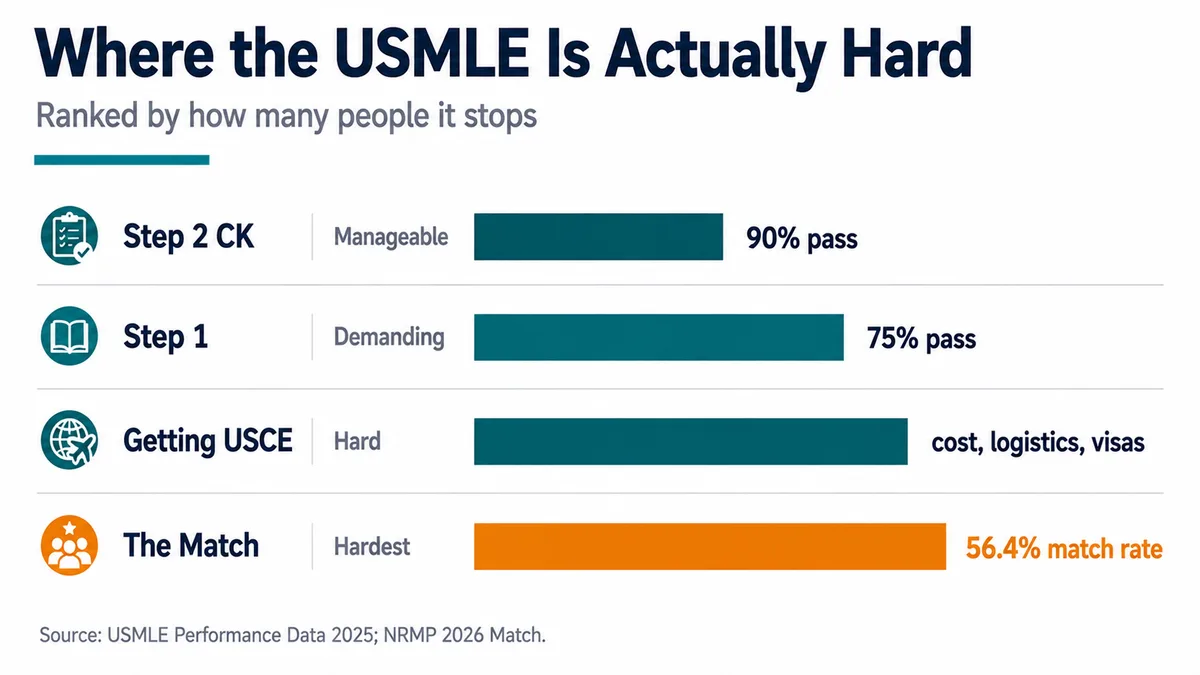
In the 2026 Match, 11,944 non-US citizen IMGs applied and 56.4% matched to a PGY-1 post. Passing every Step still leaves you facing roughly even odds at the stage that actually decides your career.
- US clinical experience. This is the single biggest gap. Programmes weight hands on USCE and US based letters heavily, and both are hard to arrange from India.
- Visa sponsorship. Many programmes do not sponsor, which removes a large share of your list before you apply.
- Cost. Exams, ECFMG fees, travel, ERAS and interviews add up over several years.
- Isolation. Most Indian applicants prepare without structured feedback, which is why avoidable mistakes persist for months.
Can an average student do it?
Yes, and this matters more than it sounds. MBBS marks are not a USMLE predictor. The exams test different things: recall of an Indian syllabus versus applied reasoning under time pressure.
What actually predicts success
Consistency over intensity. A candidate doing 40 questions daily for a year outperforms one doing 200 in bursts. The students who struggle are rarely the ones with lower marks, they are the ones who start late, study passively, and book the exam on hope.
An honest difficulty ranking
| Stage | How hard | Why |
|---|---|---|
| Step 2 CK | Manageable | 90% first time pass rate |
| Step 1 | Demanding | 75% pass rate, and a fail is permanent |
| Getting USCE | Hard | Cost, logistics and visas |
| The Match | Hardest | 56.4% match rate, largely outside your control |
Why the exam feels harder than it is
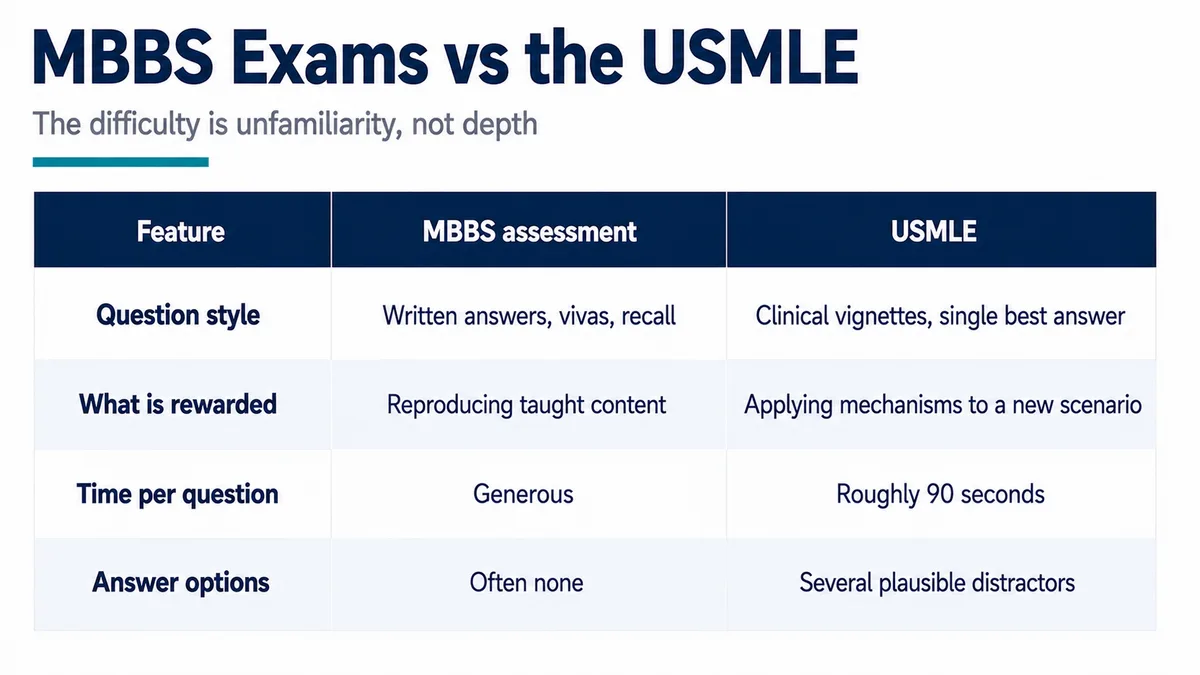
Indian students consistently describe the USMLE as harder than their college exams even when they pass comfortably. The difficulty is usually unfamiliarity rather than depth.
| MBBS assessment | USMLE | |
|---|---|---|
| Question style | Written answers, vivas, recall | Clinical vignettes, single best answer |
| What is rewarded | Reproducing taught content | Applying mechanisms to a new scenario |
| Time per question | Generous | Roughly 90 seconds |
| Answer options | Often none | Several plausible distractors |
| Syllabus source | College and university | A published content outline with weightings |
The adjustment that matters most
Indian training rewards knowing a lot. The USMLE rewards deciding quickly between options that all look reasonable. Students who struggle are usually strong on content and untrained on that decision, which is a fixable skill rather than a knowledge deficit.
A realistic timeline from India
| Stage | Typical duration | Notes |
|---|---|---|
| Early preparation during MBBS | 2 to 3 years, part time | 1 to 2 hours daily alongside college |
| Dedicated Step 1 preparation | 3 to 6 months | Longer for IMGs than for US students |
| Step 2 CK preparation | 3 to 4 months | Shorter if taken close to clinical years |
| US clinical experience | 2 to 6 months | The hardest stage to arrange and fund |
| Application and interview season | Sept to Feb | ERAS, interviews, rank order list |
Total elapsed time from starting seriously to beginning residency is commonly four to six years. Candidates who begin after internship compress this and are the group most likely to need a retake.
The costs nobody plans for
- US clinical experience. Usually the largest single expense once travel, accommodation and programme fees are counted.
- Interview season. Even with virtual interviews, the application volume itself is a significant cost.
- Repeat cycles. Many IMGs apply more than once, and each cycle carries its own cost.
- Opportunity cost. Years spent preparing are years not spent earning or completing an Indian postgraduate qualification.
Plan for two cycles, hope for one
Budgeting and planning as though the first application cycle will certainly succeed is the most common financial mistake. Given a 56.4% match rate, planning for the possibility of a second cycle is realism rather than pessimism.
Who actually struggles
It is worth being precise, because the popular assumption is wrong. The students who fail are rarely the academically weakest. In practice they share other features:
- They started late and compressed preparation into a period that could not support it.
- They studied passively, rereading notes rather than testing recall.
- They booked on hope rather than on self assessment evidence.
- They worked alone without any external check on whether their method was working.
- They optimised the wrong thing, chasing content volume when their losses were coming from pacing or technique.
The encouraging part
Every item on that list is a decision rather than an aptitude. Nothing there is about intelligence or about being an average student, which is precisely why average students clear this exam every year.
Sources
- USMLE Performance Data, 2025 pass rates by Step.
- NRMP Main Residency Match data, 2026 Match outcomes for non-US citizen IMGs.
Figures verified July 2026.
Next step
Step 1 & Step 2 CK Prep
Structured modules, 1-on-1 mentorship, and a 100-day plan to clear the boards.