USMLE Clinical Rotations and Electives: The IMG Guide (2026)
Academic Director & USMLE Educator, Dermatology Resident
The short answer
US clinical experience comes in four forms and they are not interchangeable. The dividing line that matters is whether you touch patients, because that determines whether your letter describes what you did or what you watched.
USCE is the part of the IMG journey with the least reliable information around it, and the part where money is most often wasted. Here is what each type is and what it is worth.
The four types
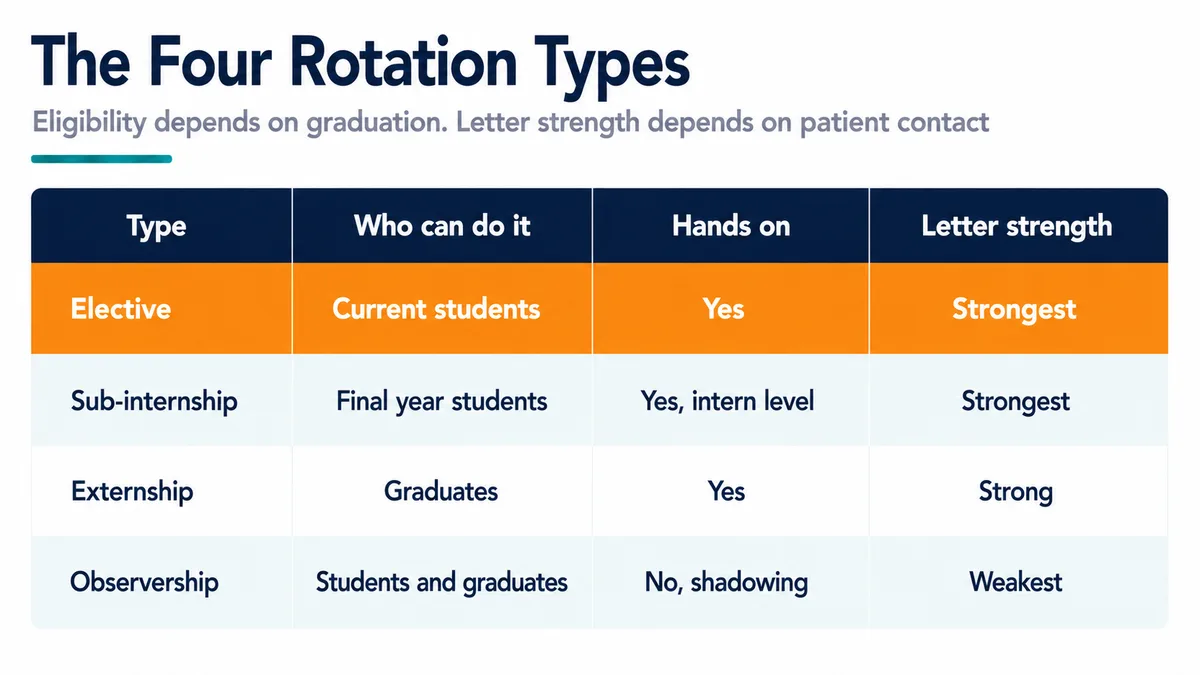
| Type | Who can do it | Hands on | Letter strength |
|---|---|---|---|
| Elective | Current students | Yes | Strongest |
| Sub-internship | Final year students | Yes, intern level responsibility | Strongest |
| Externship | Graduates | Yes | Strong |
| Observership | Students and graduates | No, shadowing only | Weakest |
The rule that decides most of this
Whether you have graduated decides what you are eligible for. Students can do electives and sub-internships; graduates are usually limited to externships and observerships. This is why doing USCE before graduating is a genuine advantage, and why final year is the best window.
How programme directors read them
Rotation type and setting combine into a rough hierarchy:
| Tier | What it looks like |
|---|---|
| Strongest | Hands on elective at a university teaching hospital with a residency programme in your specialty |
| Strong | Hands on externship at a teaching hospital, or observership at a well known institution |
| Acceptable | Hands on rotation at a community hospital that has a residency programme |
| Weak | Passive observership at an unaffiliated private clinic |
Specialty match beats prestige
Specialty specific letters are cited by 84% of programme directors as a key interview factor. A hands on rotation in your target specialty at an ordinary teaching hospital is worth more than a famous name in an unrelated field.
What it costs
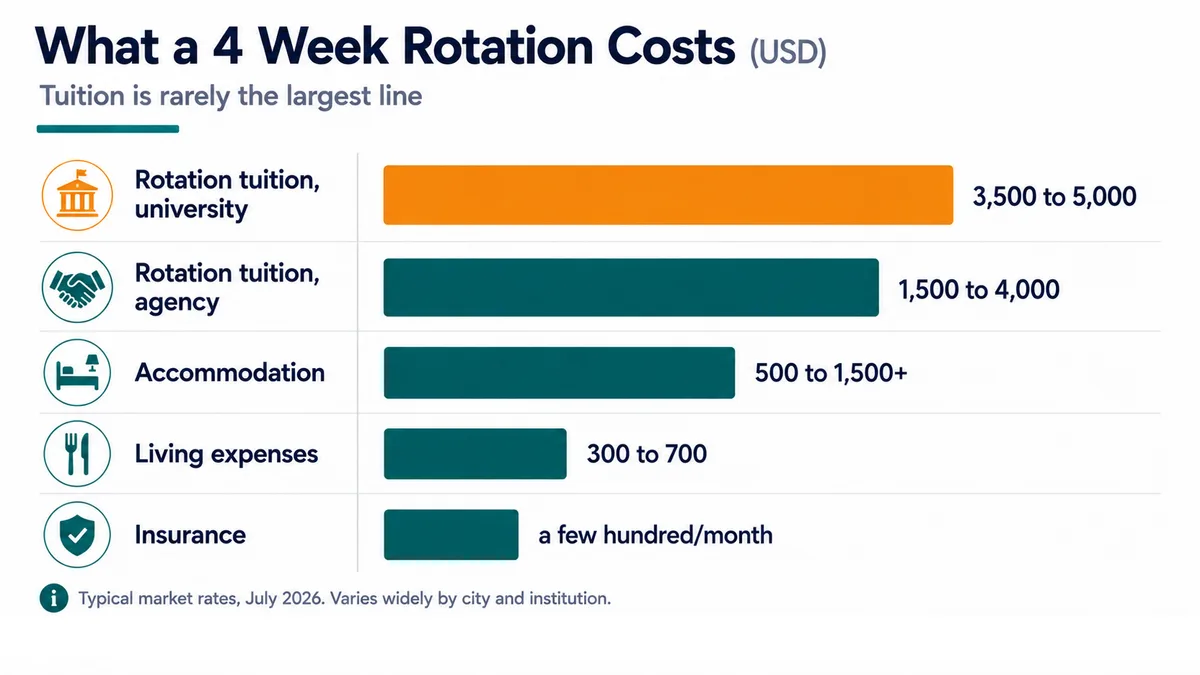
Budget per four week rotation, and note that tuition is rarely the largest line:
| Item | Typical range |
|---|---|
| Rotation tuition, university | $3,500 to $5,000 |
| Rotation tuition, agency | $1,500 to $4,000 |
| Accommodation | $500 to $900 shared, $1,500+ solo in major cities |
| Living expenses | $300 to $700 |
| Malpractice and health insurance | Often required, a few hundred per month |
Most IMGs doing two to three rotations should plan for a five figure total once flights and visa costs are included.
How to find them
- University and VSLO route. Most credible, most competitive, usually students only. Apply early.
- Direct application. Cold emailing departments and attendings. Cheapest and slowest, with a low reply rate that is still worth working through.
- Third party agencies. Fastest and least reliable. Useful when time is short, but the quality range is enormous.
Rotation mill red flags
Be cautious of anything that guarantees a letter, cannot name the hospital before payment, offers only unaffiliated private clinics, has no residency programme on site, or pressures you to pay quickly. A guaranteed letter is a generic letter, and programme directors have read thousands of them.
Timing
Finish by mid July to early August
Letters must exist before programmes review applications. Working backwards from that, rotations need booking months in advance, and anything completed in the autumn helps the following cycle rather than the current one.
Two further timing notes. Do USCE within about 12 months of applying so it reads as current. And if you are still a student, do as much as you can before graduating, because your eligibility narrows the day you do.
Why USCE matters this much
USCE is doing more work in your application than most candidates realise, because it produces several things at once rather than one.
- US based letters. The main output, and the one programmes weight most.
- Evidence you can function in a US hospital. A documented concern about IMG applicants, answered directly by having done it.
- Familiarity with the system. EMR use, team structure, presentation conventions and documentation standards.
- Contacts. Many IMG interviews come from someone who knows the applicant personally.
- A basis for your personal statement. Specific US clinical stories read very differently from general enthusiasm.
The order of value
Programmes are not counting weeks. They are reading letters. USCE is a means to a letter, so a rotation that produces a strong specific letter beats a longer rotation that produces a generic one.
Visa and eligibility notes
| Situation | What usually applies |
|---|---|
| Current student, hands on elective | Generally arranged through the host institution; confirm requirements directly |
| Graduate, hands on externship | More restricted, and host requirements vary considerably |
| Observership | No patient contact, so requirements are usually lighter |
| All types | Immunisations, background checks and insurance are commonly required and take weeks |
Confirm this with the host, not a forum
Visa and eligibility rules differ by institution and change, and getting this wrong wastes both money and a booking slot. Ask the host institution in writing what they require before paying anything.
How to choose between offers
- Is it hands on? The single biggest differentiator for letter quality.
- Does the site have a residency programme? A writer who trains residents knows the standard they are comparing you against.
- Is it in your target specialty? Specialty specific letters are cited by 84% of programme directors.
- Will you work with one attending for long enough to be remembered? Rotating between many supervisors produces vague letters.
- Does the timing land before applications? A great rotation after the deadline helps the following cycle.
Making the rotation count
Booking it is the easy part
The letter comes from how you behave once you are there: raising the letter goal in week one, presenting in the US format, committing to plans, following up on questions, and sending your CV and case list once the attending agrees. A booked rotation with no strategy produces a generic letter, which is an expensive way to obtain nothing.
Common mistakes
| Mistake | Consequence |
|---|---|
| Booking observerships only, because they are easier to get | Weak letters at full cost |
| Spreading weeks across many unrelated specialties | No writer knows you well enough |
| Leaving USCE until after graduation | Eligibility narrows, hands on options shrink |
| Paying an agency before naming the hospital | Common route to a rotation mill |
| Doing USCE years before applying | Reads as stale, letters age badly |
Sources
- NRMP Program Director Survey, 2024: specialty specific letters cited by 84% of programme directors.
- NRMP Main Residency Match data, 2026 Match outcomes for non-US citizen IMGs.
Cost ranges are typical market rates as of July 2026 and vary widely by city and institution.
Next step
Step 1 & Step 2 CK Prep
Structured modules, 1-on-1 mentorship, and a 100-day plan to clear the boards.