How to Choose USMLE Coaching in India: What Actually Matters (2026)

Academic Director & USMLE Educator, Dermatology Resident
The short answer
There is no single best USMLE coaching centre in India, and any list claiming otherwise is usually paid placement. What predicts your result is your method and your consistency, and coaching is worth paying for only when it fixes something you cannot fix alone.
This used to be a ranked list of institutes. It is more useful as a framework, because the right answer genuinely differs by candidate, and because the market changes faster than any list can.
What coaching can actually do
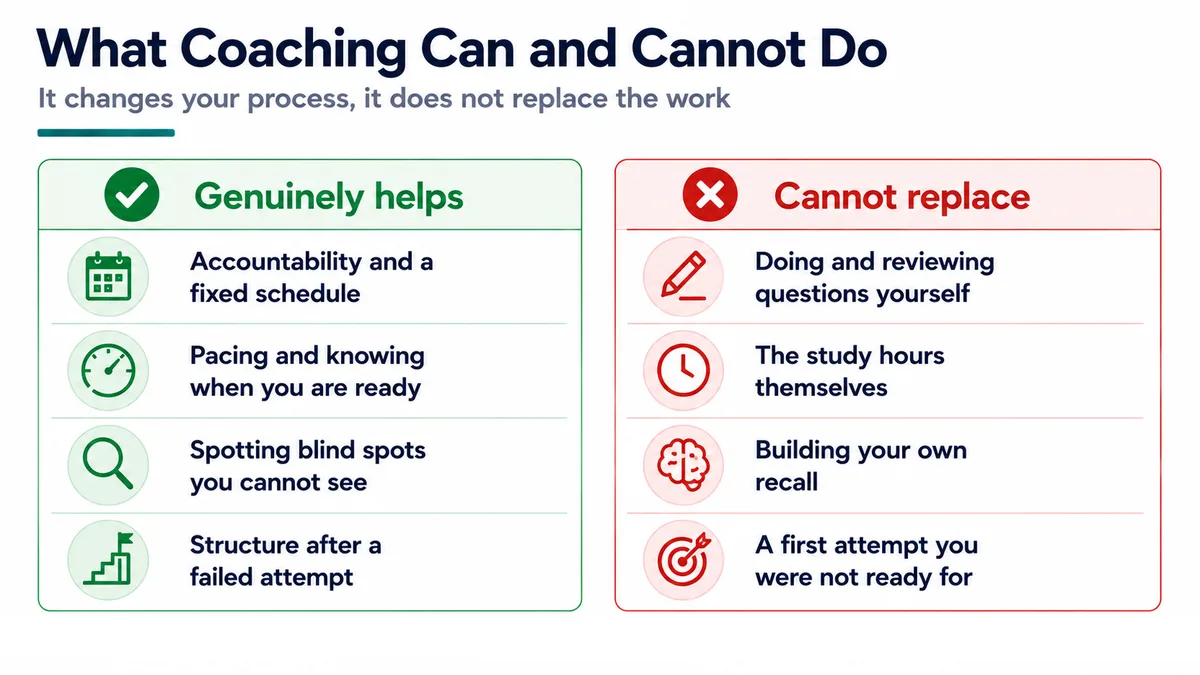
| Coaching genuinely helps with | Coaching cannot replace |
|---|---|
| Accountability and a fixed schedule | Doing and reviewing questions yourself |
| Pacing and knowing when you are ready | The hours of study themselves |
| Spotting blind spots you cannot see | Building your own recall |
| Structure after a failed attempt | A first attempt you were not ready for |
| Application, USCE and Match strategy | A visa, a letter or a Match result |
The honest test
Ask what specifically is going wrong. If the answer is "I keep losing consistency" or "I do not know whether I am on track", coaching addresses that directly. If the answer is "I have not started the question bank", no amount of teaching substitutes for beginning.
Questions to ask before paying
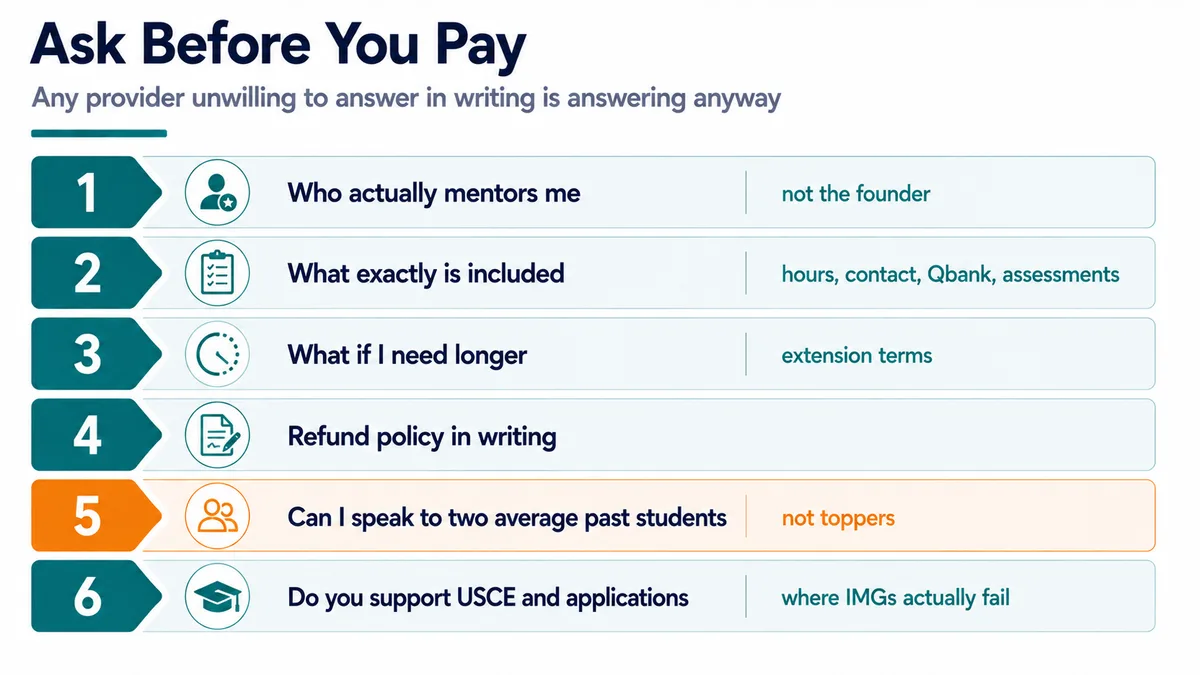
- Who actually teaches or mentors, and what is their record? Not the founder's, the person you will work with.
- What is included, precisely? Hours, contact frequency, question bank access, whether self assessments are covered.
- What happens if I need longer? Extension terms matter more than headline price.
- What is the refund policy, in writing?
- Can I speak to two recent students who did not top the class? Testimonials select for outliers.
- Do you help with USCE and applications, or only exams? The Match is where most IMGs actually struggle.
- What do you not do? A provider that claims to do everything is describing marketing rather than a service.
Red flags
Walk away from these
Guaranteed scores or guaranteed Match. Nobody can promise either. Guaranteed US clinical experience with a letter bundled into a coaching package. Pressure to pay today for a discount. Refusal to put terms in writing. Pass rates with no denominator, which usually means counting only students who completed the programme.
When self study is the better choice
Most people who pass do so without a coaching centre. Self study is usually right when:
- You are already consistent and your self assessment scores are rising.
- You have a study group or a senior who will look at your progress honestly.
- Your budget is better spent on USCE, which is what programmes actually screen on.
- You are still in second or third year MBBS, where the work is integration with college rather than exam coaching.
The budget trade off worth thinking about
A coaching package and a US clinical rotation can cost similar amounts. Programmes screen on letters and Step 2 CK, not on where you studied. If money is limited, USCE usually buys more Match value than coaching does.
What to evaluate instead of rankings
| Signal | Why it matters |
|---|---|
| Mentor to student ratio | Determines whether you get individual attention or a recorded course |
| Diagnostic before enrolment | A provider that assesses you first is planning, not selling |
| Written schedule and checkpoints | Accountability only works if it is scheduled |
| Application and USCE support | Where most IMG journeys actually fail |
| Willingness to say you are not ready | The single most valuable thing a mentor can tell you |
The one thing worth paying for
Someone who will look at your self assessment scores and tell you honestly that you are not ready to book yet. First time takers pass Step 1 at 75% and repeaters at 54%, so that one piece of advice can be worth more than a year of teaching.
The formats on offer, and who each suits
| Format | Suits | Watch for |
|---|---|---|
| One to one mentorship | Candidates who lack accountability or have failed once | Who the mentor actually is, and contact frequency |
| Live cohort classes | Candidates who want structure and peers | Class size, and whether pace is set by the group |
| Recorded course | Self directed candidates wanting cheap content | This is content, not coaching. No accountability |
| Residential programme | Candidates unable to study at home | Cost, and whether the schedule is genuinely full |
| Match and application support only | Candidates past the exams | Often the highest value stage, and the least offered |
A distinction worth holding on to
Content and coaching are different products at similar prices. Recorded lectures are content, and excellent content already exists cheaply. What you cannot easily buy elsewhere is somebody accountable for your pacing and honest about your readiness.
What good looks like in practice
- A diagnostic before enrolment. Any provider planning your preparation should first establish where you are.
- A written schedule with checkpoints. Accountability that is not scheduled does not exist.
- Regular self assessments, interpreted for you. The single most useful service on offer.
- Named mentor with reachable hours. Not a shared inbox.
- Honest readiness advice, including being told to postpone.
- Support beyond the exam. USCE, CV, letters and applications, which is where IMG journeys actually fail.
The cost comparison nobody presents
| Spend | What it buys | Does the Match screen on it |
|---|---|---|
| Coaching package | Structure, pacing, accountability | No, indirectly at best |
| Question bank subscription | The core learning tool | No, but it drives your score |
| Self assessments | Calibration, and the booking decision | No, but it prevents a fail |
| US clinical rotation | Letters and US experience | Yes, directly |
| Application and interview costs | Access to programmes | Yes, unavoidable |
Sequence your spending
Question bank and self assessments first, because they are cheap and decide whether you pass. USCE next, because programmes screen on its output. Coaching last, and only for a specific problem you have identified. Many candidates reverse this order and run out of money before the rotation that would have mattered.
If you have already failed an attempt
This is the situation where paid help most often earns its cost, because the failure mode is usually invisible from the inside.
- Insist on a diagnostic first. Knowledge gaps, pacing, technique and exam day conditions need different fixes, and a provider that starts teaching before diagnosing is selling.
- Ask directly how they handle repeat candidates and what they do differently.
- Agree the readiness criteria in advance, in writing, so the booking decision is evidence based rather than commercial.
The measure to judge any provider by
Would they tell you to postpone, knowing it delays their outcome statistics and extends their support obligation? A provider that will say that is worth more than one with a longer syllabus.
Sources
- USMLE Performance Data, 2025 first time and repeat pass rates.
- NRMP Program Director Survey, 2024 interview selection factors.
Verified July 2026.
Next step
Step 1 & Step 2 CK Prep
Structured modules, 1-on-1 mentorship, and a 100-day plan to clear the boards.