Match vs SOAP: What Actually Happens in Match Week (2026 Data)

Academic Director & USMLE Educator, Dermatology Resident
The short answer
The Match is the algorithm that pairs applicants with programmes based on rank order lists submitted weeks earlier. SOAP is the scramble that happens afterwards for people the algorithm did not place. In 2026, 2,862 positions went unfilled after the algorithm ran, and 2,632 of them were filled during SOAP, taking the combined fill rate to 99.3%.
Most applicants understand the Match. Far fewer understand SOAP until they are suddenly in it, on a Monday morning, with four hours to make decisions that shape the next several years. Here is how the two differ, and what actually happens hour by hour.
The Match: an algorithm, not an application round
The Main Residency Match is run by the NRMP. You apply through ERAS months earlier, interview through the winter, then submit a rank order list ranking the programmes you would accept. Programmes submit their own lists ranking applicants.
The algorithm is applicant proposing. It starts at the top of your list and tries to place you at your most preferred programme that also ranked you highly enough. This has one consequence people constantly get wrong:
Rank by preference, nothing else
You cannot hurt yourself by ranking a dream programme first. The algorithm never penalises you for reaching. Ranking strategically, by where you think you have the best odds rather than where you actually want to go, only makes a worse outcome more likely.
The result is binding. If you match, you are contractually committed to that programme.
SOAP: what happens when the algorithm does not place you
SOAP stands for the Supplemental Offer and Acceptance Program. It runs during Match Week for two groups: applicants who did not match, and positions that did not fill.
It is not a free for all. It runs in timed rounds, and there are hard rules:
- You can only apply to programmes with positions listed in the SOAP database.
- Programmes make offers, you accept or reject. You cannot make the first move.
- Offers expire fast. If you do not accept within the round window, the offer goes to someone else.
- Accepting is binding, exactly like matching.
- Contacting programmes outside the official process is a violation.
The 2026 numbers
| Metric | 2026 | Change on 2025 |
|---|---|---|
| Positions unfilled after the algorithm | 2,862 | up 389 |
| Programmes with unfilled positions | 941 | |
| Positions offered through SOAP | 2,581 | up 330 |
| Positions filled through SOAP | 2,632 | |
| Combined fill rate | 99.3% |
Read that fill rate carefully
99.3% of positions get filled. That statistic describes programmes, not applicants. It tells you almost nothing about your own odds, because there are far more applicants than positions. Do not read a high fill rate as reassurance.
The Match Week schedule
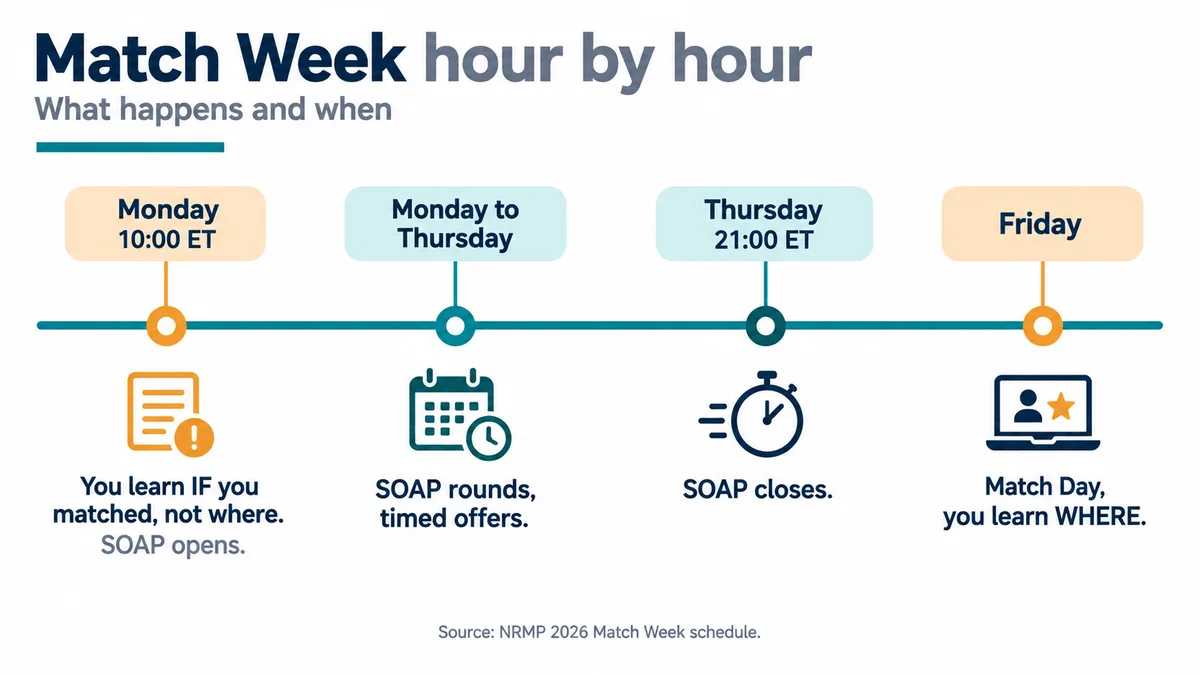
In 2026 the week ran like this, and the shape repeats each year:
| Day | What happens |
|---|---|
| Monday, 10:00 ET | You learn whether you matched, not where. SOAP opens for those who did not. |
| Monday to Thursday | SOAP rounds run. Offers are made, accepted or rejected in timed windows. |
| Thursday, 21:00 ET | SOAP closes. |
| Friday | Match Day. Everyone who matched learns where. |
The Monday trap
Monday tells you only whether you matched. If you did not, you have roughly four hours before SOAP applications are due. This is not the time to start writing a personal statement or choosing specialties. Anyone who has not prepared a SOAP plan in advance is making career decisions under extreme time pressure.
What IMGs should do differently
Non-US citizen IMGs matched at 56.4% in the 2026 Match, so a large number enter SOAP every year. Three things matter more for this group:
- Check visa sponsorship before you apply in SOAP. Many programmes with unfilled positions do not sponsor. An offer you cannot legally accept wastes one of your limited applications.
- Have a prepared shortlist. Decide in February which specialties and regions you would genuinely accept, so Monday is execution rather than deliberation.
- Have documents ready to send. A SOAP specific personal statement, an updated CV and your ECFMG status should exist before Match Week starts.
A preventable failure
The most common SOAP mistake is not a bad interview. It is applying to programmes that never sponsor visas, discovering it too late, and running out of application slots.
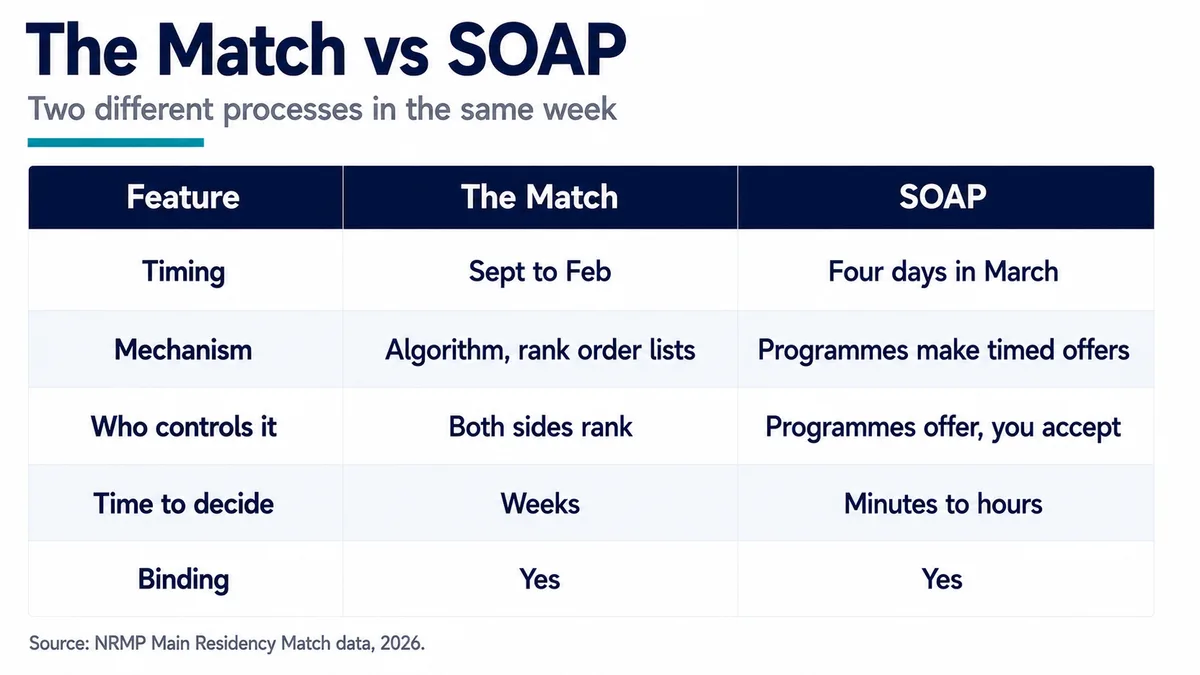
Match and SOAP compared
| The Match | SOAP | |
|---|---|---|
| Timing | Applications and interviews from Sept to Feb | Four days in March |
| Mechanism | Algorithm, rank order lists | Programmes make timed offers |
| Who controls it | Both sides rank | Programmes offer, you accept |
| Time to decide | Weeks | Minutes to hours |
| Binding | Yes | Yes |
How the algorithm actually decides
People imagine the Match as programmes picking applicants. It is closer to the reverse. The algorithm is applicant proposing, which means it works down your list first and only consults programme lists to check whether you would be accepted.
Walk through a simple case. You rank four programmes. The algorithm tries programme one. If that programme ranked you inside its available slots, you are tentatively placed. If not, it moves to programme two, and so on. A tentative placement can be displaced later if a more preferred applicant appears, and you then move down your own list again.
Three consequences worth internalising
You cannot be hurt by ranking an ambitious programme first. You cannot improve your odds by ranking a programme higher than you actually want it. And a programme never learns where you ranked it before results are final.
Why positions go unfilled at all
It seems strange that thousands of positions go unfilled when far more applicants than positions exist. Several things cause it:
- Specialty concentration. Applicants cluster in competitive specialties, leaving less popular ones short. Family medicine offered 5,491 positions in 2026 and 899 were unfilled after the algorithm.
- Geography. Programmes in rural or less desirable locations routinely fill through SOAP rather than the Match.
- Short rank lists. A programme that ranks only a small number of applicants can fail to fill even in a competitive field.
- Applicant ranking behaviour. Applicants who rank very few programmes leave themselves unmatched while positions remain open.
Where the opportunity sits
The unfilled positions are concentrated in the specialties and locations that applicants avoid. If you are willing to be flexible about both, SOAP is a genuine route rather than a consolation prize. Psychiatry, for comparison, achieved a 97.4% fill rate in 2026 and offers little SOAP opportunity.
What to prepare before Match Week
Everything below should exist by late February, because none of it can be produced well on the Monday morning.
| Item | Why it matters |
|---|---|
| A SOAP specific personal statement | Your Match statement is specialty specific and will not fit a different field |
| An updated CV | Anything since your ERAS submission needs adding |
| A ranked list of acceptable specialties | Decide when calm, not under a four hour deadline |
| A list of visa sponsoring programmes | The single most common IMG SOAP failure |
| Letters that travel across specialties | A specialty specific letter reads oddly in a different field |
| A quiet room and a stable connection | SOAP rounds are timed and unforgiving of technical problems |
Mistakes that cost people a position
- Contacting programmes outside the process. It is a violation and it can remove you entirely. The temptation is enormous and it must be resisted.
- Holding out for a better offer. Offers expire within the round. Declining a real offer in the hope of something better is how applicants finish the week with nothing.
- Applying without checking sponsorship. Every unusable application is a wasted slot from a limited allocation.
- Treating SOAP as a formality. Programmes are making real decisions on real applications, and a rushed generic submission reads exactly as it is.
- Not deciding in advance what you would accept. If you have not decided whether you would take a preliminary year, the moment an offer arrives is a terrible time to work it out.
A preliminary position is not a failure
Many applicants who take a preliminary or transitional year through SOAP reapply successfully the following cycle from inside the US system, with US letters and US clinical experience. Refusing one to protect a preference frequently costs a year with nothing to show for it.
Sources
- NRMP Main Residency Match data, 2026 Main Residency Match results and Match Week schedule.
Figures verified July 2026. NRMP publishes updated Match and SOAP data each spring.
Next step
Residency Match Strategy
Specialty selection, application strategy, and interview prep for the Match.