How Many Interviews Should You Get to Match?

Academic Director & USMLE Educator, Dermatology Resident
“How many interviews do I need to match?” is one of the most googled Match questions, and most of the numbers floating around, including our own previous answer, are built on a misreading of the source. The NRMP does not publish a count of interviews. It publishes something close, but not identical: contiguous ranks.
This guide walks through what NRMP’s Charting Outcomes data actually says for International Medical Graduates, why the commonly-cited “10–15 interviews” figure is misleading, how the real numbers vary by specialty, and what to do if your own interview count is running low.
- NRMP measures contiguous ranks, not literal interviews: a close proxy, not the same statistic.
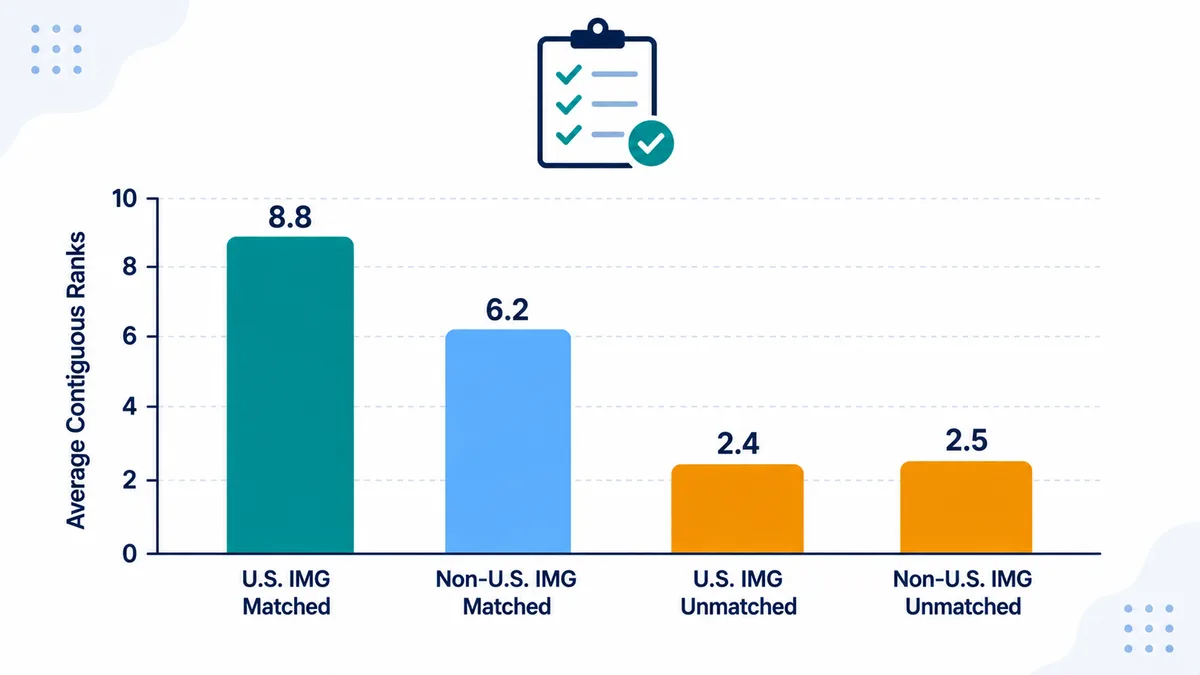
- Matched U.S. IMGs averaged 8.8 contiguous ranks in 2024; matched non-U.S. IMGs averaged 6.2.
- Match rates differ sharply by citizenship: 67.8% (U.S. IMGs) vs 58.0% (non-U.S. IMGs) in 2025.
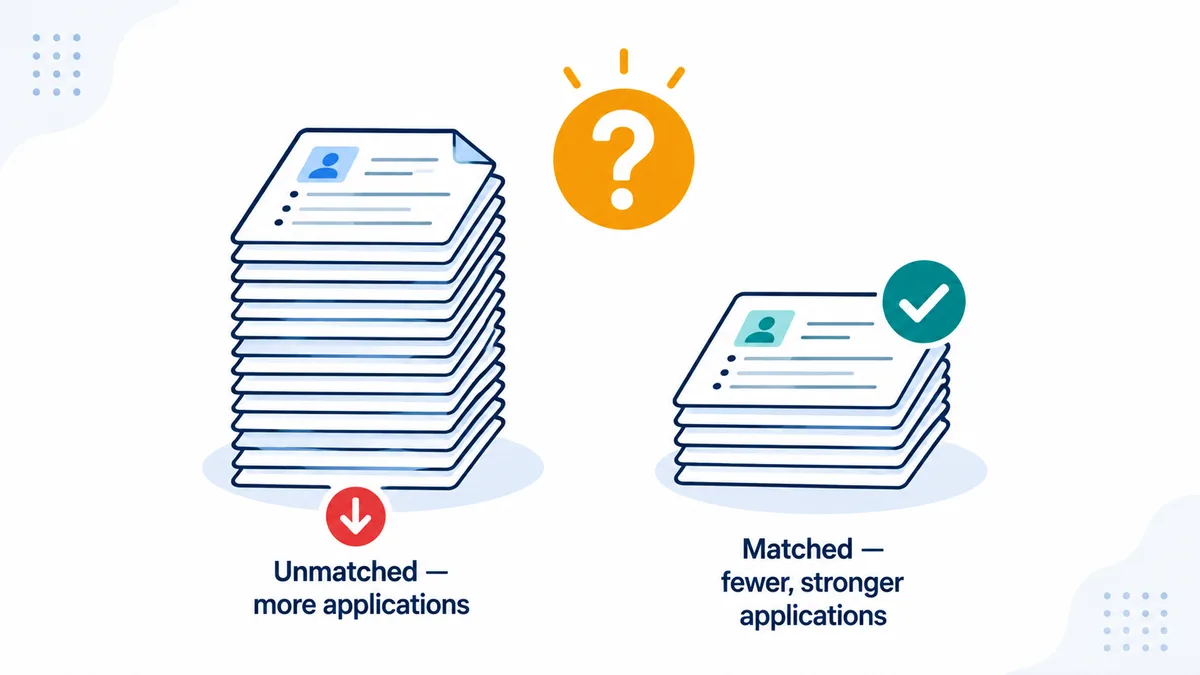
- Unmatched applicants submitted more applications than matched ones. Volume alone does not fix a weak strategy.
- No interviews by December? Treat it as a planning trigger, not a verdict.
The Real NRMP Numbers
Source: NRMP, Charting Outcomes in the Match: International Medical Graduates, 5th Edition (August 2024), covering the 2022–2024 Match cycles.
| Applicant type | Mean contiguous ranks (matched) | Mean contiguous ranks (unmatched) | 2024 match rate |
|---|---|---|---|
| U.S. IMGs | 8.8 | 2.4 | 59.9% |
| Non-U.S. IMGs | 6.2 | 2.5 | 52.8% |
2025 Main Residency Match update (more recent than the 2024 Charting Outcomes report): U.S. citizen IMGs matched at a 67.8% PGY-1 rate (4,587 active applicants); non-U.S. citizen IMGs matched at 58.0% (11,465 active applicants, up 14.4% year-over-year, with 41.3% left unmatched). Treat U.S. IMGs and non-U.S. IMGs as two distinct populations (not one “IMG” bucket) because their odds genuinely differ by about 10 points.
An earlier version of this article cited “12–15 interviews” for IMGs. That figure does not match NRMP’s own published data for matched applicants, which shows averages closer to 6–9 contiguous ranks. We are correcting it here rather than quietly editing it away.
“Contiguous Ranks” vs Interviews: What NRMP Actually Measures
NRMP’s Charting Outcomes reports track the number of programs an applicant ranks in their preferred specialty before a program in another specialty appears on their list: the “contiguous ranks.” You can only rank a program you interviewed at, which makes this a close proxy for interviews attended, but it is not the literal same statistic, and almost no source online (including our own previous post) makes this distinction clearly.
How This Varies by Specialty
Match rates for IMGs swing enormously by specialty, from Pediatrics at the top to the most competitive surgical subspecialties at the bottom:
| Specialty | U.S. IMG match rate | Non-U.S. IMG match rate |
|---|---|---|
| Pediatrics | 83.5% | 77.6% |
| Family Medicine | 66.5% | 60.8% |
| Internal Medicine | 61.6% | 53.6% |
| Psychiatry | 53.0% | 51.6% |
| Anesthesiology | 49.2% | 43.3% |
| Ob/Gyn | 41.5% | 34.4% |
| General Surgery | 31.0% | 26.6% |
| Orthopaedic Surgery | 19.4% | 12.5% |
Mean contiguous ranks for matched applicants track the same pattern: roughly 12 in Emergency Medicine versus roughly 4 in General Surgery for matched U.S. IMGs. NRMP itself flags the most competitive surgical specialties (Orthopaedics, Neurosurgery, Plastics) as having too small an IMG sample size to draw firm conclusions, worth knowing rather than inventing a number.
Applications vs Interviews: the Yield Problem
NRMP’s Applicant Survey data shows unmatched applicants of every type (including IMGs) submitted more applications than matched applicants, not fewer. IMGs average around 144 applications per cycle versus the low-70s for U.S. MD seniors. More applications do not fix a weak strategy; fit, letters, and interview performance correlate with matching more reliably than raw volume.
Preference Signaling: A Tool IMGs Should Use
ERAS preference signaling lets you send a limited number of signals to programs you are genuinely most interested in. The total varies by specialty (Internal Medicine, for example, allots 3 Gold and 12 Silver signals for the 2025–26 cycle). AAMC guidance treats IMGs identically to MDs and DOs in this system, so use every signal you are given on programs where your interest is real. Pair this with a genuinely researched answer to “why our program” once you reach the interview.
If Your Interview Count Is Low: SOAP & Backup Planning
There is no official NRMP threshold for “enough” interviews. Every number online, including this one, is judgment-based. Treat a low count as a planning trigger, not a verdict:
- Zero interviews by mid-December: treat SOAP/backup-specialty prep as active planning, not contingency.
- SOAP eligibility: opens automatically if you are unmatched or partially matched during Match Week; you can apply to up to 45 SOAP-participating programs.
- Rank-list breadth: NRMP’s own written advice is to rank every program you interviewed at and would be willing to train at, in true preference order. A longer, broader list correlates with matching more consistently than a narrow one.
Frequently Asked Questions
How many interviews do IMGs actually need to match, according to NRMP data?
NRMP’s 2024 Charting Outcomes data shows matched U.S. IMGs averaged 8.8 contiguous program ranks in their preferred specialty, and matched non-U.S. IMGs averaged 6.2. Both considerably lower than the “12–15 interviews” figure commonly cited online. NRMP tracks “contiguous ranks,” a close proxy for interviews attended, not literal interview counts, and the number needed varies hugely by specialty and citizenship status.
Do U.S. IMGs and non-U.S. IMGs have the same match odds?
No. In the 2025 Main Residency Match, U.S. citizen IMGs matched at a 67.8% PGY-1 rate versus 58.0% for non-U.S. citizen IMGs. A roughly 10-point gap that most “IMG” advice online ignores by treating the group as one bucket.
Is it better to submit more applications or focus on fewer, stronger ones?
NRMP’s own Applicant Survey data shows unmatched applicants of every type (including IMGs) submitted more applications than matched applicants, not fewer. Quality of fit, interview performance, and rank-list strategy correlate with matching more reliably than raw application volume.
What is ERAS preference signaling, and should IMGs use it?
Preference signaling lets applicants send a limited number of signals (the total varies by specialty, for example Internal Medicine allots 3 Gold plus 12 Silver signals) to programs they are genuinely most interested in. AAMC guidance treats IMGs, MDs, and DOs identically in this system, so IMGs should use every signal available to them.
What should I do if I have very few interviews by December?
There is no official NRMP threshold for a “safe” interview count, so treat a low count as an active planning trigger rather than waiting for certainty: strengthen a backup or less-competitive specialty option, prepare SOAP materials in advance, and revisit your rank-list breadth. NRMP data consistently shows applicants with longer, broader rank lists match more often than those with narrow lists.
Conclusion
There is no single magic number of interviews that guarantees a match, and the “10–15” figure repeated across the internet is a loose paraphrase of a statistic NRMP defines differently. Know the real numbers for your applicant type and specialty, apply strategically rather than just broadly, and if your count is running low by December, treat it as a signal to plan, not a verdict on your chances.
Want a strategy built around your own profile? Explore our USMLE Step 1 & Step 2 CK preparation program and see how our students have matched into U.S. residency.
Next step
Residency Match Strategy
Specialty selection, application strategy, and interview prep for the Match.