Why IMGs Do Not Get Residency Interviews (and How to Fix It)

Academic Director & USMLE Educator, Dermatology Resident
The short answer
Most IMG applications are never read. They are removed by automated filters in the application system before a human sees them. In 2026, 11,944 non-US citizen IMGs applied and 56.4% matched, and the difference is usually filters rather than merit.
Applicants tend to assume a rejection means a programme considered them and declined. Usually no one looked. Understanding which filters exist is the difference between applying harder and applying better.
The six filters that remove you
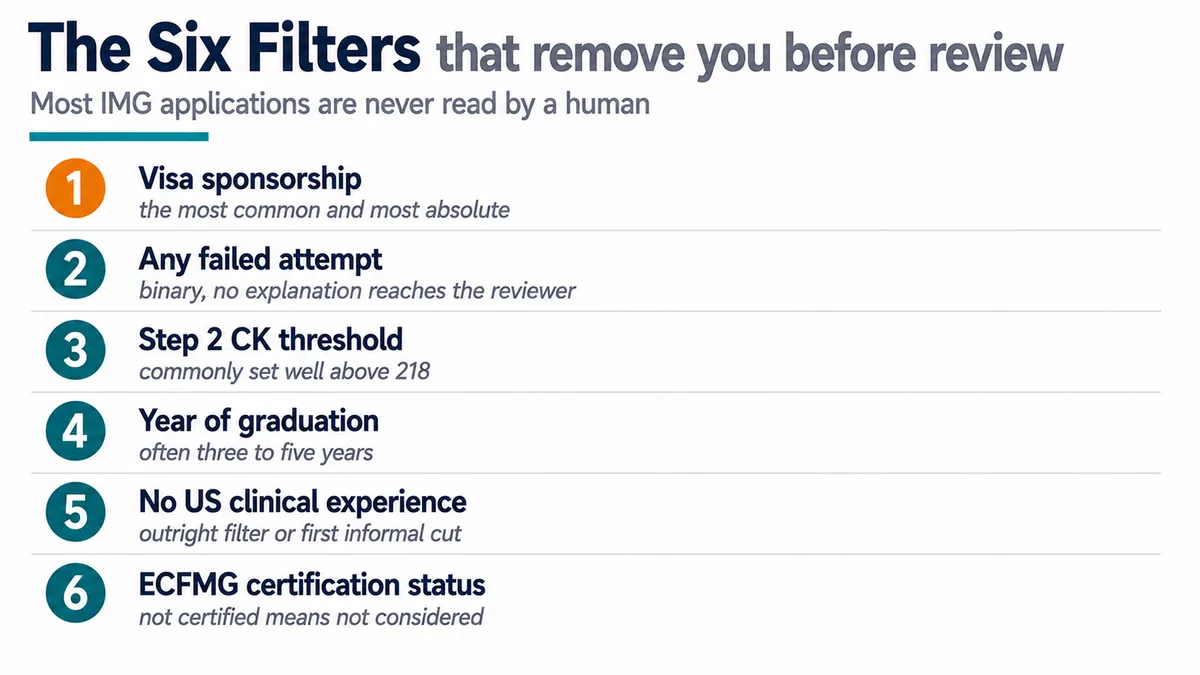
- Visa sponsorship. The most common and the most absolute. A programme that does not sponsor will never see your file, no matter how strong it is.
- Any failed attempt. Many programmes screen out applicants with a failed Step before review. This is binary and no explanation reaches the reviewer.
- Step 2 CK score threshold. With Step 1 now pass or fail, Step 2 CK carries the numeric filter. Thresholds are commonly set well above the 218 pass mark.
- Year of graduation. Many programmes filter on years since graduation, often at three to five years. This is the filter applicants least expect.
- No US clinical experience. Some programmes filter on it outright. Many more use it as the first informal cut.
- ECFMG certification status. Not being certified, or not being clearly on track, removes you from consideration at a large share of programmes.
Why applying to more programmes rarely helps
If you fail a filter, applying to 150 programmes that use the same filter produces 150 rejections. Volume only works when the extra programmes differ on the filter that is blocking you. Filter fit beats application count.
What the 2026 data shows
| Metric | 2026 |
|---|---|
| Non-US citizen IMG active applicants | 11,944 |
| Change on 2025 | up 479 |
| PGY-1 match rate | 56.4% |
| Overall placement rate | 59.9% |
Both rates were slightly down on the previous year even though the Match grew to more than 38,000 positions. The pool is growing faster than the posts available to it.
What actually changes the outcome
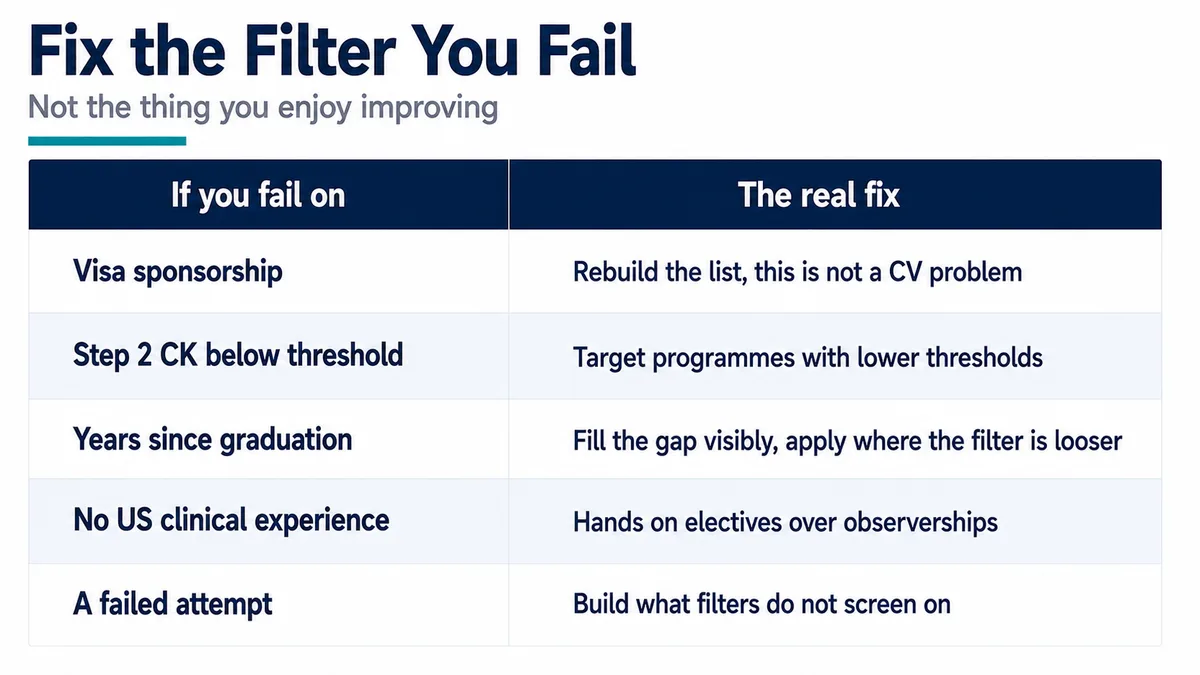
Fix the filter you fail, not the thing you enjoy improving
Applicants often add a fourth research project while failing the visa filter on most of their list. Identify which specific filter removes you, then spend your effort there.
| If you fail on | The real fix |
|---|---|
| Visa sponsorship | Rebuild your list around sponsoring programmes before applying. This is a list problem, not a CV problem |
| Step 2 CK below threshold | Delay applying and retake only if genuinely feasible, otherwise target programmes with lower thresholds |
| Years since graduation | Fill the gap visibly with clinical work, research or a fellowship, and apply where the filter is looser |
| No US clinical experience | Prioritise hands on electives and externships over observerships, because they generate stronger letters |
| A failed attempt | Build strength in areas filters do not screen on, and target explicitly IMG friendly programmes |
The signals that matter once a human reads your file
- US based letters of recommendation. A letter from a US attending who supervised you carries far more weight than a strong letter from outside the system.
- Hands on USCE. Electives and externships beat observerships, because shadowing produces weaker letters.
- A coherent story. Programmes look for a reason you want their specialty and their setting. Generic applications read as generic.
- Evidence you will stay. Regional ties, clear reasons for the location, and realistic expectations all reduce perceived flight risk.
The most common wasted year
Adding research to an application that fails on visa or graduation year. Research is valuable, but it never unlocks a filter it was not blocked by.
How to work out which filter is blocking you
This is diagnosable rather than mysterious. Work through the list in order and stop at the first honest yes.
| Question | If yes |
|---|---|
| Did most of your programmes sponsor your visa type | If no, this is almost certainly your primary blocker |
| Do you have a failed attempt on record | Expect a large share of programmes to screen you out automatically |
| Is your Step 2 CK score below the common threshold band | You are being cut numerically before review |
| Are you more than three to five years from graduation | A widely used and frequently overlooked filter |
| Do you have hands on US clinical experience | If not, you are competing without the strongest available signal |
| Were you ECFMG certified when programmes reviewed | Late certification removes you at many programmes regardless of merit |
Usually it is one thing, not everything
Applicants tend to conclude their whole application is weak. More often a single filter removes them from most of their list while the rest of the application is perfectly competitive. Finding the one is far more productive than improving everything.
Building a list that can actually see you
List construction is where most of the recoverable value sits, and it is the part applicants spend least time on.
- Start from sponsorship. Remove every programme that does not sponsor your visa type. Do this first, before anything else.
- Filter on IMG track record. Programmes whose current residents include IMGs from your region demonstrably do not screen you out.
- Check the graduation year tolerance if you are several years out.
- Spread across competitiveness. A list weighted entirely towards well known programmes produces silence.
- Prefer places you have a reason to be. Regional ties, prior rotations and existing contacts all reduce perceived flight risk.
The arithmetic that surprises people
Sixty well matched applications routinely outperform two hundred poorly matched ones. Once a filter removes you, additional applications to similar programmes add cost and nothing else.
What a strong IMG application contains
| Element | What good looks like |
|---|---|
| Step 2 CK | Comfortably above common filter thresholds, not merely above 218 |
| US clinical experience | Hands on electives or externships, ideally in your target specialty |
| Letters | At least one from a US attending who supervised you directly |
| ECFMG certification | Complete, or clearly on track, before programmes review |
| Research | Relevant and explainable, rather than numerous and generic |
| Personal statement | A specific reason for this specialty and this kind of programme |
If you are reapplying
A second cycle only works if something material changed. Reapplying with the same application to the same list produces the same result.
- Change the list first. It is the fastest and cheapest variable to move.
- Add hands on USCE if that was the gap, ideally producing a new US letter.
- Fill the interval visibly. An unexplained year is itself a negative signal; clinical work or research removes that.
- Ask for honest feedback from anyone inside a programme who will give it. Applicants routinely misdiagnose their own weakness.
Reapplying is normal
With a 56.4% match rate for non-US citizen IMGs, a large number of matched residents applied more than once. A second cycle is a common route rather than an admission of failure, provided the second application is genuinely different from the first.
Sources
- NRMP Main Residency Match data, 2026 applicant counts and match rates for non-US citizen IMGs.
Figures verified July 2026.
Next step
Residency Match Strategy
Specialty selection, application strategy, and interview prep for the Match.