How to Stand Out on US Clinical Rotations as an IMG (2026)
Academic Director & USMLE Educator, Dermatology Resident
The short answer
Standing out is not about working longer hours. It is about being the person your attending can write a specific letter about. 84% of programme directors cite specialty specific letters as a key factor in deciding who to interview, and a letter is only specific if the writer watched you make decisions.
Most advice on this topic is written for US medical students on core rotations. Your situation is different: you have a few weeks rather than a year, the attending does not know your school, and the entire point of the rotation is the letter at the end of it. This is written for that.
Not all rotations are worth the same
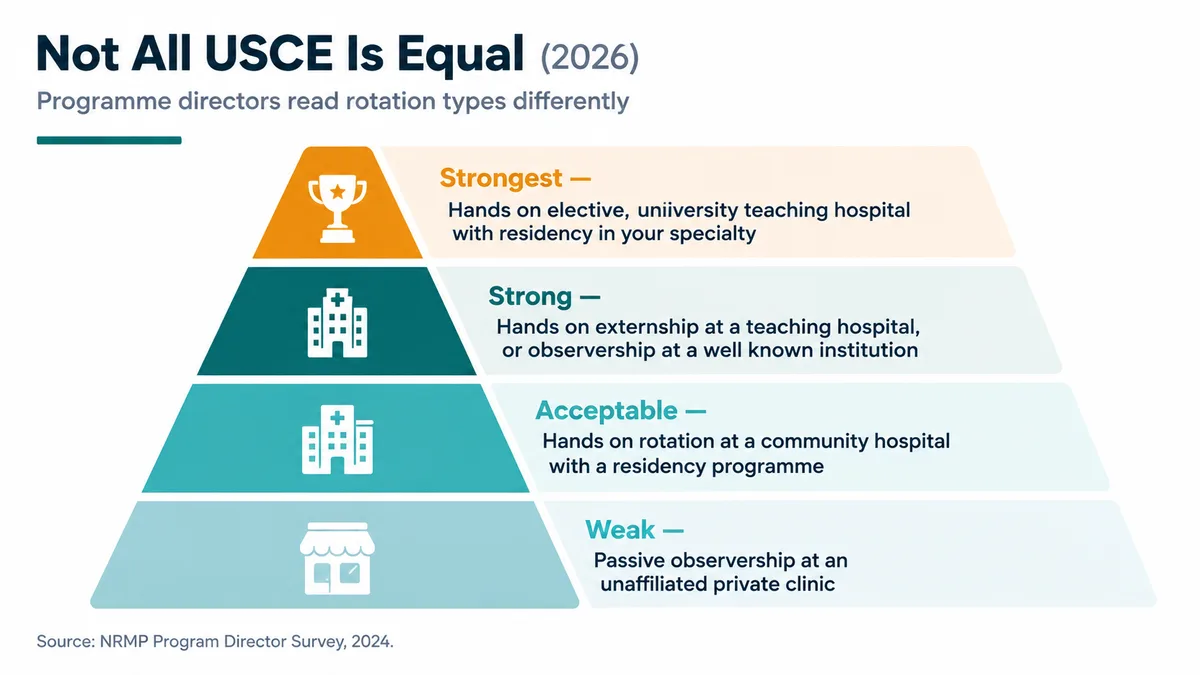
Before anything else, understand what you have actually booked. Programme directors read rotation types differently, and no amount of hard work moves a bottom tier rotation up.
| Tier | What it is | How it reads |
|---|---|---|
| Strongest | Hands on elective as a student at a university teaching hospital with a residency programme in your specialty | The writer supervised real decisions and knows the residency standard |
| Strong | Hands on externship as a graduate at a teaching hospital, or observership at a well known institution | Credible, especially with a specialty match |
| Acceptable | Hands on rotation at a community hospital with a residency programme | Fine if the letter is specific and the attending is engaged |
| Weak | Passive observership at an unaffiliated private clinic | Reads as shadowing. Produces generic letters |
Hands on beats prestigious
A hands on rotation at an ordinary community teaching hospital usually produces a better letter than shadowing at a famous name, because the writer can describe what you did rather than what you watched.
Say what you want on day one
The single highest value thing you can do happens before you have seen a patient. Most IMGs wait until the final day to raise the letter, by which point the attending has already formed a general impression rather than a documented one.
The opening conversation
Early in the first week, ask for two minutes and say: "My goal for this rotation is to earn a strong letter of recommendation from you. What would you need to see from me to be able to write one?"
This does three things at once. It tells the attending to pay attention to you specifically. It gets you an explicit list of what they value. And it makes the final ask a follow up rather than a cold request.
The oral case presentation is your exam
Attendings assess your clinical reasoning almost entirely through how you present patients. This is the skill that separates candidates, and it is the one IMGs most often get wrong because the US format differs from what many were trained on.
| Section | What belongs there |
|---|---|
| Opener | One sentence: age, relevant history, presenting problem, duration |
| History of present illness | Chronological, only what is relevant to the differential |
| Pertinent history and review | Positives and relevant negatives only |
| Examination | Vitals, then focused findings |
| Investigations | What is abnormal and what it means |
| Assessment and plan | Your reading of the problem and what you would do about it |
Where most IMGs lose marks
Two habits: presenting everything rather than what is relevant, and stopping at the assessment without committing to a plan. Commit to a plan even when you are unsure. Being wrong and reasoning aloud is far better received than being safe and silent, because the attending can only assess reasoning they can hear.
Aim for under five minutes for a new patient. Prepare the opener sentence verbatim the night before.
How to be useful rather than present
- Arrive before the team. See your patients, read the overnight notes, know what changed. The point is not the early start, it is arriving with information nobody else has yet.
- Read about your own patients. Not the textbook chapter, the specific question your patient raises. Bring one relevant piece of evidence to rounds.
- Answer the question you could not answer. Saying "I do not know, I will find out and tell you tomorrow" and then doing it is the most reliable way to be remembered well.
- Offer to write the note. It is genuine work taken off the team and it puts your reasoning in writing.
- Ask for feedback in week one, not at the end. Feedback you can still act on is worth more than a verdict.
- Treat nurses and staff as colleagues. Attendings notice, and they ask.
Asking for the letter properly
Ask in the last three to five days of the rotation, in person, while the specifics are fresh. Use the word strong, because it gives the writer a graceful way to decline rather than producing a lukewarm letter.
Make it easy to say yes
Send, in one email: your CV, your personal statement draft, a short list of the specific cases you worked on together, your specialty and timeline, and the submission instructions. A writer with material writes a specific letter. A writer without it writes "hardworking and pleasant", which does nothing for you.
How many letters, and from whom
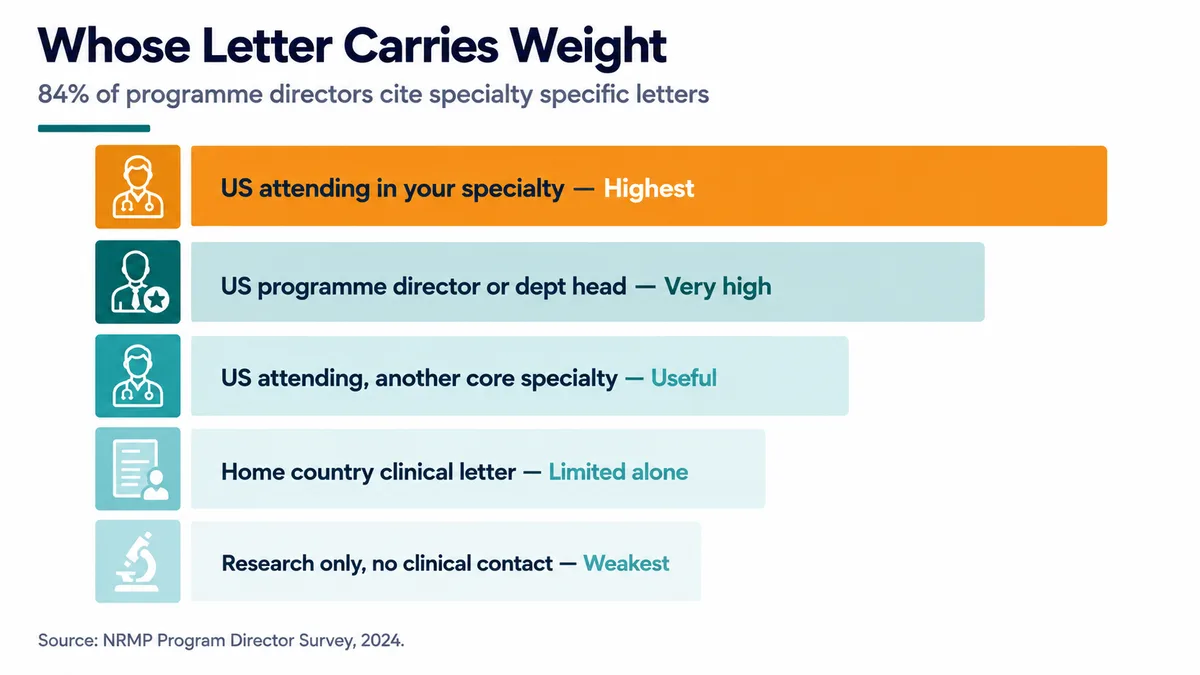
| Writer | Weight |
|---|---|
| US attending in your target specialty | Highest |
| US programme director or department head | Very high |
| US attending in another core specialty | Useful |
| Home country clinical letter | Limited on its own |
| Research only, no clinical contact | Weakest as a clinical letter |
Most IMGs should target two to three US clinical letters, at least one from your target specialty. Given the 84% figure, a specialty match matters more than the institution's name.
Timing your rotations against the application cycle
The deadline that catches people
Your letters must exist before programmes review applications. Working backwards, USCE should finish by mid July to early August for that cycle, which means booking months earlier. A brilliant rotation in October helps next year, not this one.
Your first week, day by day
The first week decides how the rest of the rotation goes, because it sets what the attending expects from you. Coast through it and you spend the remaining weeks fighting a first impression.
| When | What to do |
|---|---|
| Before day one | Learn the EMR name, the round times, the team structure and who your attending actually is |
| Day one | Arrive early, introduce yourself to nurses and residents by name, ask what is expected of a student here |
| Day two or three | Have the letter conversation. Ask what they would need to see |
| End of week one | Ask for feedback. "What is one thing I could do better next week?" |
| Every evening | Read on your own patients, prepare tomorrow's opener sentences |
What attendings actually notice
Attendings assess a small number of things and largely ignore the rest. Knowing which is which saves an enormous amount of wasted effort.
- Whether your presentations improve. Nobody expects week one to be polished. They expect week three to be better than week one, and they notice when it is not.
- Whether you follow through. The single most repeated behaviour in strong letters is the person who said they would look something up and did.
- Whether you commit. A student who says "I think this is heart failure because of X, and I would start Y" is assessable. A student who lists possibilities is not.
- How you treat people with no power over you. Nurses and support staff are asked, informally and often.
- Whether you are pleasant to have around at 6am. This sounds trivial and appears in more letters than clinical knowledge does.
What they largely do not notice
How many hours you stayed, how much you have read in total, or your marks at home. Effort that produces nothing visible in a presentation or a note is effort the letter cannot describe.
Mistakes that quietly cost the letter
| Mistake | What it signals |
|---|---|
| Waiting until the last day to mention the letter | The attending has impressions but no specifics to write |
| Presenting every detail | Cannot separate relevant from irrelevant, which is the core skill |
| Never committing to a plan | No reasoning to assess, so the letter stays generic |
| Correcting a resident publicly | Reads as a teamwork problem regardless of who was right |
| Disappearing when work is boring | Noticed immediately and remembered |
| Asking questions you could have looked up | Uses the attending as a search engine |
| Sending no materials after they agree | Guarantees a short, vague letter |
The whole thing in one sentence
Everything above serves one purpose: giving your attending concrete sentences to write. A letter that says "top 10%, and here is the case where I saw it" opens doors. A letter that says "hardworking and pleasant" is filler, and programme directors read hundreds of them.
Sources
- NRMP Program Director Survey, 2024: specialty specific letters cited by 84% of programme directors, mean importance 4.2, up from 70% in 2020.
- NRMP Main Residency Match data, 2026 Match outcomes for non-US citizen IMGs.
Figures verified July 2026.
Next step
US Clinical Rotations
Hands-on USCE and strong LORs from US clinical settings programs trust.