How to Find the Best US Clinical Experience for IMGs?
Academic Director & USMLE Educator, Dermatology Resident
US Clinical Experience (USCE) is one of the few parts of an IMG application you can still build after graduation, and program directors treat it as a genuine signal of readiness. But the advice online is thin on specifics: no real cost numbers, no honest answer on whether VSLO is even open to you, and no scam checklist for the fee-based programs that dominate this space.
This guide covers what USCE actually costs, how far ahead to plan it, the real difference between an observership, externship, and sub-internship, the visa path each one needs, and the red flags that separate a legitimate program from one that will pad your CV without helping your application.
- Hands-on beats passive: sub-internships and externships carry far more weight than observerships.
- VSLO is mostly closed to IMGs post-graduation, and its Free Mover pathway ends August 2026.
- Budget $500 to $4,000+ depending on rotation type, and plan 6–9 months ahead.
- B1/B2 usually covers observerships; hands-on rotations increasingly need a J-1.
- One excellent hands-on rotation beats five short observerships stacked on a CV.
Observership vs Externship vs Sub-Internship
These three terms get used loosely, but program directors read them very differently.
| Observership | Externship | Sub-Internship | |
|---|---|---|---|
| Hands-on level | Shadowing only, no patient contact | Histories, notes, supervised involvement | Intern-level: rounding, orders, presentations |
| Typical cost | $500–$1,500 | $500–$2,500 | $2,000–$4,000+ |
| Typical duration | 2–8 weeks | 4–8 weeks | 4 weeks |
| Usual visa | B1/B2 | B1/B2 or J-1 | J-1 or institution-specific |
| Letter quality | Weak, often just a certificate | Strong, if the evaluator knows you well | Strongest, mirrors a resident evaluation |
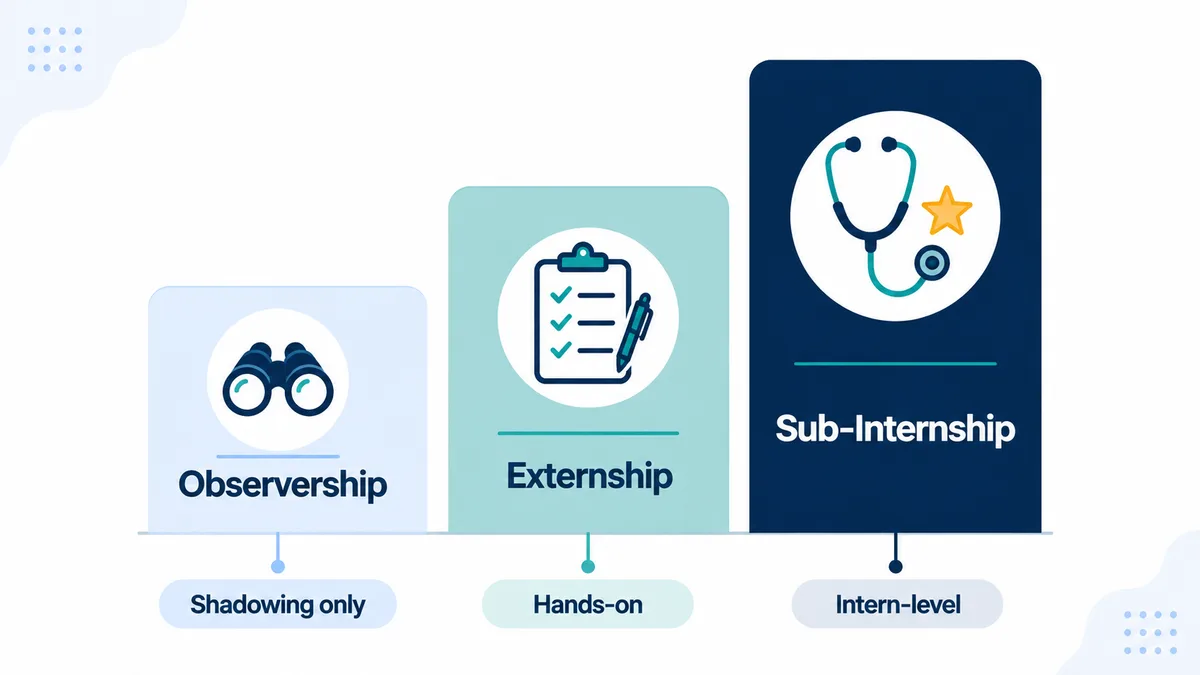
The recurring theme across advisors who work with IMGs: one excellent hands-on rotation with a strong letter beats five mediocre observerships. Stacking short shadowing stints on your CV to look busy tends to read as padding, not preparation.
What US Clinical Experience Really Costs
Pricing is rarely published up front, and no source gives audited numbers, so treat these as directional ranges, not guarantees. Always ask for an itemized breakdown before paying.
| Rotation type | Typical price range |
|---|---|
| Observership | $500–$1,500 (some formal hospital programs run higher) |
| Externship | $500–$2,500, sometimes split into an application fee ($100–$500) plus a rotation fee |
| Sub-internship | $2,000–$4,000, up to $7,000 at some competitive academic centers |
Timeline: When to Start Planning
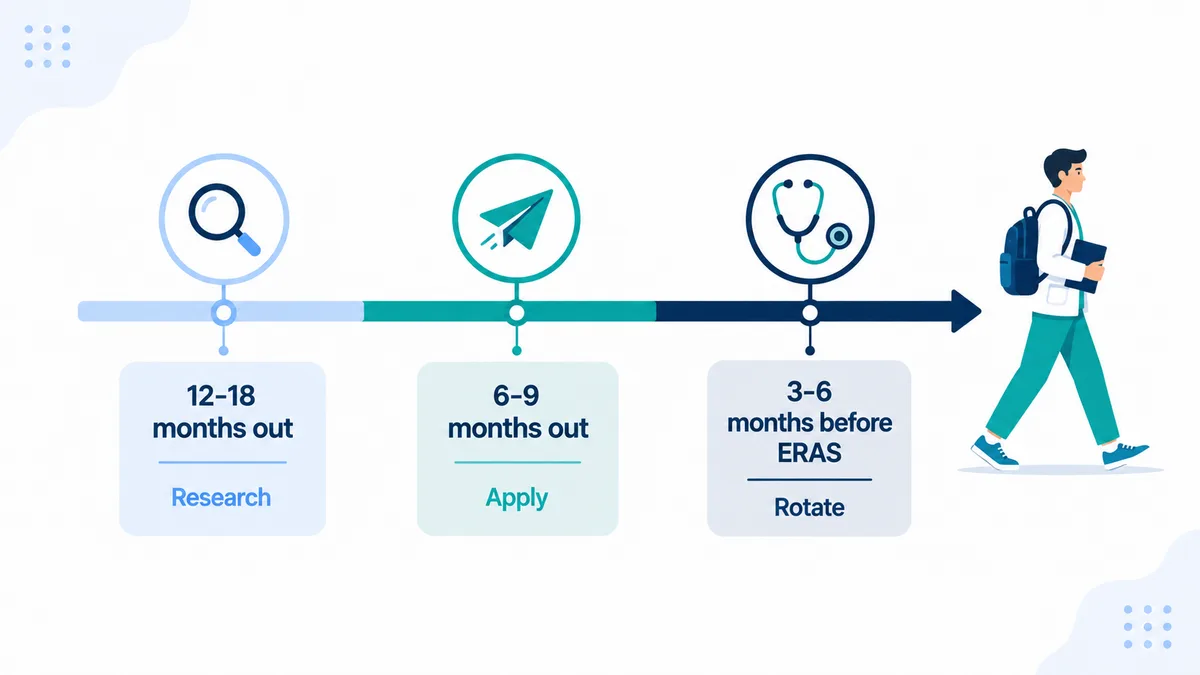
- 12–18 months out: research programs and shortlist a few.
- 6–9 months out: submit applications; popular programs at known teaching hospitals fill this far ahead.
- 3–6 months before ERAS: schedule your strongest rotation so the letter it generates is still fresh when you apply.
Can IMGs Use VSLO (Formerly VSAS)?
Mostly no, and this is where a lot of advice online gets it wrong. VSLO is built for currently enrolled medical students at participating institutions, not graduated IMGs. Its Free Mover pathway, which had let some non-affiliated international students in, is scheduled to end in August 2026. In practice, graduated IMGs find rotations through dedicated placement platforms, direct outreach to a sponsoring physician or department, or individual medical schools’ international visiting-elective programs, not through VSLO.
B1/B2 vs J-1: Which Visa Do You Need
Most passive, shadowing-only observerships are done on a B1/B2 visitor visa. Programs with real hands-on patient contact, or with a research/academic-exchange component, increasingly require a J-1 exchange visitor visa instead.
Young, recently graduated, currently unemployed applicants are a common profile for 214(b) “non-immigrant intent” denials on B1/B2. A program that issues a formal visa support or invitation letter, rather than leaving you to sort logistics alone, meaningfully reduces that risk.
Red Flags of Low-Value or Scam USCE Programs
- Guaranteed letters of recommendation promised before you have even met the physician.
- A large upfront payment (over roughly $3,000) with no itemized breakdown of what it covers.
- No clearly outlined clinical responsibilities: vague “gain USCE” language instead of a real schedule.
- No named, verifiable supervising physician actively involved in teaching.
- Purely virtual observerships with no in-person clinical exposure, rated lowest of all USCE types by program directors.
- No visa support or formal invitation letter.
How Much USCE Is Actually Enough
There is no official number, but the consistent advisory consensus is 2–4 rotations totaling roughly 8–12 weeks, concentrated in a couple of institutions rather than scattered across many one-week stints. Keep your USCE within about 1–3 years of when you apply to residency; older experience gets discounted as outdated. For what to do with the letters this experience generates, see what program directors actually seek from USCE.
Frequently Asked Questions
What's the real difference between an observership, an externship, and a sub-internship for IMGs?
An observership is shadowing only, no patient contact, and carries the least weight with program directors. An externship gives you hands-on responsibilities like taking histories and writing notes under supervision, and generally carries more weight. A sub-internship puts you in an intern-level role with rounding and clinical input, and is the most valued of the three, but also the most competitive and expensive to secure.
Can IMGs use VSLO/VSAS to find US clinical rotations?
Mostly no. VSLO (formerly VSAS) is built for currently enrolled medical students at participating institutions, not graduated IMGs. Its “Free Mover” pathway, which let some non-affiliated international students in, is scheduled to end in August 2026. Graduated IMGs typically go through dedicated placement platforms, direct hospital outreach, or individual medical schools’ international visiting-elective programs.
How much does US clinical experience typically cost for IMGs?
Costs vary widely: observerships generally run $500–$1,500, externships around $500–$2,500, and sub-internships $2,000–$4,000 or more at competitive academic centers. Always ask for an itemized breakdown of application fees versus rotation fees before paying, and be wary of any program demanding a large lump sum upfront with no clear structure.
How far in advance should I apply for a US clinical rotation?
Start researching 12–18 months before you plan to apply to residency, and submit applications 6–9 months before your target rotation start date. Popular programs at well-known teaching hospitals can fill 12 months or more in advance.
Do I need a B1/B2 visa or a J-1 visa for a US clinical rotation?
Most passive, shadowing-only observerships are done on a B1/B2 visitor visa. Programs with hands-on patient contact increasingly require a J-1 exchange visitor visa instead. Because young, recently graduated applicants are a common profile for 214(b) denials on B1/B2, a program that provides a formal visa support letter meaningfully reduces your visa risk.
Conclusion
Good USCE is not about collecting certificates. It is one or two hands-on rotations, planned far enough ahead, that generate a letter a program director actually believes. Spend your budget and time there rather than on a string of short observerships, and confirm visa and legitimacy signals before you pay anyone.
Want expert eyes on your application? Explore our USMLE Step 1 & Step 2 CK preparation program and see how our students have matched into U.S. residency.
Next step
US Clinical Rotations
Hands-on USCE and strong LORs from US clinical settings programs trust.