What Program Directors Look for in a USMLE Match Interview?

Academic Director & USMLE Educator, Dermatology Resident
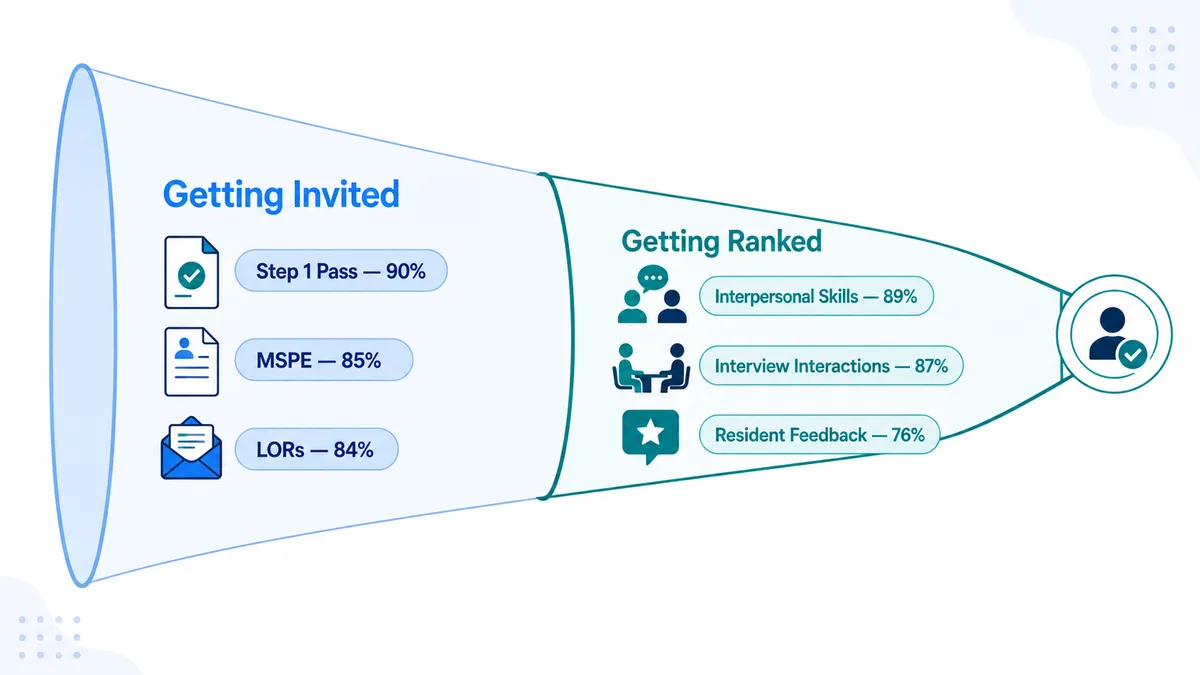
Program directors do not decide your rank position the moment you walk in. They decide it in two separate stages that reward different things. Your USMLE scores, MSPE, and letters get you the invitation. What happens once you are in the room is what actually moves you up or down the final list. Confusing the two is the single biggest reason applicants over-prepare for the wrong thing.
This guide breaks down exactly what the NRMP’s own Program Director Survey data says programs weigh at each stage, the concrete red and green flags PDs report watching for, the IMG-specific concerns programs hold, and how interview format and post-interview etiquette actually work under NRMP rules.
- Scores and MSPE decide who gets invited; interpersonal read decides who gets ranked highly.
- Interpersonal skills (89%) and interview interactions (87%) are the top-rated ranking factors in NRMP’s own survey.
- Resident feedback from informal moments (dinners, tours) genuinely counts: 76% of programs use it.
- PDs’ top cited IMG concerns are communication with patients and teams.
- Thank-you notes and second looks do not officially affect your rank position under NRMP rules.
Two Different Games: Getting Invited vs Getting Ranked
NRMP’s 2024 Program Director Survey (1,150 PDs, fielded before Match Week to avoid outcome bias) asked programs what factors they use at each stage, and the two lists barely overlap:
| Interview-invitation stage | % of PDs using it | Importance (of 5) |
|---|---|---|
| USMLE Step 1 pass status | 90% | 4.5 |
| MSPE / Dean’s Letter | 85% | 4.1 |
| Specialty-specific letters of recommendation | 84% | 4.2 |
| Ranking stage (after interview) | % of PDs using it | Importance (of 5) |
|---|---|---|
| Interpersonal skills | 89% | 4.8 |
| Interactions during the interview | 87% | 4.8 |
| Feedback from current residents | 76% | 4.6 |
Your file gets you through the door on the strength of your scores and paperwork. Once inside, the two highest-rated factors in NRMP’s own data are entirely about how you come across as a person, not your CV. That is genuinely good news: interview day is where you have the most room to move your own rank position, for better or worse.
What Program Directors Are Really Assessing
PDs quoted in AMA reporting describe the filter in blunt terms: would I trust this person at 2 a.m. with my sickest patient, and will they be someone the team actually wants to work alongside for years. Dr. David Marzano, Dr. Ricardo Correa, and Dr. Chadd Kraus, all practicing program directors, independently point to the same underlying test: does this person’s in-person presence match the strength of their file.
Red Flags That Sink Candidates
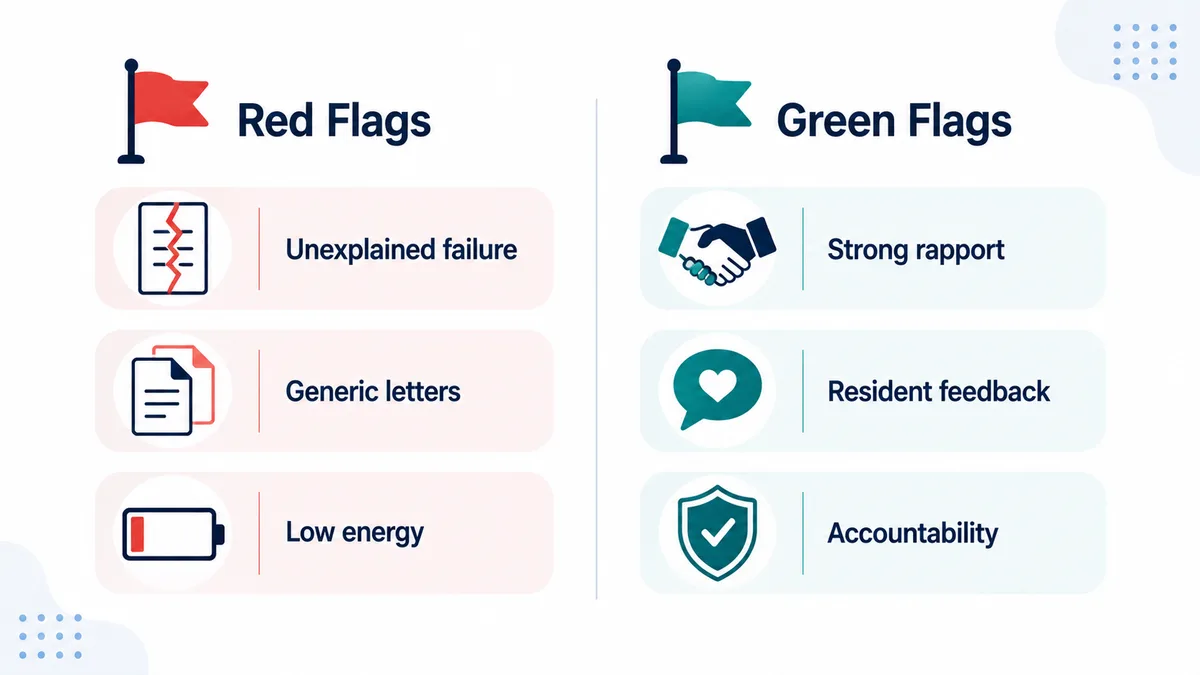
- Unexplained USMLE Step 1/Step 2 CK failure or multiple attempts with no addressed narrative anywhere in the application.
- Generic, template-sounding letters of recommendation that say nothing specific about you.
- “Box-checking”: listing activities without explaining what you did or how they shaped your direction.
- Unprofessional or public social media content.
- No or stale US clinical experience (older than 1–2 years), an IMG-specific flag.
- Low energy or flat affect on interview day. PDs read this as a preview of night-shift performance.
Green Flags That Move You Up the List
- A genuinely strong interpersonal read during the interview conversation itself.
- Specific, positive feedback from current residents you interacted with informally: dinners and tours count.
- Demonstrated accountability and concrete corrective action after any setback, rather than avoidance.
- A specialty-specific letter that speaks to real clinical moments, not generic praise.
- A consistent specialty-commitment narrative across your personal statement, rotations, and interview answers.
IMG-Specific Concerns Program Directors Have
| PD concern | Data point | How to address it |
|---|---|---|
| Communication with patients/team | Top-rated IMG challenge in PD surveys (4.4/5 and 4.3/5) | Give concrete USCE anecdotes showing patient rapport; practice mock interviews for clarity |
| Familiarity with the US healthcare system | IMGs’ own top self-rated weakness | Reference specific US rotation experiences (EMR use, interdisciplinary rounds) unprompted |
| Visa sponsorship uncertainty | 54.4% match rate needing sponsorship vs 67.9% not needing it (2026 data) | Research each program’s actual J‑1/H‑1B sponsorship history before applying |
| Recency/depth of USCE | Named red flag across multiple sources | Prioritize hands-on sub-internships over observerships; keep USCE within 1–2 years |
A well-built USMLE CV and specific, US-based letters of recommendation do most of the work here before you even reach the interview room.
Interview Format in 2026: Virtual, In-Person, and What It Means
Most specialties (including Internal Medicine, per current society guidance) continue to recommend a virtual format for the 2025–2026 cycle, largely for cost savings on both sides. Some surgical and subsurgical specialties have shifted back toward in-person interviews or added optional second-look visits. For applicants interviewing from abroad, this mostly changes logistics (time zones and a stable camera setup), not what is actually being assessed.
Thank-You Notes and Second Looks: Do They Matter?
Under the NRMP Match Communication Code of Conduct, programs cannot let post-interview contact affect your rank position, and current Internal Medicine society guidance explicitly tells applicants a thank-you note is unnecessary. Attending or skipping an optional second-look visit similarly has no bearing on where you land on the list. Treat both as courtesy, not strategy. See our companion guide on common interview questions and how to answer them for what actually does move the needle on interview day.
Frequently Asked Questions
What do residency program directors actually look for in a Match interview, according to real data?
Per the NRMP’s 2024 Program Director Survey (1,150 PDs surveyed), the top-rated ranking factors after the interview are interpersonal skills (89% of programs consider it, rated 4.8/5 importance) and interactions during the interview itself (87%, also 4.8/5), ahead of scores or research output, which matter more at the earlier interview-invitation stage.
Does Step 2 CK score matter more than interview performance for the final rank list?
Step 2 CK and related exam results primarily influence whether you get invited to interview in the first place. Once you are in the interview room, NRMP data shows the deciding factors shift to interpersonal skills, interview interactions, and resident feedback, meaning a strong interview can meaningfully outweigh a middling score once you have cleared the invitation bar.
What are the biggest interview red flags for IMG applicants specifically?
The most cited red flags are unexplained USMLE failures, no or outdated US clinical experience (USCE), and communication concerns. Published needs-assessment data shows program directors rate communication with patients and with team members as the top challenges they associate with IMG candidates. Addressing these directly in your interview answers, rather than hoping they go unnoticed, is the standard advice from residency advisors.
Are residency interviews still virtual in the 2025-2026 Match cycle?
Most specialties, including Internal Medicine, continue to recommend a virtual interview format for 2025–2026 per specialty society guidance, largely due to cost savings for both applicants and programs. Some surgical subspecialties have begun returning to in-person interviews, so confirm the format specialty-by-specialty and program-by-program rather than assuming.
Do thank-you notes or second-look visits after a residency interview improve your rank position?
No. Under the NRMP Match Communication Code of Conduct, programs are barred from letting post-interview contact affect ranking, and specialty guidance for Internal Medicine explicitly tells applicants that thank-you notes are unnecessary and that attending or skipping a second-look visit has no bearing on rank position.
Conclusion
Your application gets you the interview; who you are in the room decides your rank position. Know both games, address the specific concerns PDs hold about IMGs head-on, and treat interview day as the highest-leverage part of the entire Match process, because according to program directors themselves, it is.
Want expert eyes on your Match strategy? Explore our USMLE Step 1 & Step 2 CK preparation program and see how our students have matched into U.S. residency.
Next step
Residency Match Strategy
Specialty selection, application strategy, and interview prep for the Match.