USMLE Step 1 vs Step 2 CK: Every Key Difference (2026 Update)

Academic Director & USMLE Educator, Dermatology Resident
The short answer
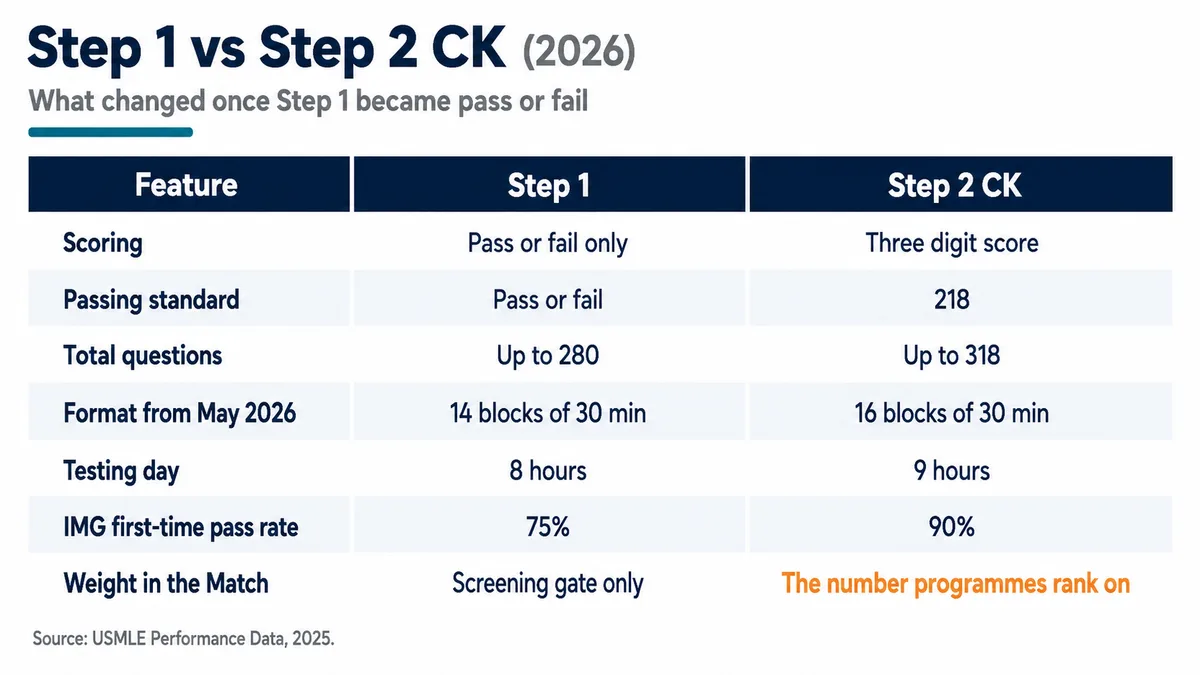
Step 1 tests foundational science and is reported only as pass or fail. Step 2 CK tests clinical management and returns a three digit score, which is now the number programmes screen on. Both exams moved to 30 minute blocks in May 2026.
Since Step 1 became pass or fail in 2022, the relationship between these two exams inverted. Advice written before that change is actively misleading. Here is where things stand in 2026.
Side by side
| Step 1 | Step 2 CK | |
|---|---|---|
| What it tests | Foundational sciences applied to medicine | Clinical knowledge and patient management |
| Scoring | Pass or fail only | Three digit score |
| Passing standard | Pass or fail designation | 218, raised from 214 on 1 July 2025 |
| Total questions | Up to 280 | Up to 318 |
| Format from May 2026 | 14 blocks of 30 minutes | 16 blocks of 30 minutes |
| Format before May 2026 | 7 blocks of 60 minutes | 8 blocks of 60 minutes |
| Testing day | 8 hours | 9 hours |
| IMG first time pass rate, 2025 | 75% | 90% |
| Weight in the Match | Screening gate only | The number programmes rank on |
What Step 1 actually covers
Step 1 is discipline heavy. The published content outline gives these ranges:
| Discipline | Share of exam |
|---|---|
| Pathology | 45 to 55% |
| Physiology | 30 to 40% |
| Pharmacology | 10 to 20% |
| Microbiology | 10 to 20% |
| Gross anatomy and embryology | 10 to 20% |
| Biochemistry | 5 to 15% |
| Immunology | 5 to 15% |
Why these do not sum to 100
Questions are integrative, so a single item can count towards several disciplines at once. Treat the ranges as emphasis, not as a syllabus checklist.
What Step 2 CK actually covers
Step 2 CK is organised around clinical decisions rather than disciplines. Internal medicine dominates, followed by surgery, paediatrics, obstetrics and gynaecology, and psychiatry. The questions are longer, and the task is usually "what do you do next" rather than "what is the mechanism".
The difference that catches people out
Step 1 rewards knowing why something happens. Step 2 CK rewards knowing what to do about it, in the right order. Strong Step 1 performers frequently underestimate Step 2 CK because the reasoning style is genuinely different, not merely harder.
Which one matters more now
Step 2 CK, and it is not close. Once Step 1 became pass or fail, programmes lost their main numerical screening tool and shifted that weight onto Step 2 CK.
- Step 1 is a gate. Passing keeps you eligible. It adds nothing beyond that. Failing is very costly.
- Step 2 CK is the signal. It is the number in filters, in rank list discussions and in interview conversations.
What this means practically
Do not spend an extra two months chasing a Step 1 margin that will never be visible to anyone. Pass it safely, then put the surplus effort into Step 2 CK, where every point is visible and counted.
Sequencing and timing
Most IMGs take Step 1 first, then Step 2 CK. Two practical notes:
- Step 2 CK closer to your clinical years is easier. Ward exposure does real work here, so taking it while clinical material is fresh helps.
- Your Step 2 CK score must exist before applications. A score arriving after programmes begin reviewing is a score that did not influence your screening.
The seven year clock
Most licensing authorities require all three Steps within seven years, and the clock starts when you pass your first Step. Passing Step 1 very early, then pausing for years, can quietly consume that window.
How the questions differ in practice
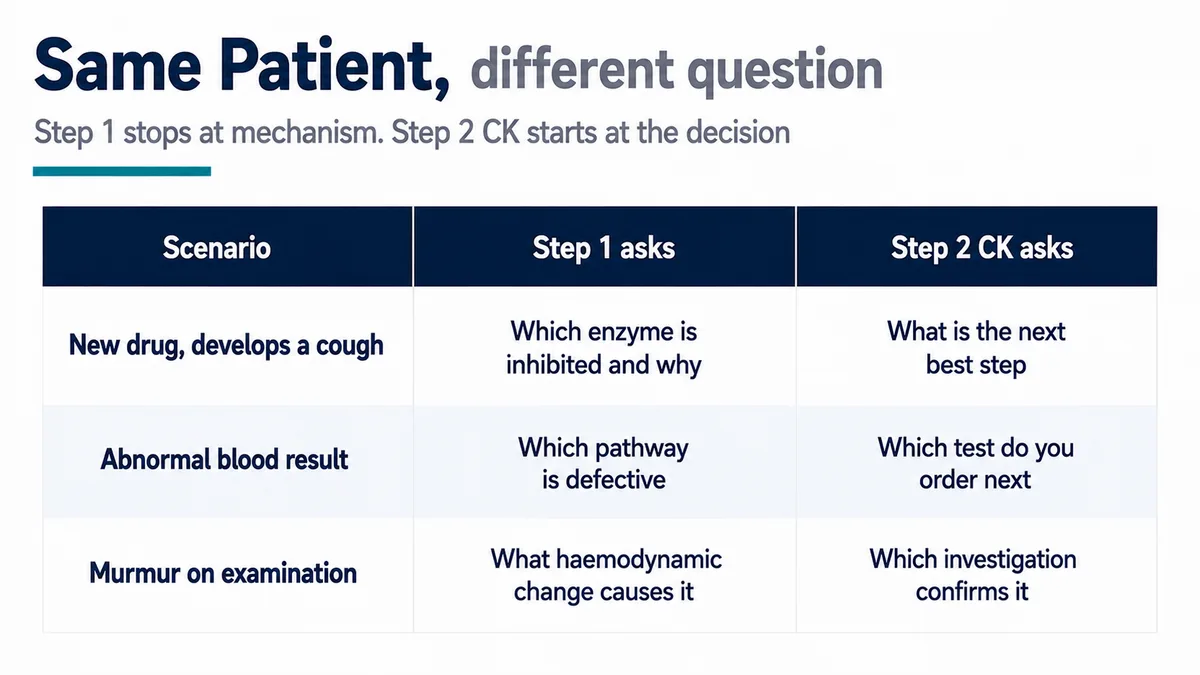
The clearest way to see the difference is to look at what each exam does with the same clinical scenario.
| Step 1 asks | Step 2 CK asks | |
|---|---|---|
| A patient on a new drug develops a cough | Which enzyme is inhibited and why does that cause cough | What is the next best step in management |
| An abnormal blood result | Which pathway is defective | Which test do you order next |
| A murmur on examination | What haemodynamic change produces it | Which investigation confirms it and when do you refer |
Step 1 stops at the mechanism. Step 2 CK starts after the diagnosis is largely apparent and tests the decision. This is why strong Step 1 performers sometimes underperform: they keep reasoning towards mechanism when the question wants an action.
A reliable tell
If a Step 2 CK question can be answered by knowing which of five options is the correct next action, spending 90 seconds deriving the underlying physiology is wasted time. The exam rewards recognising the decision point quickly.
What changed when Step 1 became pass or fail
Before 2022, Step 1 produced a three digit score and programmes screened on it heavily. That single change redistributed weight across the entire application.
- Step 2 CK absorbed the screening role. It is now the number in programme filters.
- Softer signals gained weight. Letters, US clinical experience, research and school reputation matter more than they did, because one large numeric discriminator disappeared.
- Failing Step 1 became relatively more damaging. When Step 1 was scored, a modest score was a weak signal. Now the only signals it can send are pass, which is neutral, or fail, which is negative.
- Timing pressure moved. Because Step 2 CK now carries the score, taking it early enough for the result to exist before applications became critical.
Advice written before 2022 is actively misleading
Any guidance that talks about a target Step 1 score, or about Step 1 being the most important exam for the Match, predates the change. Seniors who matched before 2022 often give this advice sincerely and it no longer applies.
Preparation differences that matter
| Step 1 | Step 2 CK | |
|---|---|---|
| Typical dedicated period | Longer, because the content base is broader | Shorter if clinical exposure is recent |
| Best study method | Mechanism first, then consolidation | High volume questions, management focused |
| Role of clinical exposure | Limited | Very high, wards do real work here |
| Where marks are lost | Gaps in foundational understanding | Pacing and second guessing |
| Cost of a weak result | A fail is permanent and filtered on | A low score limits programme options |
Planning the two together
- Pass Step 1 safely, do not optimise it. There is no visible reward for a comfortable pass over a narrow one.
- Take Step 2 CK while clinical material is fresh. Sitting it long after your clinical years means relearning what you once knew from the wards.
- Work backwards from the application deadline. Score release takes several weeks, so a Step 2 CK date too close to submission produces a score that arrives after screening.
- Watch the seven year window. It opens when you pass your first Step, so a long gap between the two exams consumes it.
Sources
- USMLE Performance Data, 2025 pass rates and exam formats.
- USMLE Step 1 content outline and specifications.
Figures verified July 2026.
Next step
Step 1 & Step 2 CK Prep
Structured modules, 1-on-1 mentorship, and a 100-day plan to clear the boards.