How to Pass the USMLE on Your First Attempt (2026 Strategy)

Academic Director & USMLE Educator, Dermatology Resident
The short answer
Among IMGs in 2025, 75% of first time Step 1 takers passed and only 54% of repeaters did. That gap is not about ability, because they are largely the same people. It is about method, and about not sitting the exam before the evidence says you are ready.
Nearly everything written about passing first time is a list of study tips. The tips matter less than one decision: when you book.
The numbers
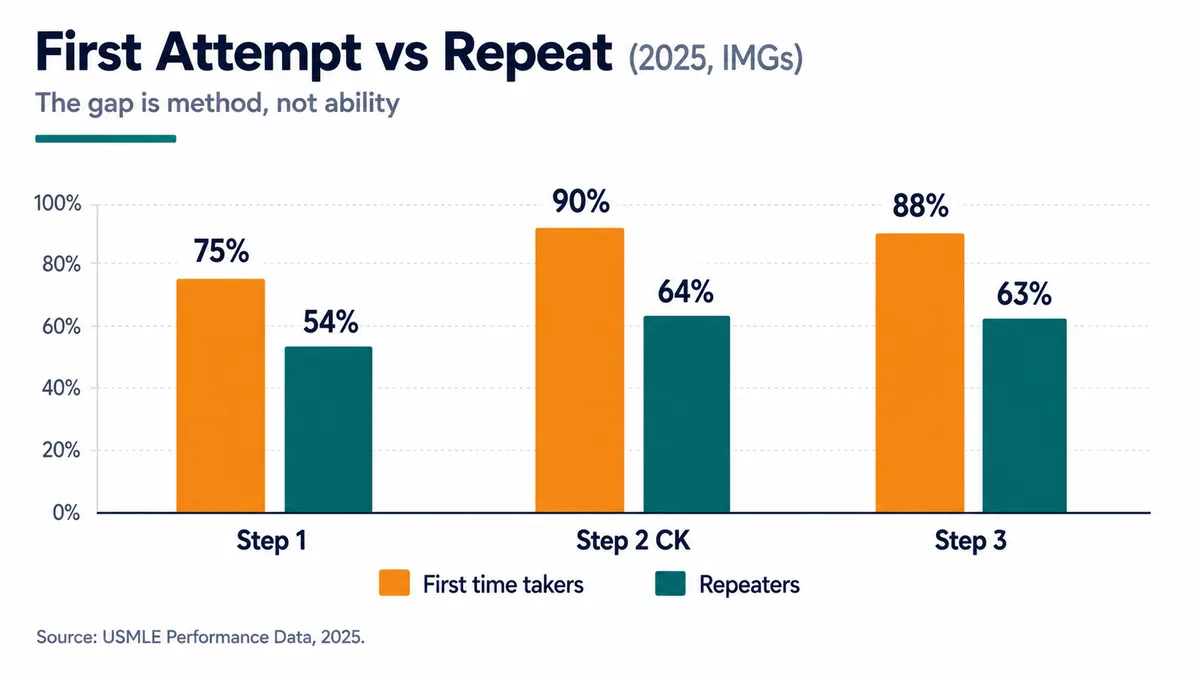
| Exam | First time takers | Repeaters | Gap |
|---|---|---|---|
| Step 1 | 75% | 54% | 21 points |
| Step 2 CK | 90% | 64% | 26 points |
| Step 3 | 88% | 63% | 25 points |
Why a retake is harder, not easier
You would expect a second attempt to be easier: you have seen the exam and you know the gaps. It is not, because most retakes repeat the same method that failed. And a failed attempt is permanent on your transcript, with many programmes filtering on it before a human reads the application.
The readiness test
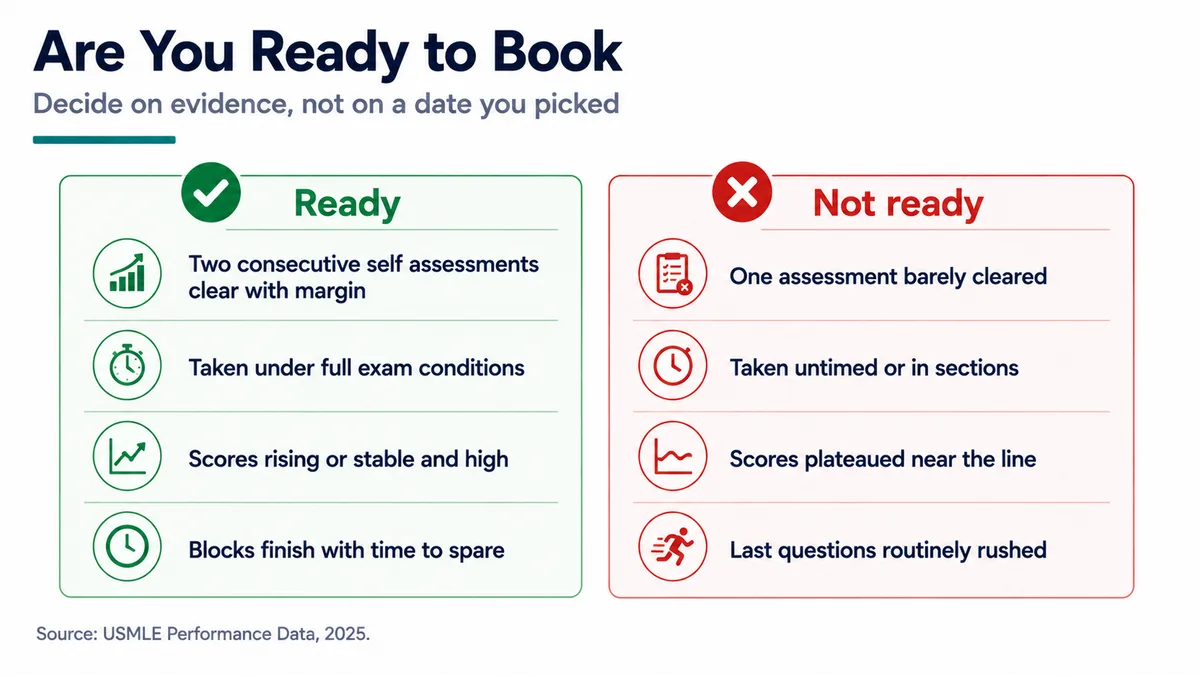
This is the only part of this article that genuinely decides the outcome.
| You are ready when | You are not ready when |
|---|---|
| Two consecutive self assessments clear the pass line with margin | One self assessment barely cleared it |
| Both were taken under full exam conditions | You took them untimed or in sections |
| Scores are still rising or have stabilised high | Scores have plateaued near the line |
| You finish blocks with time to spare | You routinely rush the last few questions |
| You can explain why wrong answers are wrong | You recognise answers without knowing why |
The most expensive habit in USMLE preparation
Booking a date first and studying towards it. The date then drives the decision instead of the evidence, and a borderline self assessment predicts a borderline result. Pick the date after the evidence, not before.
What first time passers do differently
- They start questions early. Questions are how gaps get found. Saving them until you feel ready means finding gaps when there is no time left to fix them.
- They review harder than they answer. Reviewing a block properly takes longer than doing it. If your review is quicker than the block, you are collecting questions rather than learning.
- They use self assessments as a steering wheel. One every three to four weeks across the whole preparation, not one at the end.
- They review old material daily. Over a multi month preparation, unreviewed material genuinely disappears.
- They study mechanisms. Step 1 devotes 60 to 70% of questions to applying foundational science and only 20 to 25% to diagnosis.
- They protect sleep. Retention collapses without it, and burnout arrives in the final weeks, at the worst possible time.
Train at the current exam rhythm
The format changed on 14 May 2026
Step 1 now runs as 14 blocks of 30 minutes with up to 20 questions each, replacing 7 blocks of 60 minutes. Step 2 CK runs 16 blocks of 30 minutes. Content and question counts are unchanged, but anyone practising exclusively in 60 minute blocks is training the wrong pacing.
What forces a retake
| Cause | Prevention |
|---|---|
| Booked before self assessments supported it | Two consecutive passes with margin, real conditions |
| Read passively instead of testing recall | Close the book and explain the topic aloud |
| Never practised full length under timing | At least two full length practice sessions |
| Studied everything equally | Weight by the published content outline |
| Burned out in the final weeks | Sustainable schedule with a lighter day weekly |
If you only take one thing
Delaying the exam by six weeks costs six weeks. Failing costs a permanent transcript entry, a retake at 54% odds, and a filter that removes you from a large share of programmes before anyone reads your file. The asymmetry is enormous, and it always favours waiting.
How to review a question block properly
Almost every first attempt failure traces back to one habit: answering questions without reviewing them properly. Answering is the cheap half.
- Read every explanation, including for correct answers. A lucky guess and real knowledge look identical in your percentage and are completely different in reality.
- Learn from the distractors. Each wrong option is usually the right answer to a neighbouring question, so one reviewed item can teach four or five facts.
- Flag guesses honestly. Unaudited guesses are the most reliable source of exam day surprises.
- Write one sentence per miss, in your own words. Not a copied explanation. What you actually got wrong.
- Sort misses by cause. Knowledge, misreading, timing, or technique. The distribution tells you what to fix next.
The ratio that matters
Reviewing a block properly takes longer than doing it. If your review is consistently quicker than the block itself, you are collecting questions rather than learning from them, and your score will plateau.
A realistic timeline
| Phase | Duration | Focus |
|---|---|---|
| Foundation | Varies, often years alongside college | Understanding mechanisms, system by system |
| Question phase | 3 to 6 months | First full pass with proper review |
| Calibration | Throughout | Self assessment every 3 to 4 weeks |
| Dedicated | 6 to 12 weeks | Second pass, weak areas, timed blocks |
| Final fortnight | 2 weeks | Consolidation and pacing only, no new material |
IMGs typically need the longer end of these ranges, since the foundation phase runs alongside a different curriculum.
The final two weeks
Stop learning, start consolidating
New material in the last fortnight displaces things you already knew and adds anxiety without adding recall. The final two weeks are for reviewing what you have already covered, practising at the 30 minute block rhythm, and fixing your sleep before test day.
- No new resources. Whatever you have not covered by now stays uncovered.
- Two full length practice sessions under real conditions, including breaks.
- Shift your sleep to match the exam start time at least a week out.
- Plan the day itself. Travel, food, what you take in, when you break. Reduces decisions on the day.
Exam day
| Situation | What to do |
|---|---|
| A block goes badly | Let it go. It is not scored separately and there is no recovering it by dwelling |
| You are running behind | Guess and move. An unanswered question is certainly wrong |
| Two options both look right | Reread the last line. It usually distinguishes them |
| You want to change an answer | Change it if you found a specific reason, not on feeling alone |
| Break time | Take it. Skipping breaks to save minutes costs accuracy later |
The first attempt is an asset
You get exactly one clean record, and it is worth more than any single study decision. Treat the date as something you earn with self assessment evidence rather than something you set in advance and hope to grow into.
Sources
- USMLE Performance Data, 2025 first time and repeat pass rates.
- USMLE Step 1 content outline and 2026 exam format.
Figures verified July 2026.
Next step
Step 1 & Step 2 CK Prep
Structured modules, 1-on-1 mentorship, and a 100-day plan to clear the boards.