How Long to Study for USMLE Step 1? (2026 Guide)

Academic Director & USMLE Educator, Dermatology Resident

“How long should I study for Step 1?” is the first question almost every student asks, and the honest answer is: it depends on where you are starting. There is no single magic number, because preparation time is a function of your foundation, your daily hours, and whether you are a US student or an IMG balancing other demands. What looks like a 6-week sprint for one person is a 5-month journey for another.
This guide gives you a realistic framework: the factors that set your timeline, how to establish a baseline before you count any weeks, the typical preparation ranges, why IMGs often need more runway, and the readiness signals that actually tell you it is time to sit the exam. With Step 1 now pass/fail, the target is a confident pass, and that takes the right amount of time, not the most.
- There is no fixed number: preparation time depends on your foundation, hours/day, and IMG status.
- Most students use a dedicated block of 6–8 weeks on top of months of pre-dedicated study.
- IMGs often need longer: commonly 4–6 months of total prep.
- Set a baseline NBME first; let the score, not the calendar, decide.
- Readiness is measured by practice-test performance, not weeks elapsed.
The Honest Answer: It Depends on These Factors
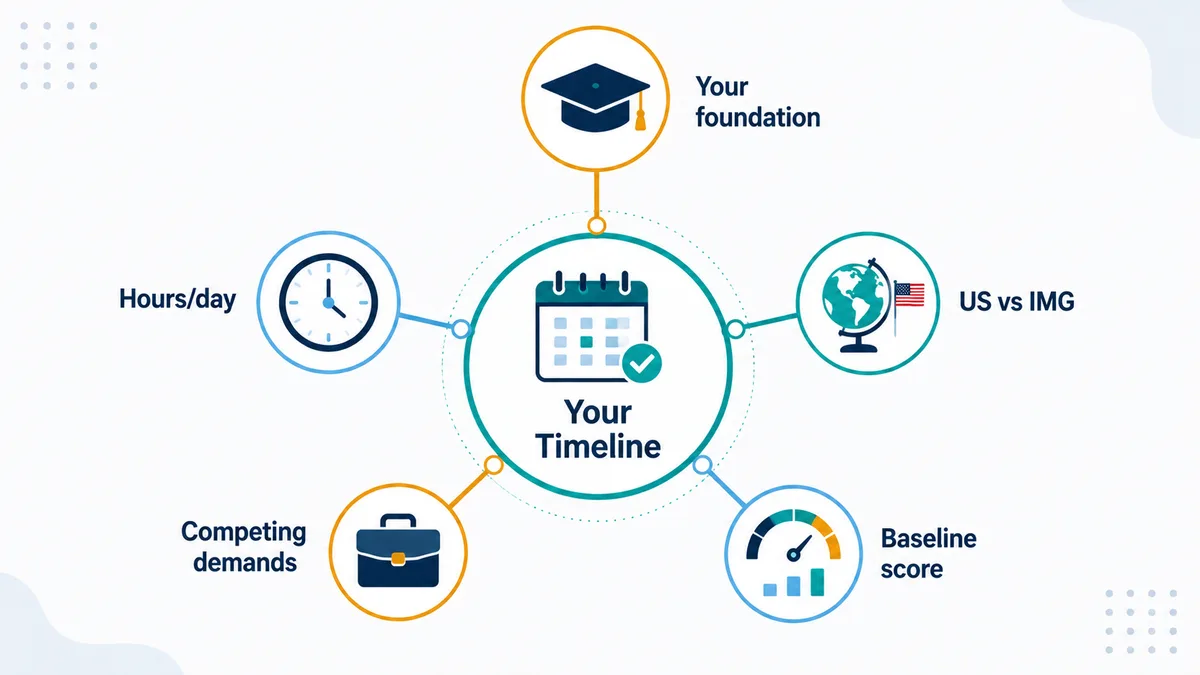
Before reaching for a number, weigh what actually moves your timeline:
| Factor | Effect on your timeline |
|---|---|
| Your current foundation | Stronger basics → shorter runway |
| Study hours per day | More focused hours → fewer weeks needed |
| US student vs IMG | IMGs often need more total time |
| Competing demands | Coursework/work → longer pre-dedicated phase |
| Baseline NBME score | The gap to passing sets the length |
Set a Baseline Before You Count Weeks
The single most useful thing you can do is take a baseline NBME self-assessment early. It converts “how long should I study?” into a concrete question: how far is my current score from a confident pass? A small gap means a short dedicated block; a large one means more runway. Guessing at a timeline without a baseline is how students both over-prepare and run out of road.
Typical Step 1 Preparation Timelines
With those caveats, here are the common ranges students actually use:
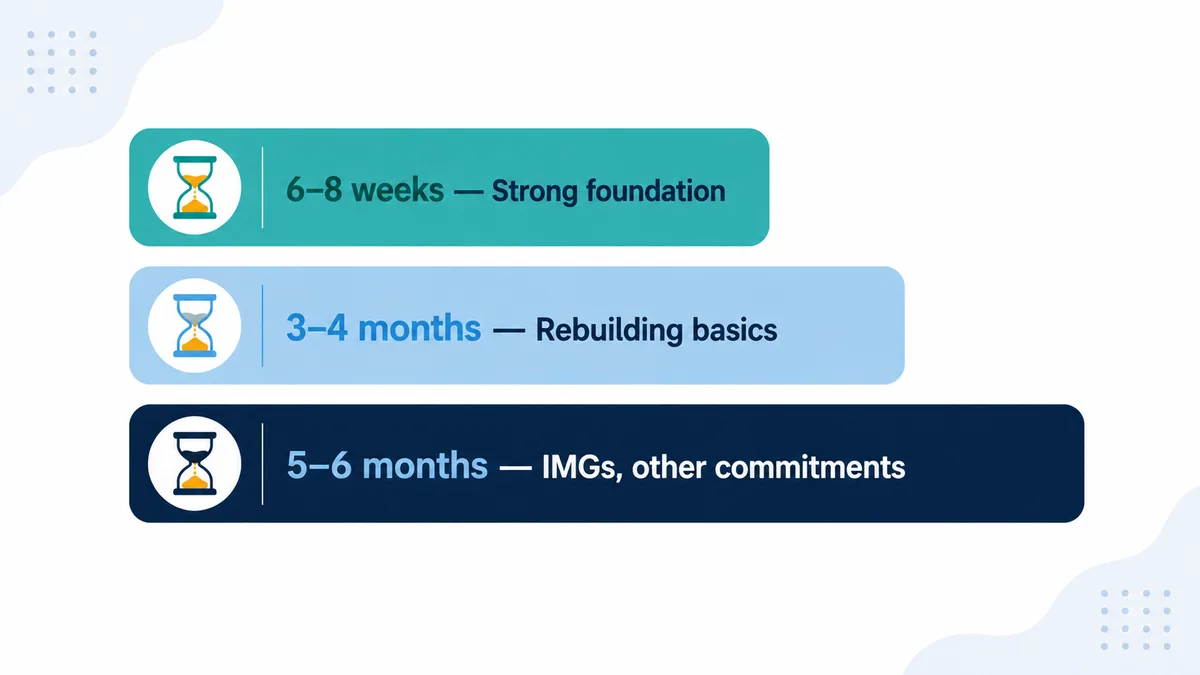
| Timeline | Best for |
|---|---|
| ~6–8 week dedicated | US students with a solid pre-clinical foundation |
| 3–4 months total | Students needing to rebuild weak areas; many IMGs |
| 5–6 months total | IMGs studying around other commitments or with a lower baseline |
For most IMGs, yes: four months of consistent, well-structured study is a realistic runway to a confident pass, provided you start from a reasonable baseline and protect daily question practice. If your baseline is very low, lean toward the longer end.
Dedicated vs Total Preparation Time
Be clear about which number you mean. Total preparation includes the months of pre-dedicated study you do alongside coursework; the dedicated period is the focused full-time block right before the exam (commonly 6–8 weeks). When people quote “I studied for six weeks,” they usually mean the dedicated block, on top of a foundation built over far longer. Plan both, and structure them with our Step 1 study-schedule guide. If a six-month runway fits your situation, our 6-month Step 1 blueprint lays it out month by month.
Why IMGs Often Need More Time
IMGs frequently need a longer runway, not because of ability, but circumstance: studying around internship or work, a curriculum that differs from the US basic-science emphasis, and less built-in exposure to USMLE-style questions. That is normal. Build a longer pre-dedicated phase, start your Qbank earlier, and let your NBME trend (not a borrowed timeline) tell you when you are ready. For the bigger picture of where Step 1 sits, see what the USMLE is and how the Steps fit together.
How to Know You Are Ready (Regardless of the Calendar)
Weeks elapsed do not determine readiness. Performance does. You are ready when:
- Your NBME scores have plateaued comfortably above passing across several forms.
- You are finishing timed blocks on pace.
- You can reason through unfamiliar questions, not just recall facts.
- Your UWSA and Free 120 results agree with your NBMEs.
Quality Over Quantity
More months do not guarantee a better outcome. Deep, deliberate study does. A focused four months of active recall, timed practice, and reviewed questions beats six months of passive re-reading. Watch out for the silent habits that waste prep time, and remember that endless preparation has its own cost: burnout and a stale plateau.
Frequently Asked Questions
How long does it typically take to prepare for USMLE Step 1?
Most students use a 6–8 week dedicated block on top of months of pre-dedicated study. IMGs commonly need 3–6 months of total preparation. The right length depends on your baseline, daily hours, and foundation.
Is 4 months enough to prepare for Step 1?
For most IMGs, yes. Four months of consistent, well-structured study (with daily question practice and regular NBMEs) is a realistic runway to a confident pass from a reasonable baseline. A very low baseline may need longer.
What is the difference between dedicated and total preparation time?
Total preparation includes the months of study you do alongside coursework; the dedicated period is the focused full-time block (usually 6–8 weeks) right before the exam. Most “I studied for X weeks” claims refer to the dedicated block only.
Do IMGs need more time to prepare for Step 1?
Often, yes. Usually because of competing commitments and a curriculum that differs from the US basic-science emphasis, not ability. Build a longer pre-dedicated phase and let your NBME trend, not a borrowed timeline, decide when you are ready.
How do I know I am ready to take Step 1?
When your NBME scores plateau comfortably above passing across several forms, you are finishing timed blocks on pace, and your UWSA and Free 120 results agree. Readiness is about performance, not weeks on the calendar.
Conclusion
There is no universal preparation time for Step 1, only the right amount for you. Set a baseline, separate your pre-dedicated and dedicated phases, give yourself more runway if you are an IMG, and let your practice-test trend decide when to sit the exam. Done well, the goal is not the longest prep, but the most deliberate one.
Want a timeline built around your baseline? Explore our USMLE Step 1 & Step 2 CK preparation program and see how our students have matched into U.S. residency.
Next step
Step 1 & Step 2 CK Prep
Structured modules, 1-on-1 mentorship, and a 100-day plan to clear the boards.