Common USMLE Step 1 Mistakes: The 5 Silent Score Killers (2026)

Academic Director & USMLE Educator, Dermatology Resident
The short answer
Most Step 1 failures are not knowledge failures, they are method failures. Among IMGs in 2025, 75% of first time takers passed and only 54% of repeaters did. The five mistakes below account for most of that gap, and every one of them is fixable.
Preparing for Step 1 is not about how much you study, it is about how little of it you waste. These five patterns are the ones that quietly consume months.
1. Treating First Aid as a textbook
First Aid is a review book. It is an index of what you should already understand, written in compressed note form. Reading it cover to cover before you understand the underlying material produces recognition without comprehension.
Why this is so costly
The exam devotes 60 to 70% of its questions to applying foundational science concepts and only 20 to 25% to diagnosis. Memorising First Aid optimises you for the smaller slice.
The fix: pair First Aid with a lecture or video resource that explains mechanisms. Use First Aid to consolidate after you understand, never to learn from scratch.
2. Delaying the question bank
The "I am not ready yet" instinct is the most expensive one in Step 1 preparation. Students save the Qbank until they feel prepared, then discover in the last eight weeks that questions were the thing that would have made them prepared.
| Approach | What happens |
|---|---|
| Questions from the start, system by system | Gaps are found and fixed while there is time |
| Questions saved until the end | Gaps are found when there is no time left |
The fix: start questions on day one, on whatever system you are currently studying. A low early score is information, not a verdict.
3. Saving NBMEs for the end
Self assessments are the only calibrated predictor available. Using them only in the final fortnight means discovering a problem at the exact point you can no longer act on it.
Use them as a steering wheel
An NBME every three to four weeks tells you whether your method is working. One NBME two weeks out tells you only whether to panic.
The fix: schedule self assessments regularly across the whole preparation, under full exam conditions, and treat each one as a plan review rather than a grade.
4. Ignoring spaced repetition
Step 1 preparation runs for months and the volume is large enough that unreviewed material genuinely disappears. Students who study linearly, moving system to system without returning, arrive at the exam having forgotten most of what they covered first.
The fix: a review system, whether Anki or a structured written system, that brings old material back on a schedule. Twenty minutes daily of review beats a re-read of an entire subject.
5. The ten hour grind
Long unbroken study days feel productive and are not. Retention falls sharply after several hours, and sustained overwork through a multi month preparation reliably produces burnout in the final weeks, which is the worst possible timing.
The measure that matters
Count questions completed and reviewed, not hours seated. Four distracted hours are worth less than one focused block, and the honest metric exposes that immediately.
The fix: a sustainable daily schedule with real rest, protected sleep, and one lighter day a week.
The format changed in May 2026
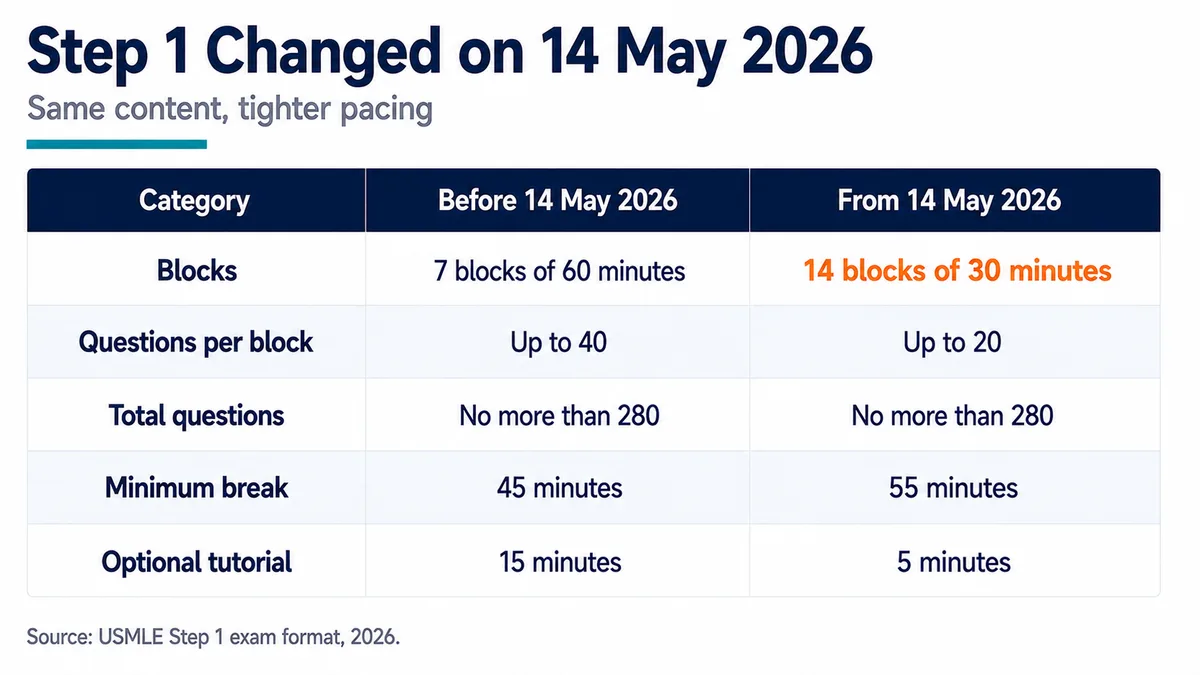
One mistake now has a new form. From 14 May 2026, Step 1 runs as 14 blocks of 30 minutes with up to 20 questions each, replacing 7 blocks of 60 minutes. Anyone practising exclusively in 60 minute blocks is training at the wrong rhythm.
| Before 14 May 2026 | From 14 May 2026 | |
|---|---|---|
| Blocks | 7 of 60 minutes | 14 of 30 minutes |
| Questions per block | Up to 40 | Up to 20 |
| Minimum break time | 45 minutes | 55 minutes |
The five in one table
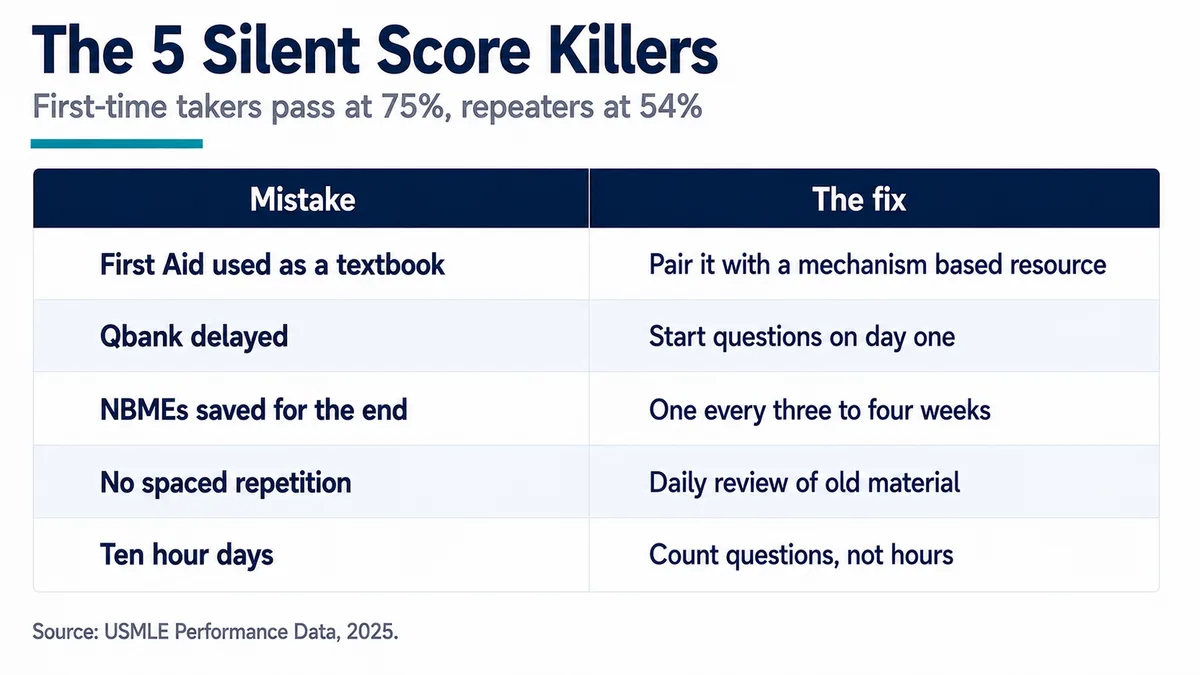
| Mistake | The fix |
|---|---|
| First Aid as a textbook | Pair it with a mechanism based resource |
| Qbank delayed | Start questions on day one |
| NBMEs saved for the end | One every three to four weeks |
| No spaced repetition | Daily review of old material |
| Ten hour days | Sustainable schedule, count questions not hours |
The single highest value decision
Do not book the exam until two consecutive self assessments, taken under real conditions, clear the pass line with margin. The 75% versus 54% gap between first takers and repeaters is the most consequential statistic in Step 1 preparation.
How to tell which mistake is yours
All five feel like normal studying from the inside, which is why they persist for months. These are the observable symptoms.
| Symptom | Underlying mistake |
|---|---|
| You recognise answers but cannot explain why they are right | First Aid used as a textbook |
| Your question bank is barely started and the exam is months away | Qbank delayed |
| You have never sat a full self assessment under real conditions | NBMEs saved for the end |
| Material from two months ago feels completely new | No spaced repetition |
| Long study days with falling accuracy | The ten hour grind |
The uncomfortable test
Pick a topic you studied six weeks ago and, without notes, explain it aloud for two minutes. Most people cannot, and discover that months of reading produced far less durable knowledge than the hours suggested.
Reviewing questions properly
Nearly every mistake on this page converges on one habit: doing questions without reviewing them properly. Answering is the cheap part.
- Read every explanation, including for questions you got right. A correct guess and correct knowledge look identical in your score and are completely different in reality.
- Learn from the distractors. Each wrong option is usually the right answer to a nearby question, so a well reviewed item teaches several facts.
- Flag lucky guesses honestly. Unaudited guesses are the most reliable source of exam day surprises.
- Write one sentence per miss. Not a copied explanation, your own sentence about what you actually got wrong.
- Sort misses by cause. Knowledge, misreading, timing or technique. The distribution tells you what to fix.
The right ratio
Reviewing a block properly takes longer than answering it. If your review consistently takes less time than the block itself, you are collecting questions rather than learning from them.
What good progress actually looks like
| Phase | Reasonable expectation |
|---|---|
| First weeks of questions | Low accuracy. This is normal and not predictive |
| After the first full pass of a system | Noticeable improvement on that system specifically |
| Mid preparation | Self assessment scores moving upward between attempts |
| Final month | Two consecutive self assessments clearing the pass line with margin |
| Final fortnight | Consolidation and timing practice only, no new material |
A plateau is information
Scores that stop improving over several weeks almost never mean you need more hours. They usually mean the method has stopped working, most often because review has quietly become passive. More of an ineffective method produces more of the same result.
The mistake underneath all five
Every item here shares one root: confusing familiarity with knowledge. Rereading feels productive because the material becomes recognisable, and recognition feels like understanding right up until the moment a question requires retrieval instead.
The single change worth making
Replace rereading with retrieval everywhere it appears. Close the book and explain the topic. Answer questions before you feel ready. Take self assessments early and often. Every genuine improvement in Step 1 preparation is a version of this one change.
The Next Steps approach
At Next Steps USMLE we do not just hand over materials, we curate a roadmap that separates our students from the average test taker. Here is generic advice set against the Next Steps curated method.
| Area | Generic advice | Next Steps method |
|---|---|---|
| First Aid | Memorise the book in isolation | Supplement with lectures for conceptual understanding |
| Qbank timing | Start once you "know the content" | Day one integration to build active recall |
| Assessment | Use NBMEs as a final predictor | Regular diagnostics to fix weak points early |
| Retention | Passive re-reading and highlighting | Spaced repetition staircase with Anki and crash courses |
| Wellness | Grind until you drop | Regulated study and rest balance for cognitive recovery |
The mantra
The route to a Step 1 pass is not "study more". It is eat, sleep, study well, because a preparation that burns you out in month four never reaches month six.
Sources
- USMLE Performance Data, 2025 first time and repeat pass rates.
- USMLE Step 1 content outline and 2026 exam format.
Figures verified July 2026.
Next step
Step 1 & Step 2 CK Prep
Structured modules, 1-on-1 mentorship, and a 100-day plan to clear the boards.