USMLE Step 1 Syllabus 2026: Full Content Outline and Weightings

Academic Director & USMLE Educator, Dermatology Resident
The short answer
Step 1 is built around foundational sciences applied to clinical scenarios. Pathology (45 to 55%) and physiology (30 to 40%) dominate, and 60 to 70% of the exam tests applying foundational science concepts. From 14 May 2026 the exam runs as 14 blocks of 30 minutes.
Most "syllabus" articles list subjects without weightings, which is useless for planning. These are the official published ranges.
Discipline based weightings
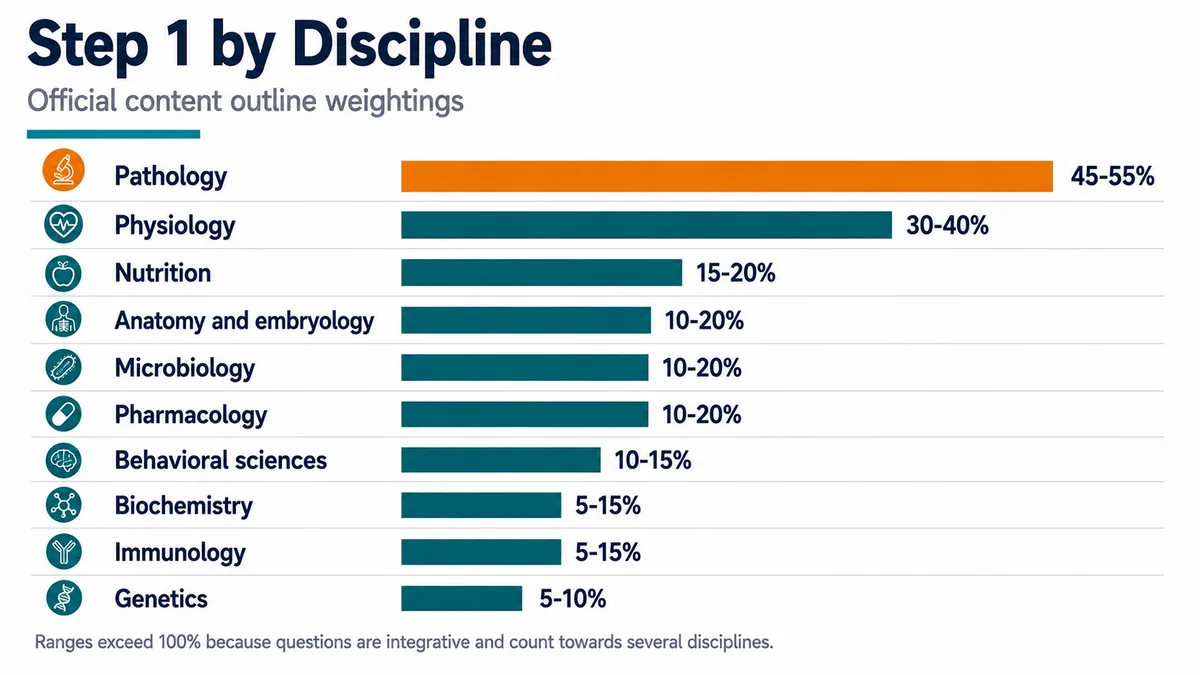
| Discipline | Share of exam |
|---|---|
| Pathology | 45 to 55% |
| Physiology | 30 to 40% |
| Nutrition | 15 to 20% |
| Gross anatomy and embryology | 10 to 20% |
| Microbiology | 10 to 20% |
| Pharmacology | 10 to 20% |
| Behavioral sciences | 10 to 15% |
| Biochemistry | 5 to 15% |
| Histology and cell biology | 5 to 15% |
| Immunology | 5 to 15% |
| Genetics | 5 to 10% |
Why these add up to more than 100%
Questions are deliberately integrative, so one item can count towards several disciplines at once. A vignette can be pathology, pharmacology and physiology simultaneously. Read the ranges as emphasis, never as a checklist to tick off.
System based weightings
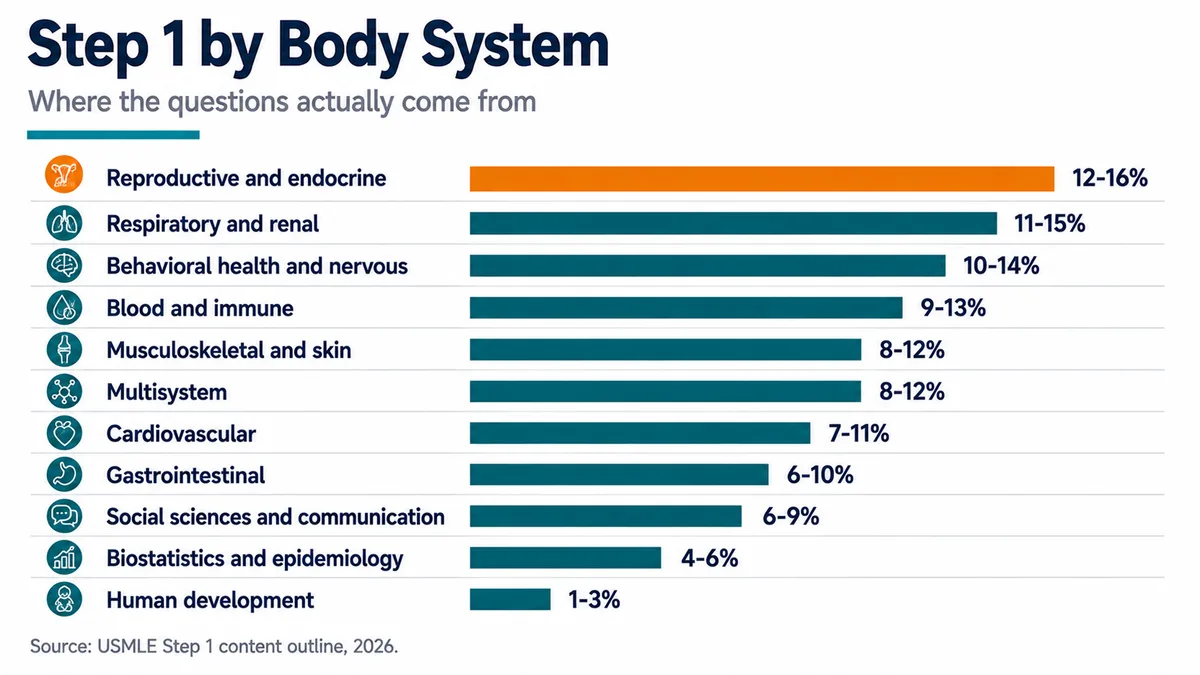
| System | Share of exam |
|---|---|
| Reproductive and endocrine systems | 12 to 16% |
| Respiratory and renal or urinary systems | 11 to 15% |
| Behavioral health and nervous systems, special senses | 10 to 14% |
| Blood, lymphoreticular and immune systems | 9 to 13% |
| Musculoskeletal, skin and subcutaneous tissue | 8 to 12% |
| Multisystem processes and disorders | 8 to 12% |
| Cardiovascular system | 7 to 11% |
| Gastrointestinal system | 6 to 10% |
| Social sciences, communication and interpersonal skills | 6 to 9% |
| Biostatistics and epidemiology, population health | 4 to 6% |
| Human development | 1 to 3% |
What the exam asks you to do
| Competency | Share of exam |
|---|---|
| Applying foundational science concepts | 60 to 70% |
| Patient care: diagnosis | 20 to 25% |
| Communication and interpersonal skills | 6 to 9% |
| Practice based learning and improvement | 4 to 6% |
The most useful line in the whole outline
Only 20 to 25% of Step 1 is diagnosis. 60 to 70% is applying mechanisms. Candidates who study by memorising disease presentations are optimising for a quarter of the exam.
Exam format from May 2026
| Before 14 May 2026 | From 14 May 2026 | |
|---|---|---|
| Blocks | 7 blocks of 60 minutes | 14 blocks of 30 minutes |
| Questions per block | Up to 40 | Up to 20 |
| Total questions | No more than 280 | |
| Testing day | One 8 hour session | |
| Minimum break time | 45 minutes | 55 minutes |
| Optional tutorial | 15 minutes | 5 minutes |
Scoring is unchanged: Step 1 has been reported as pass or fail since 2022.
Turning the outline into a study order
- Anchor everything on pathology and physiology. Together they can account for most of the exam. Learn other subjects in service of these two, not in parallel.
- Study by system, not by subject. The system weightings tell you how the exam is assembled, and integrated questions reward integrated study.
- Front load the heavy systems. Reproductive and endocrine, respiratory and renal, and neuro together can approach 45% of the exam.
- Do not skip biostatistics. At 4 to 6% it is small, but it is high yield per hour because the content is narrow and stable.
- Practise mechanisms out loud. If you cannot explain why a drug causes an effect, you know a fact rather than a mechanism, and the exam tests the mechanism.
A practical check
Take any question you got right and ask whether you could explain the mechanism to someone else. If not, you recognised an answer rather than knowing it, and that gap is exactly what the exam is built to find.
What the weightings mean for your study order
A content outline is only useful if it changes what you do on Monday morning. Here is how the published ranges translate into sequencing.
| Priority | What to cover | Why |
|---|---|---|
| First | Pathology and physiology together, system by system | They can account for most of the exam and they reinforce each other |
| Second | Pharmacology alongside the same systems | Drug questions almost always sit inside a system context |
| Third | Microbiology and immunology | Self contained, high yield, and easy to schedule |
| Fourth | Biochemistry and genetics, defect focused | Small share, and the exam tests defects rather than whole pathways |
| Throughout | Biostatistics, ethics and communication | Narrow, stable content with a high return per hour |
The system first principle
Because a single question can test several disciplines at once, studying cardiology across pathology, physiology and pharmacology in the same week produces the integrated understanding the exam actually measures. Studying all of pharmacology in isolation does not.
The heavy systems, in order
Four system groups together account for a large share of the paper. If your time is limited, this is where it belongs.
- Reproductive and endocrine, 12 to 16%. The single largest system group and frequently under-prepared because it spans two traditionally separate topics.
- Respiratory and renal or urinary, 11 to 15%. Heavily physiological, and the acid base material rewards genuine understanding over memorisation.
- Behavioral health and nervous systems, 10 to 14%. Neuroanatomy plus psychiatry, and students often prepare one and neglect the other.
- Blood, lymphoreticular and immune, 9 to 13%. Dense but highly learnable, with strong overlap into microbiology.
The parts people systematically neglect
- Biostatistics and epidemiology, 4 to 6%. A small share, but the content is narrow, stable and repeatedly examined, which makes it one of the best returns per hour on the whole exam.
- Social sciences, communication and interpersonal skills, 6 to 9%. Larger than biostatistics and almost universally under-prepared. These questions are answerable through principle rather than recall.
- Human development, 1 to 3%. Genuinely small. It is reasonable to deprioritise this, and worth knowing that it is reasonable.
- Practice based learning, 4 to 6% of competencies. Study design and evidence interpretation, which overlaps heavily with biostatistics.
A common misallocation
Students routinely spend weeks on gross anatomy detail while skipping ethics and communication entirely. Anatomy is 10 to 20% and mostly clinically applied; social sciences and communication together with biostatistics can reach a comparable share and take a fraction of the time to learn.
Using the outline to audit your preparation
Once every few weeks, take the system table and mark each row honestly:
- Covered and tested. You have studied it and answered questions on it at a reasonable rate.
- Covered but untested. You have read it but never proven you can apply it. This is the most dangerous category, because it feels like progress.
- Not covered. Honest gaps, which are easier to fix than false confidence.
The audit that predicts trouble
If most of your heavy systems sit in category two, you are on track for a disappointing self assessment. Reading is not the same as retrieval, and only one of them is what the exam measures.
Sources
- USMLE Step 1 content outline and specifications.
- USMLE Step 1 exam format and testing day structure.
Weightings verified July 2026. The USMLE revises the content outline periodically.
Next step
Step 1 & Step 2 CK Prep
Structured modules, 1-on-1 mentorship, and a 100-day plan to clear the boards.