USMLE Step 2 CK Syllabus 2026: Subjects and Official Weightings

Academic Director & USMLE Educator, Dermatology Resident

Search “USMLE Step 2 CK syllabus” and you will find a hundred pages listing the same vague subject names. That is not what the USMLE publishes, and it is not what your exam is built from. There is no official Step 2 CK syllabus in the sense an Indian medical college means it — no prescribed chapter list, no fixed reading.
What the USMLE does publish is far more useful: a content outline plus three specification tables that state, in percentage ranges, exactly how the exam is assembled. This guide walks through all three, in the USMLE’s own numbers, and then translates them into what you should actually do with your study hours.
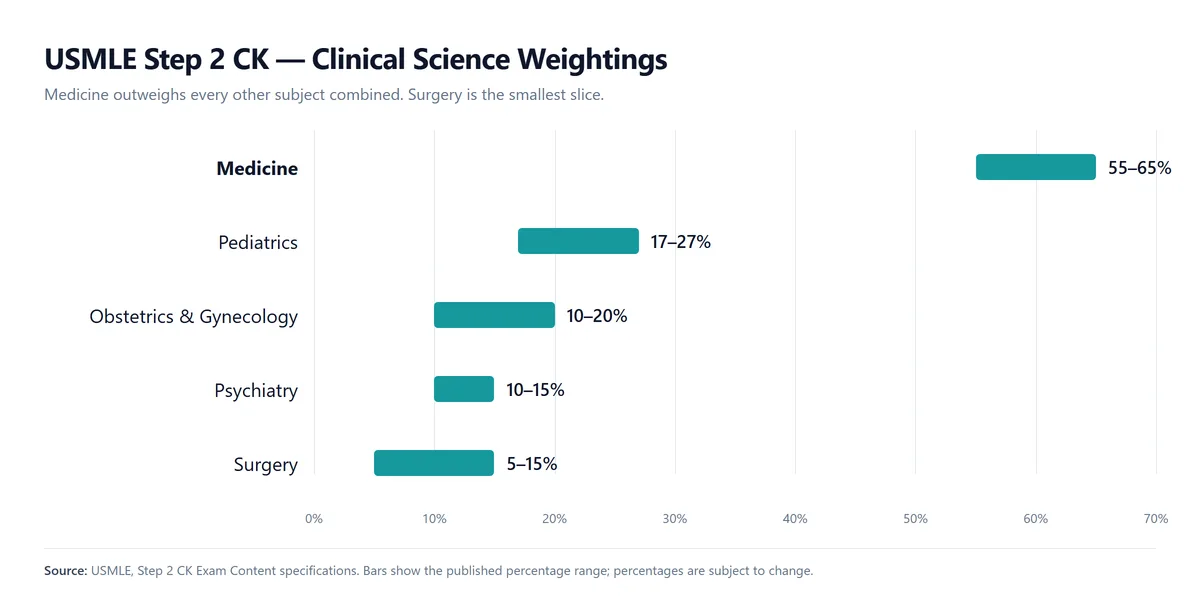
Step 2 CK is specified three ways at once, and every question is coded on all three axes:
- Clinical science — Medicine dominates at 55–65%
- System / discipline — 15 categories, none above 20%
- Physician task — diagnosis and management, not recall
The ranges overlap and sum well past 100% because a single question is counted on more than one axis.
Format from 7 May 2026: 16 blocks × 30 minutes · up to 318 questions · ~9-hour day.
There Is No Official “Step 2 CK Syllabus” — Here Is What Exists Instead
The USMLE program publishes two things you can actually plan against:
- The USMLE Content Outline — a long, shared outline covering all three Steps, organised by general principles and individual organ systems. It is a classification scheme for writing questions, not a revision checklist. Very few students need to read it end to end.
- The Step 2 CK exam specifications — three compact tables giving the percentage range each category can occupy on any given test form. This is the part worth memorising, and it is what the rest of this article covers.
These are ranges, not fixed quotas, and the USMLE states plainly that percentages are subject to change at any time. Two people sitting different forms on the same day can get meaningfully different mixes. Plan for the middle of each range, never the edge.
Step 2 CK Subjects: The Clinical Science Weightings
If you only look at one table, look at this one. It answers the question most students are really asking when they search for the “syllabus” — which subjects are on Step 2 CK, and how much does each one matter?
| Clinical science | Range |
|---|---|
| Medicine | 55–65% |
| Pediatrics | 17–27% |
| Obstetrics & Gynecology | 10–20% |
| Psychiatry | 10–15% |
| Surgery | 5–15% |
Two things jump out. First, Medicine is the exam. At 55–65% it outweighs every other subject combined, and internal medicine reasoning is the backbone of most vignettes even when the stem is nominally surgical or obstetric.
Second, Surgery is only 5–15% — consistently the lowest weighting, and consistently the subject IMGs over-prepare because it felt hardest in medical school. If you are allocating dedicated weeks by how anxious a subject makes you rather than by how many questions it buys you, this table should change your plan.
Step 2 CK Content Specifications: Systems and Disciplines
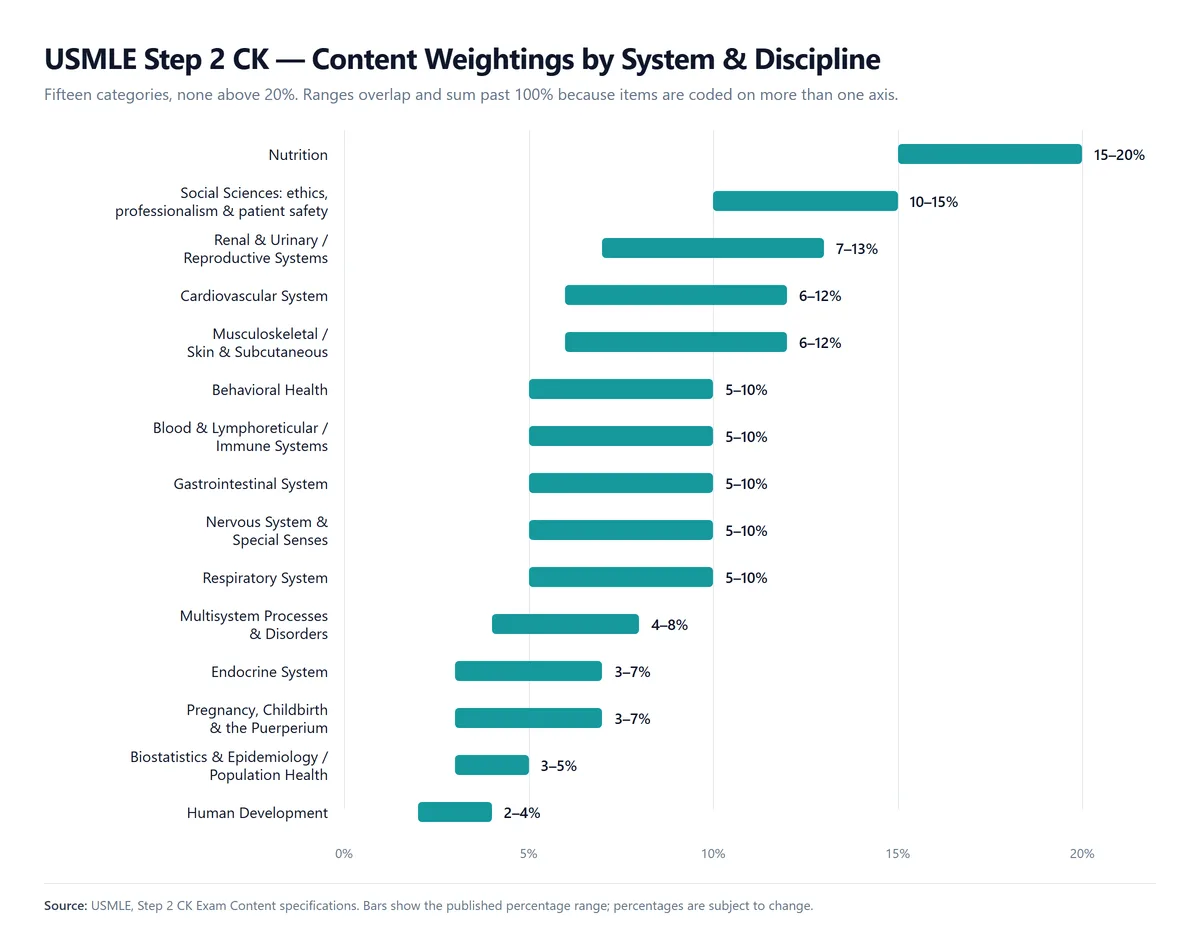
The second axis cuts the same exam by organ system and cross-cutting discipline. Fifteen categories, and note how flat the distribution is — nothing here is a shortcut.
| System / discipline | Range |
|---|---|
| Nutrition | 15–20% |
| Social Sciences: Legal/Ethical Issues & Professionalism / Systems-based Practice & Patient Safety | 10–15% |
| Renal & Urinary System & Reproductive Systems | 7–13% |
| Cardiovascular System | 6–12% |
| Musculoskeletal System / Skin & Subcutaneous Tissue | 6–12% |
| Behavioral Health | 5–10% |
| Blood & Lymphoreticular / Immune Systems | 5–10% |
| Gastrointestinal System | 5–10% |
| Nervous System & Special Senses | 5–10% |
| Respiratory System | 5–10% |
| Multisystem Processes & Disorders | 4–8% |
| Endocrine System | 3–7% |
| Pregnancy, Childbirth & the Puerperium | 3–7% |
| Biostatistics & Epidemiology / Population Health / Interpretation of Medical Literature | 3–5% |
| Human Development | 2–4% |
Human Development covers normal age-related findings and care of the well patient. Nutrition sits at the top of the table because items coded to Nutrition are also coded to an organ-system category — which is why these percentages add up to well over 100. Do not read the table as a pie chart.
Social Sciences — ethics, professionalism, patient safety, systems-based practice — is the second-largest category on the exam, larger than cardiology and larger than GI. It is also the category almost nobody schedules dedicated revision for. Those questions are free marks if you have read the material once and lost marks if you have not.
Physician Tasks and Competencies: The Half Most Students Ignore
The third axis is what the question asks you to do. This is where Step 2 CK diverges hardest from Step 1, and where most under-performance actually comes from.
| Competency | Range |
|---|---|
| Patient Care: Diagnosis | 16–20% |
| Patient Care: Laboratory / Diagnostic Studies | 13–17% |
| Patient Care: Mixed Management | 12–16% |
| Patient Care: Pharmacotherapy | 8–12% |
| Patient Care: Clinical Interventions | 6–10% |
| Patient Care: Health Maintenance / Disease Prevention | 5–10% |
| Patient Care: Prognosis / Outcome | 5–9% |
| Systems-based Practice & Patient Safety | 5–7% |
| Professionalism | 5–7% |
| Practice-based Learning & Improvement | 3–5% |
| Medical Knowledge: Applying Foundational Science Concepts | 0% |
| Patient Care: History and Physical Exam | 0% |
Read those last two rows again. Pure foundational-science recall is weighted at zero, and so is history-and-physical technique — those competencies are assessed on Step 1 and Step 3 instead. Foundational science still appears, but only underneath a patient-care question, never as the thing being asked.
Add up the patient-care rows and roughly two-thirds of the exam is diagnosis, investigation and management. That is a test of clinical decision-making under time pressure. It is the reason students who can recite a textbook still land at 230: they are studying for the wrong verb.
What These Weightings Actually Mean for Your Study Plan
- Weight your Qbank time towards Medicine. At 55–65%, internal medicine deserves more than half your question volume. Most students split subjects evenly and quietly under-train the biggest category on the exam.
- Stop over-investing in Surgery. 5–15% does not justify a dedicated fortnight. Cover it properly, then move on.
- Schedule ethics and patient safety explicitly. 10–15% on one axis plus another 10–14% of competency weighting, and it is learnable in a few focused sessions.
- Practise the next step, not the diagnosis. Given the management weighting, train yourself to answer “what do I do now?” rather than stopping once you have named the disease.
- Do not chase the low rows. Human Development at 2–4% is perhaps six or seven questions. Knowing the weighting tells you when to stop.
How Many Questions Are on Step 2 CK?
Since 7 May 2026 the exam runs as sixteen 30-minute blocks of no more than 20 questions each, up to 318 questions in total, across a day of roughly nine hours with a minimum of 55 minutes of break time. The old eight 60-minute blocks are gone.
The content specifications above did not change with the format — the same weightings apply — but your pacing did, at about 90 seconds per question with half as much room to recover inside a block. We break the mechanics down in the 2026 Step 2 CK format guide.
From Syllabus to Schedule
Knowing the weightings is the easy half. Converting them into daily question targets, a sensible NBME order and a realistic taper is the part that actually moves a score, and it is the part a table cannot do for you.
If you are starting from scratch, work through our 12-week Step 2 CK study plan, which maps these weightings onto a week-by-week schedule. If you already have a number in mind, what a top Step 2 CK score really takes covers where the effort curve flattens and what the matched-applicant averages actually are.
All weightings above are taken directly from the USMLE’s published Step 2 CK Exam Content specifications (content, physician tasks/competencies and clinical science tables). Percentages are subject to change at any time — check the source before test day. Format details: USMLE Step 2 CK.
Next step
Step 1 & Step 2 CK Prep
Structured modules, 1-on-1 mentorship, and a 100-day plan to clear the boards.