USMLE Step 2 CK Study Plan: A Realistic 12-Week Schedule

Academic Director & USMLE Educator, Dermatology Resident
With the transition of USMLE Step 1 to a pass/fail system, your Step 2 Clinical Knowledge (CK) score has become the single most critical numerical metric in your residency application. In 2026, Program Directors (PDs) are managing record-breaking application volumes, and for many competitive specialties a high CK score is the first gatekeeper. Achieving a top-tier score isn’t just about how much you know. It’s about a structured strategy that lets you peak exactly on test day.
If you feel overwhelmed by the sheer volume of medical content, you aren’t alone. But success isn’t found in frantic, 16-hour study days that lead to burnout. Instead, you need a realistic, week-by-week study plan that fits into your life. This guide walks through how to prepare for Step 2 CK week by week: what to do in each phase, how many questions to run, when to sit each NBME, and how to recover if you fall behind. The 12-week roadmap below gives you the structure to master the material, build mental endurance, and open doors to your top-choice residency programs.
How to Prepare for Step 2 CK: The Four-Phase Approach
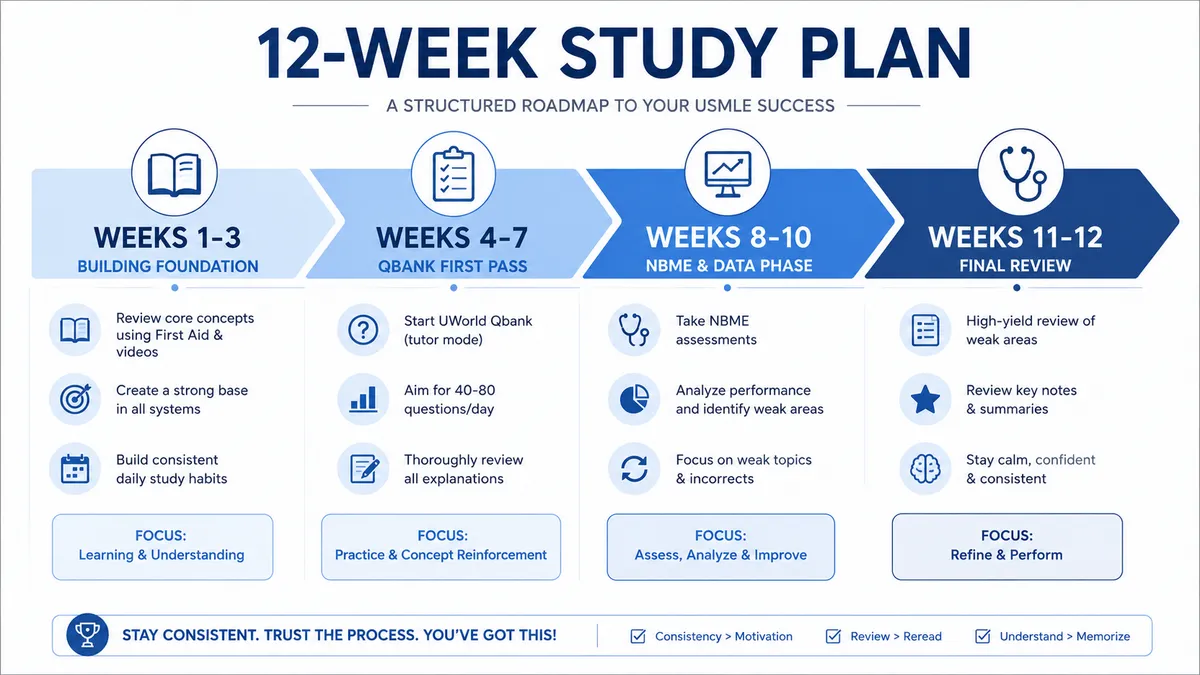
The realistic 12-week plan runs in four phases:
- Weeks 1–3: build the foundation
- Weeks 4–7: Qbank first pass (timed, random)
- Weeks 8–10: NBME & data review
- Weeks 11–12: final polish & taper
Sit the exam once your self-assessment scores consistently clear your target.
2026 passing score: 218 · This plan targets: 250+
Working to 4, 6 or 8 weeks instead? The timeline table below tells you what each one can realistically deliver.
First, Know the Exam and What “250+” Really Means
Before diving into the plan, anchor your target with the facts:
- Format: Step 2 CK is a one-day, roughly 9-hour exam, with up to 318 questions across sixteen 30-minute blocks of about 20 questions each, plus break time. This block structure changed in May 2026. See our guide to the 2026 Step 2 CK format.
- Passing score (2026): 218. That is the floor, but passing isn’t the goal here.
- What a competitive score looks like: NRMP data puts the mean at 250.4 for US MD seniors who matched their preferred specialty, so 250 is the matched-applicant average rather than a stretch goal. On the USMLE norm table, 240 sits at the 24th percentile of all test-takers, 250 at the 47th, 260 at the 74th, and 270 at the 94th. See what it takes to score 280+ on Step 2 CK. Clearing 250+ puts you level with matched applicants and keeps competitive specialties open; 260+ is strongly competitive and 270+ is genuinely elite.
- Why it matters now: with Step 1 pass/fail, PDs lean on Step 2 CK as the primary numerical screen. For more, see what program directors expect in the Step 2 match interview.
Don’t Have 12 Weeks? Pick Your Timeline First
Twelve weeks is the plan most people should run, but it is not the only viable one. What actually determines your timeline is how many focused hours you can protect per day, not how many weeks sit on the calendar. A student with four clear weeks and twelve free hours a day has more total study time than someone with twelve weeks and three hours squeezed around a surgery rotation.
Find your row before you read another word of the plan:
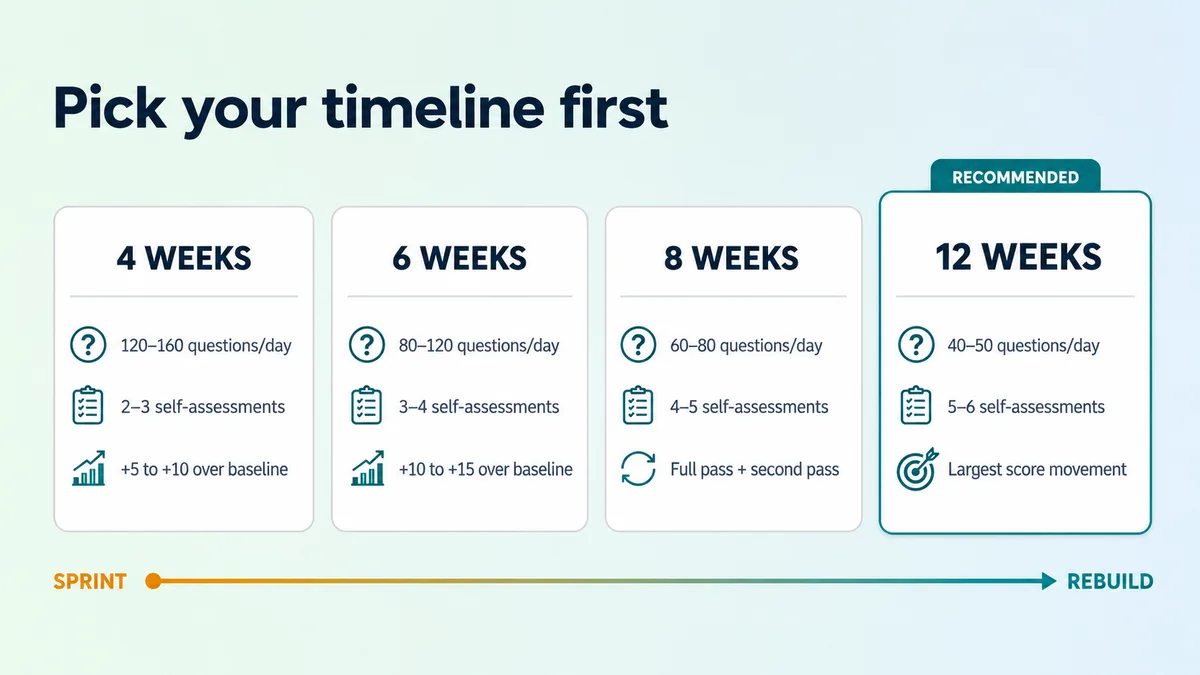
| Timeline | Who it actually suits | Questions/day | Self-assessments | Realistic outcome |
|---|---|---|---|---|
| 4 weeks | Strong Shelf performer, just finished core rotations, fully dedicated 10–12 h/day | 120–160 | 2–3 | Consolidation, not transformation. Expect to land near your baseline, +5 to +10. |
| 6 weeks | Dedicated block, decent clinical base, no major weak systems | 80–120 | 3–4 | +10 to +15 over baseline is realistic with disciplined review. |
| 8 weeks | Dedicated or near-dedicated, one or two soft subjects to rebuild | 60–80 | 4–5 | Enough runway for a full Qbank pass plus a targeted second pass of incorrects. |
| 12 weeks (this plan) | Still on rotations, or an IMG studying around clinical duties — 4–6 h/day | 40–50 | 5–6 | The largest score movement, because spaced repetition has time to actually work. |
Shorter timelines do not fail because of the calendar. They fail because there is no room left for a second pass. The first pass teaches you the content; the second pass of your incorrects is where the score moves. If your timeline cannot fit both, you are not running a compressed plan — you are running a single pass and hoping.
If a four-week window is genuinely all you have, do not attempt to cover everything. Run the Qbank on your three weakest systems only, take a self-assessment at the halfway mark, and accept that this is a consolidation sprint rather than a rebuild.
Is a 12-Week Study Plan Right for You?
Twelve weeks is the sweet spot for students still on clinical rotations who can’t commit to a long dedicated block. If you have a full dedicated period you may compress to 6–8 weeks; if you are balancing heavy clinical duties you may want a longer runway. This plan is rotation-friendly: it assumes you are studying around your responsibilities, not instead of them. Curious how Step 2 CK differs in strategy from Step 1? See our breakdown of the key differences between Step 1 and Step 2 CK.
Pre-Dedicated vs Dedicated: How to Split the 12 Weeks
Almost every competing plan assumes you are sitting at a desk with nothing else to do. Most people reading this are not. The single most useful thing you can do before Week 1 is decide which weeks are pre-dedicated and which are dedicated, because the two phases have completely different rules.
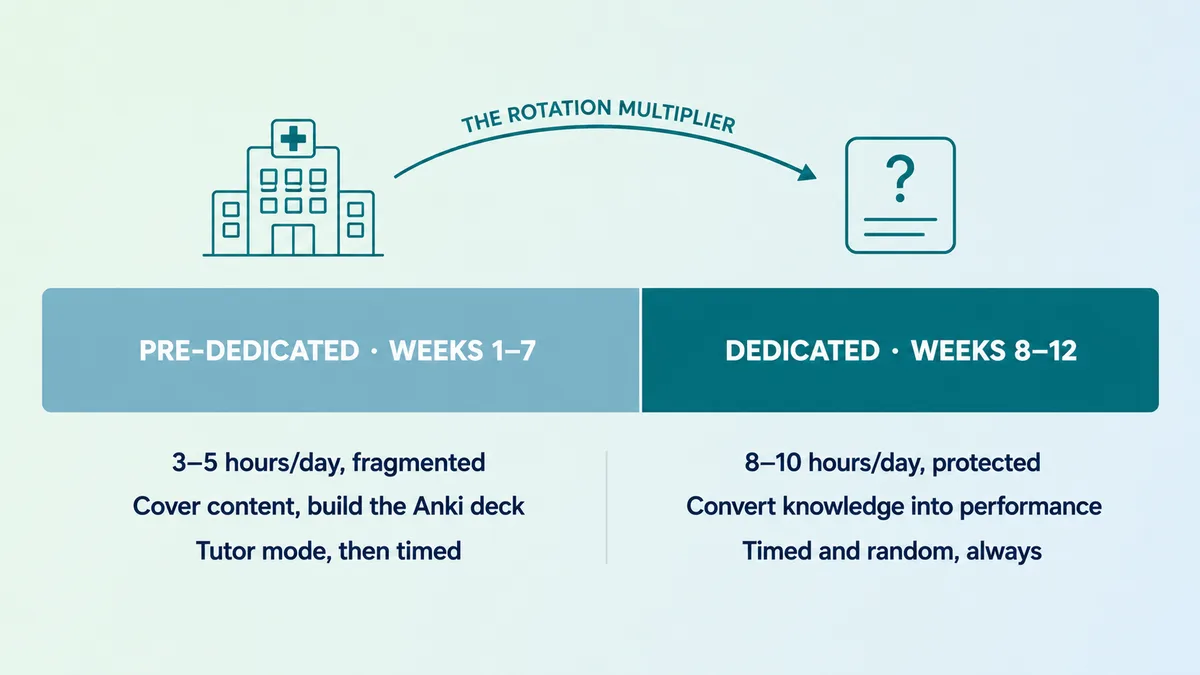
| Pre-dedicated (on rotations) | Dedicated (final block) | |
|---|---|---|
| Typical weeks | Weeks 1–7 | Weeks 8–12 |
| Daily hours | 3–5, fragmented | 8–10, protected |
| Primary job | Cover content, build the Anki deck | Convert knowledge into test-day performance |
| Qbank mode | Tutor mode early, then timed | Timed and random, always |
| What to exploit | Your current rotation — do the matching Qbank system while you are living it | Back-to-back blocks for stamina |
| What to avoid | Full-length assessments (they waste a scarce resource on an unprepared brain) | New resources — nothing new after Week 10 |
If you are on your Paediatrics rotation, do the Paediatrics Qbank blocks that month. Seeing a condition on the ward and then meeting it in a question the same week produces retention that no amount of isolated revision matches. This is the one genuine advantage students on rotations have over students in a pure dedicated block — and almost nobody uses it deliberately.
For a deeper method on extracting value from each block you complete, read our walkthrough on how to review a Qbank block properly — the review, not the questions, is where the learning happens.
Your Resource Arsenal
Have these ready before Week 1 so you are not assembling tools mid-prep:
- Primary Qbank: the USMLEed Qbank is your core engine for the daily question blocks. Many students pair it with UWorld, the widely recognized standard, to maximize exposure to question styles.
- Self-assessment forms: USMLEed Forms alongside the official NBME Self-Assessments and UWSA 1 & 2 are your most accurate score predictors.
- Spaced repetition: Anki to lock high-yield facts into long-term memory.
- Reference & depth: video lectures and a quick-reference resource such as AMBOSS for weak topics.
- Official practice: the USMLE Free 120 for the real interface and the latest question styles.
Phase 1: How to Study in Weeks 1–3 — Building the Foundation
The first three weeks are about stabilizing your routine and organizing your arsenal. Many students struggle because they jump into high-intensity question blocks before their resources are ready.
- Organize your resources so every tool above is ready to go on Day 1.
- Establish a daily schedule: decide now when your study blocks will be. Consistency is the foundation of long-term retention.
- Ease into the content with light Qbank usage in tutor mode. This lets you learn the “logic” of Step 2 questions and the reasoning behind correct answers without the pressure of a ticking clock.
Phase 2: The Qbank First Pass (Weeks 4–7)
This is the engine room of your preparation. Over these four weeks you will ramp your intensity to 40–50 questions per day (USMLEed plus UWorld).
Why “Timed + Random” Mode Is Non-Negotiable
In this phase you must transition from tutor mode to random and timed mode:
- Simulating exam-day stress: the real exam never tells you which system a question belongs to. Random mode forces your brain to switch instantly between Pediatrics, Surgery, and Internal Medicine.
- Developing your internal clock: a lack of timed practice is a common critical mistake. Practicing under time constraints now builds the pacing to finish a 30-minute, 20-question block without rushing the last few.
Study Smart, Not Just Hard
Two techniques separate top scorers from the rest:
- Active recall: don’t passively re-read explanations. After each block, close the screen and explain why the right answer is right and each distractor is wrong. Retrieval beats recognition.
- Spaced repetition: feed every missed concept into Anki so it resurfaces at increasing intervals. This is how facts move to long-term memory before test day.
Read every explanation deeply, annotate your weak topics as you go, and maintain a daily Anki habit.
What a Realistic Study Day Actually Looks Like
Theory is easy; execution is hard. Below are three real day structures — pick the one that matches the phase you are in. Every one of them assumes you finish the day having reviewed everything you attempted, because an unreviewed block is a wasted block.
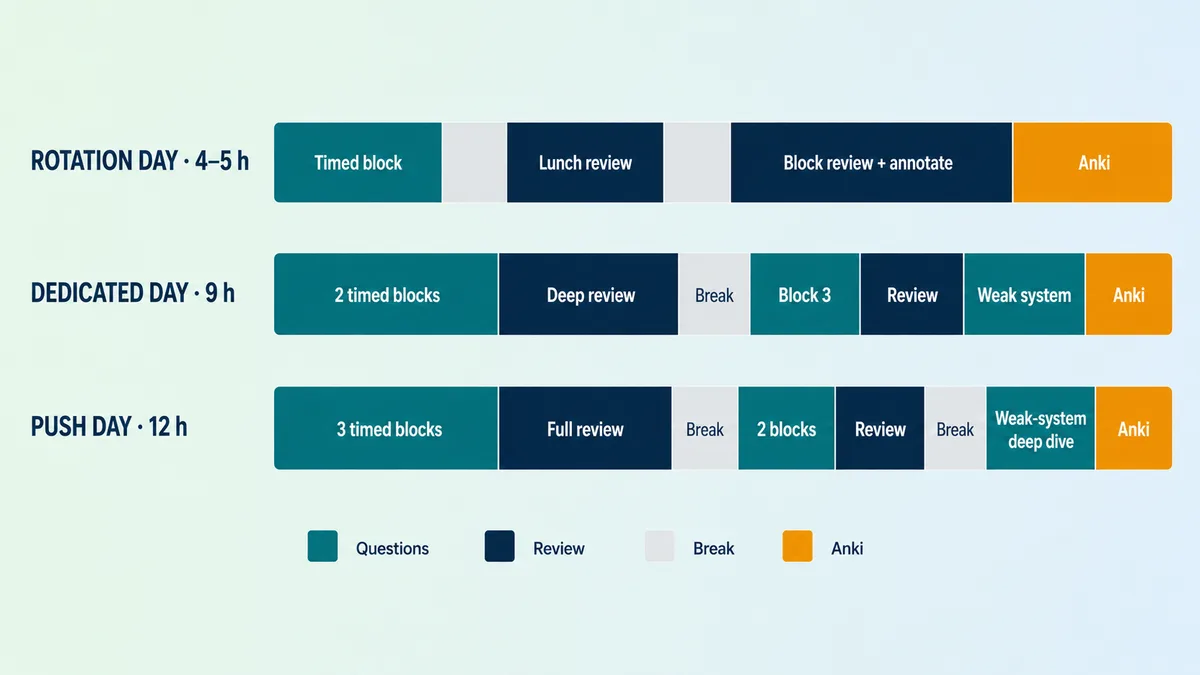
Option 1: The Rotation Day (4–5 focused hours)
For Weeks 1–7 while you are still on the wards. The goal is non-negotiable minimums, not heroics.
| Time | Task | Why |
|---|---|---|
| 06:30–07:15 | One timed block (20 Qs) | Done before the day can steal it |
| Lunch (~30 min) | Review 8–10 explanations | Splits the review load so evenings stay survivable |
| 19:00–20:30 | Finish block review + annotate weak topics | The actual learning window |
| 20:30–21:00 | Anki, every single day | Non-negotiable — skipping compounds fast |
Option 2: The 9-Hour Dedicated Day
The sustainable default for Weeks 8–12. Most students who try to run twelve-hour days end up averaging seven, because the fourth day collapses.
| Time | Task |
|---|---|
| 08:00–09:30 | Two timed, random blocks back to back (40 Qs) |
| 09:30–11:30 | Deep review of both blocks — explain every distractor aloud |
| 11:30–12:30 | Break. Leave the desk, eat properly. |
| 12:30–14:00 | Third timed block + review |
| 14:00–16:00 | Weak-system focused set or video lectures on the day’s worst topic |
| 16:00–17:00 | Anki backlog + add today’s new cards |
| 17:00–18:00 | Light re-read of annotated notes, then stop |
Option 3: The 12-Hour Push Day
Use this sparingly — two or three times a week at most, and never in the final ten days. It exists for catching up, not as a default.
| Time | Task |
|---|---|
| 07:00–09:00 | Three timed, random blocks (60 Qs) |
| 09:00–12:00 | Full review of all three blocks |
| 12:00–13:00 | Break — genuinely away from screens |
| 13:00–15:00 | Two further blocks (40 Qs) |
| 15:00–17:00 | Review + annotate |
| 17:00–18:00 | Break / meal |
| 18:00–20:00 | Weak-system deep dive |
| 20:00–21:00 | Anki, then hard stop |
Question volume is the easiest metric to inflate and the least predictive of your score. A student doing 40 questions with ruthless review beats a student doing 120 with skimmed explanations, every time. If your review time is not at least equal to your question time, your day is badly balanced.
Phase 3: The NBME & Strategic Data Phase (Weeks 8–10)
As you enter the final month, your focus shifts from general learning to targeted assessment and strategy. These assessments are your most accurate predictors of performance, and skipping them leaves you blind to your actual readiness.
Which Forms, in Which Order
The official Step 2 CK self-assessment is NBME’s Comprehensive Clinical Science Self-Assessment (CCSSA): 200 questions across four 50-question blocks, priced from $62 per form, with a lookup table that converts your equated percent correct into a USMLE-scale score. Alongside it sit UWSA 1 and 2 and the official Free 120.
Sequencing matters more than most students realise, because forms are a finite resource and you cannot un-see one:
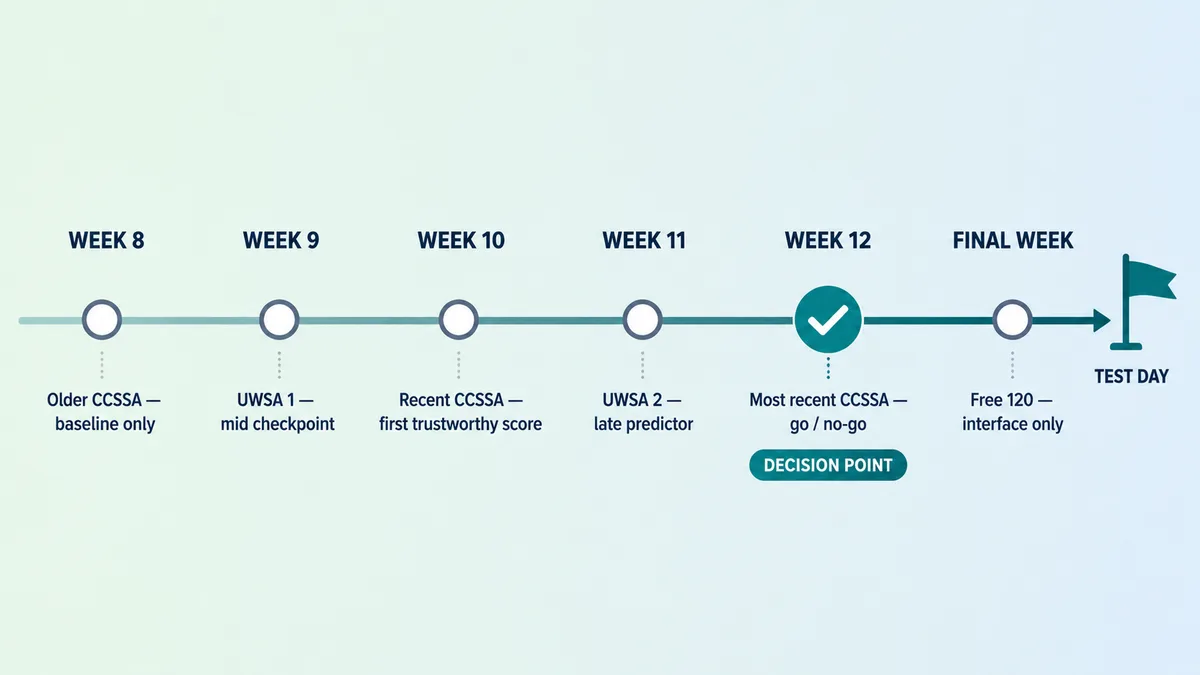
| When | What to take | What it is for |
|---|---|---|
| Start of Week 8 | An older CCSSA form | Baseline only. Burn an older form here — you want the number, not the prediction. |
| Week 9 | UWSA 1 | Mid-preparation checkpoint; historically reads slightly high. |
| Week 10 | A recent CCSSA form | The first score you should genuinely trust. |
| Week 11 | UWSA 2 | Late predictor and stamina rehearsal. |
| Week 12 (7–10 days out) | The most recent CCSSA form | Your go / no-go decision point. |
| Final week | Free 120 | Real interface and current question styles — not a score predictor. |
How to Read the Number You Get Back
A single assessment is noise. Three assessments are a trend, and the trend is the only thing worth acting on. Read your results like this:
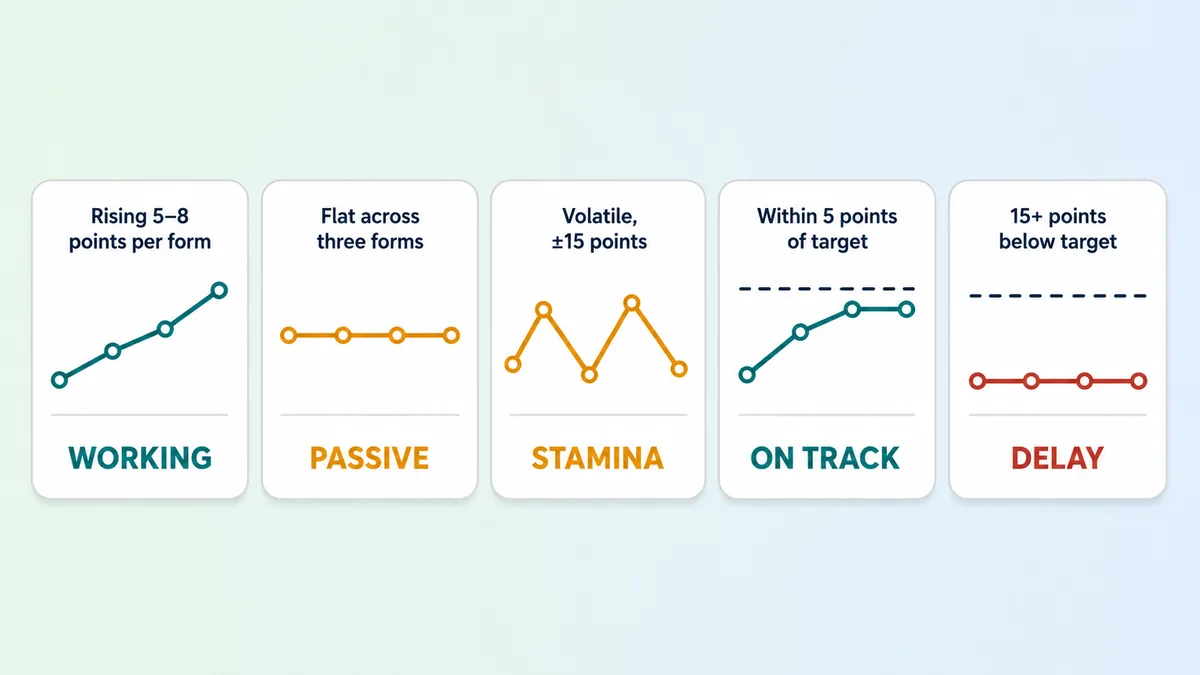
| What you see | What it means | What to do |
|---|---|---|
| Rising by 5–8 points per form | The plan is working exactly as intended | Change nothing. Keep going. |
| Flat across three forms | You are reviewing passively — recognising answers, not retrieving them | Switch to explaining every distractor aloud before reading the explanation |
| Volatile, ±15 points | Usually stamina or timing, not knowledge | Start doing back-to-back blocks; check where in the exam your accuracy drops |
| Within 5 points of target, 2 weeks out | You are on track — the final fortnight typically adds a few more points | Hold the date |
| 15+ points below target, 2 weeks out | The gap will not close in ten days | Push the date if your eligibility window allows it. A delayed strong score beats an on-time weak one. |
Decide your go / no-go on your most recent two assessments, taken under full timed conditions, not on how prepared you feel. Feelings peak and trough weekly; the trend line does not lie.
How to Target Weak Systems
Phase 3 is where you become a sniper with your review. Instead of reviewing everything, target the weak systems your practice exams expose. If your NBME report shows a dip in Cardiology or OB/GYN, dedicate specific blocks to those subjects: re-watch relevant lectures and do focused question sets until your performance matches your stronger areas. This is also the time to start back-to-back blocks to build the mental endurance the 9-hour exam demands. Want a deeper scoring playbook? Read our guide on what a top-end Step 2 CK score actually takes.
Phase 4: The Final Polish (Weeks 11–12)
The final two weeks are about refinement and mental preservation.
- Second pass of incorrects: revisiting the questions you missed is the fastest way to shore up lingering gaps in logic.
- The “Free 120”: take the official USMLE Free 120 to get comfortable with the latest question styles and interface.
- The taper: like an athlete before a big event, taper and rest before exam day. Cramming in the final 48 hours is a recipe for fatigue and simple errors.
If You’ve Fallen Behind: The Recovery Protocol
Almost everyone falls behind at some point — a rotation runs long, you get ill, a week disappears. The students who still score well are not the ones who never slipped; they are the ones who triaged instead of panicking. Panic looks like trying to catch up on everything at once, which reliably costs you the following week too.
Work through this in order:
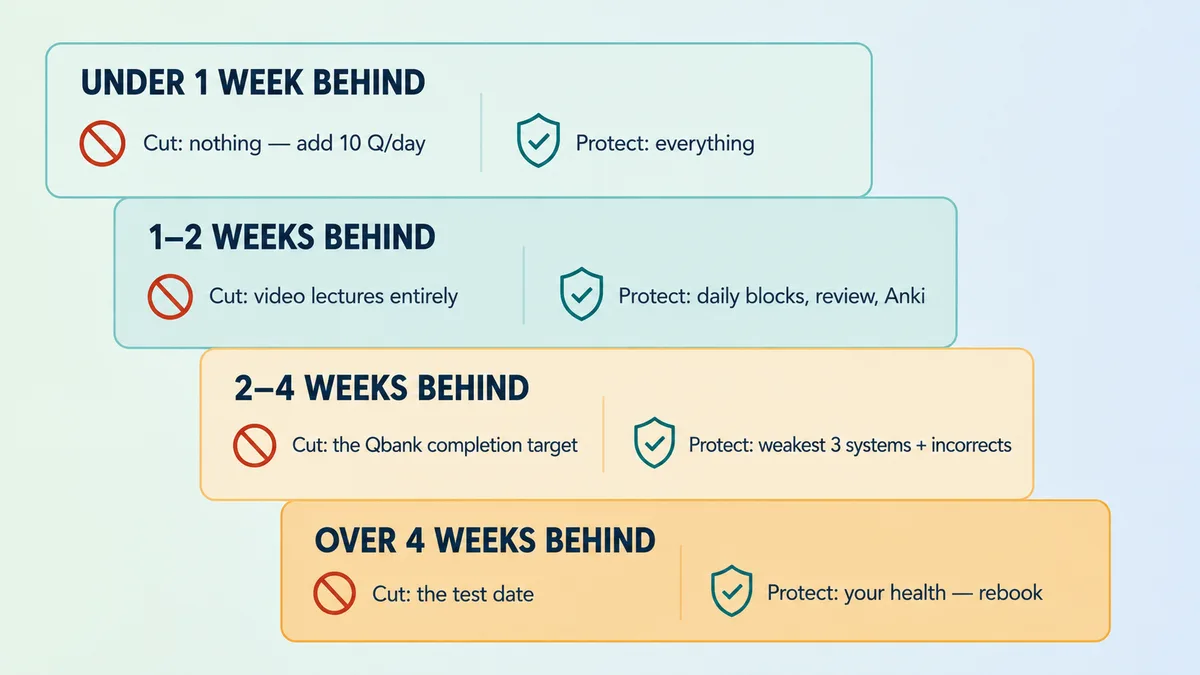
| How far behind | What to cut | What to protect |
|---|---|---|
| Under 1 week | Nothing. Add 10 questions/day for a fortnight. | Everything — this is normal variance. |
| 1–2 weeks | Video lectures entirely. Drop to Qbank + Anki only. | Daily blocks, full review, Anki streak. |
| 2–4 weeks | The Qbank completion target. You will not finish it — accept that now. | Your weakest three systems and every incorrect you have logged. |
| Over 4 weeks | The test date. | Your health. Rebook and rebuild rather than sitting a coin-flip exam. |
- Never re-do the backlog chronologically. Skip forward to today’s scheduled work and absorb the missed material through your incorrects instead.
- Percentage complete is a vanity metric. Finishing 70% of the Qbank with rigorous review beats 100% skimmed, and it is not close.
- Protect the Anki streak above all else. A missed Anki week creates a review debt that takes three weeks to clear.
- One recovery day, not one recovery week. Take a single full day off, then restart on the current week’s schedule — not the one you missed.
Booking, Cost, and When Your Score Actually Lands
The logistics decide your timeline as much as the studying does, and they are the part most study plans skip entirely. Work backwards from the date your score needs to be in hand, not from your test date.
| Item | What to budget |
|---|---|
| Step 2 CK registration | $695 base fee |
| International testing surcharge | +$235 if you test outside the US or Canada |
| Self-assessment forms | From $62 each — budget for five or six |
| Eligibility period | A three-month window you select at registration |
| Score release | 3–4 weeks after test day, on a weekly release cycle |
If your score has to reach programmes by a fixed date, count back six weeks from that deadline, not four: three to four weeks of standard turnaround plus a two-week cushion for the delays that cluster around new form launches and peak residency-application season. Our full breakdown of the Step 1 and Step 2 CK score release timeline covers what actually causes the slow ones.
For the complete fee picture across every Step, including the ECFMG and ERAS costs that stack on top, see our guide to what the USMLE really costs in 2026.
Success Story: Why the Score Matters

To understand the real-world impact of a high score, consider Raghu, a student who achieved a 253 on Step 2 CK. Reflecting on his journey, Raghu shared how his score completely shifted the dynamic of his residency interviews:
“My Step 2 score played a 100% vital role in my application process. There is no doubt about it. While rotating and attending conferences, I noticed a consistent pattern: right after introductions, Program Directors would immediately ask, ‘What is your score?’ When they heard I was in the 250s, the response was immediate validation: ‘Oh, that’s good.’ The conversation then naturally flowed into my research and clinical experience. I saw a stark difference in how PDs engaged with me compared to students with slightly lower scores. In this competitive landscape, your score truly determines how long the door stays open for you.”
Establishing Your Weekly Rhythm
Success is built on consistency over perfection. To avoid burnout and keep productivity high, follow this sustainable weekly rhythm:
- Maintain daily study blocks: treat it like a professional job.
- Take one full rest day: you need 24 hours away from the books every week to recharge.
- Weekly self-review: reflect on what went well and what to change next week.
- Protect your sleep: sleep is when your brain moves information from short-term to long-term memory, so protecting it is a vital part of your study plan.
Critical Mistakes to Avoid
As you progress through your 12 weeks, stay vigilant against these common traps:
- Skipping NBMEs: you need the data to know whether you are ready.
- No timed practice: you must be comfortable with the pace of the exam.
- Neglecting weak areas: don’t just study what you already know.
- Comparing yourself to others: your journey is unique, so focus on your own score trends.
- Chasing question count: volume without equal review time is the most common way to plateau.
- Burning your newest forms early: save the most recent self-assessments for the decision point, not the baseline.
- Reworking the backlog chronologically after falling behind, which costs you the following week as well.
Exam format and the 16-block change effective 7 May 2026: USMLE Step 2 CK. Passing score, norm table and percentiles: USMLE Score Interpretation Guidelines. Matched-applicant averages: NRMP Charting Outcomes. Self-assessment format, block structure and pricing: NBME Self-Assessments.
Frequently Asked Questions
How long should you study for USMLE Step 2 CK?
Most students need 6–12 weeks. Twelve weeks suits those studying around clinical rotations; a focused dedicated period can compress to 6–8 weeks.
How many practice questions per day for a 250+?
Aim for 40–50 questions per day during your first pass (two to three of the new 20-question timed blocks), with deep review of every explanation. Quality of review matters more than raw volume.
Which NBMEs best predict my real Step 2 CK score?
UWSA 1 & 2 and the latest NBME forms correlate well with the real exam. Take them on a schedule and watch the trend across several rather than reacting to a single score.
How do I study for Step 2 CK during clinical rotations?
Protect one timed block daily, review explanations at lunch, and save deeper review for after your shift. This 12-week, rotation-friendly plan is built for exactly that balance.
What is a good Step 2 CK score in 2026?
The passing score is 218. US MD seniors who matched their preferred specialty averaged 250.4 (NRMP), and on the USMLE norm table 250 is roughly the 47th percentile of all test-takers, 260 the 74th and 270 the 94th. So 250+ puts you level with matched applicants, 260+ is strongly competitive, and 270+ is elite.
Can I study for Step 2 CK in 4 weeks?
Only if you are already close. Four weeks is a consolidation sprint, not a rebuild — expect roughly +5 to +10 over your baseline, and only with 10–12 protected hours a day. If you are more than 15 points from your target, a four-week window will not close the gap.
What should I do if I fall behind schedule?
Triage rather than catch up chronologically. Under a week behind, add ten questions a day. One to two weeks, cut video lectures and keep Qbank plus Anki. Two to four weeks, abandon the Qbank completion target and protect your three weakest systems. Beyond four weeks, move the test date.
How much does Step 2 CK cost?
The base registration fee is $695, plus a $235 international testing surcharge if you sit outside the US or Canada. Budget another $62 or so per self-assessment form, and plan on five or six of them across the twelve weeks.
How long after the exam do Step 2 CK scores come out?
Typically three to four weeks, released on a weekly cycle. Build a two-week cushion on top when a deadline depends on it — delays cluster around new form launches and peak application season.
Should I study for Step 2 CK during rotations or wait for a dedicated block?
Use both. Treat Weeks 1–7 as pre-dedicated and work the system you are currently rotating through, then protect Weeks 8–12 as a dedicated block for timed practice and self-assessments. The rotation overlap is a genuine retention advantage most students never exploit.
Conclusion
The Step 2 CK is your gateway to a successful residency match. Whether you run the full twelve weeks or compress it into eight, the mechanics are the same: cover the content, convert it with timed practice, let the self-assessment trend tell you when you are ready, and taper before test day. Consistency beats intensity. Small steps, big results — now finish strong.
Ready to prepare with faculty guidance? Explore our USMLE Step 1 & Step 2 CK preparation program and see how our students have matched into U.S. residency.
Next step
Step 1 & Step 2 CK Prep
Structured modules, 1-on-1 mentorship, and a 100-day plan to clear the boards.