USMLE Step 2 CK in 2026: New 16-Block Format, Real Score Targets & Test-Day Strategy

Academic Director & USMLE Educator, Dermatology Resident
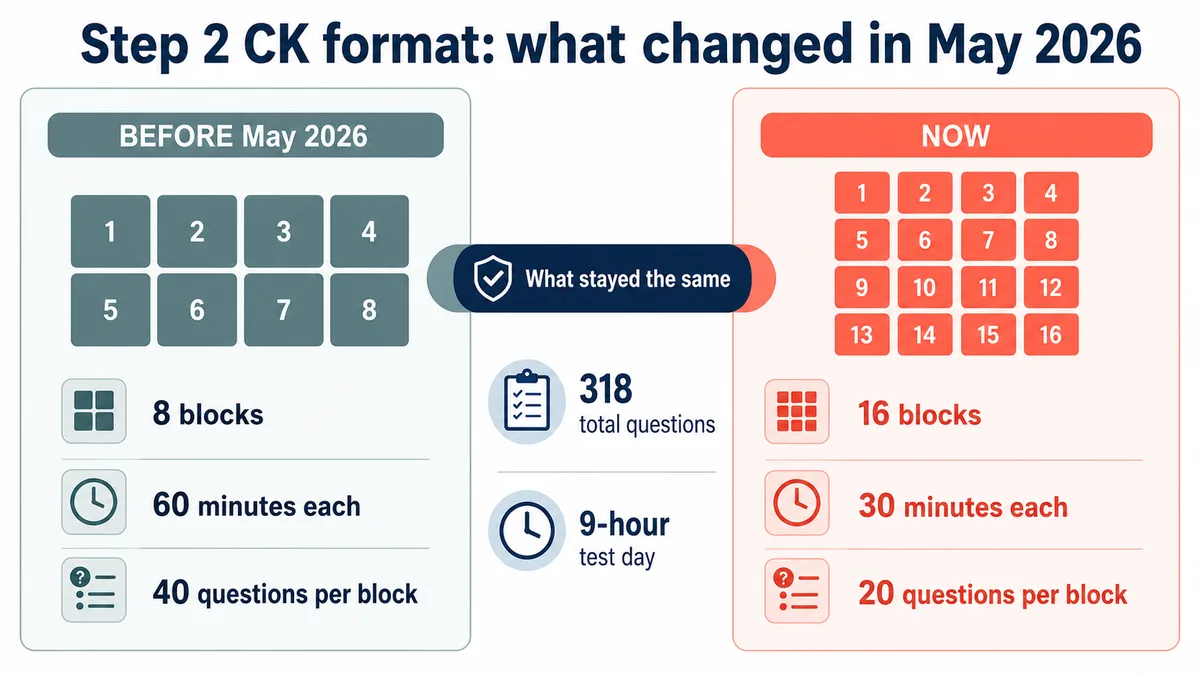
If you are preparing for Step 2 CK from a guide written last year, you are preparing for an exam that no longer exists. On 7 May 2026 the USMLE replaced the familiar eight 60-minute blocks with sixteen 30-minute blocks. Same 318 questions, same nine-hour day — but half the room to recover when a question goes badly.
Nothing about the medicine changed. What changed is the rhythm, and rhythm is where most points quietly leak. This guide covers the new format, the score you actually need (not the one you need to pass), and the test-day mechanics that separate a 240 from a 260 — written for IMGs, useful for everyone.
- The exam is now 16 blocks × 30 minutes × ~20 questions. Total questions and exam length are unchanged.
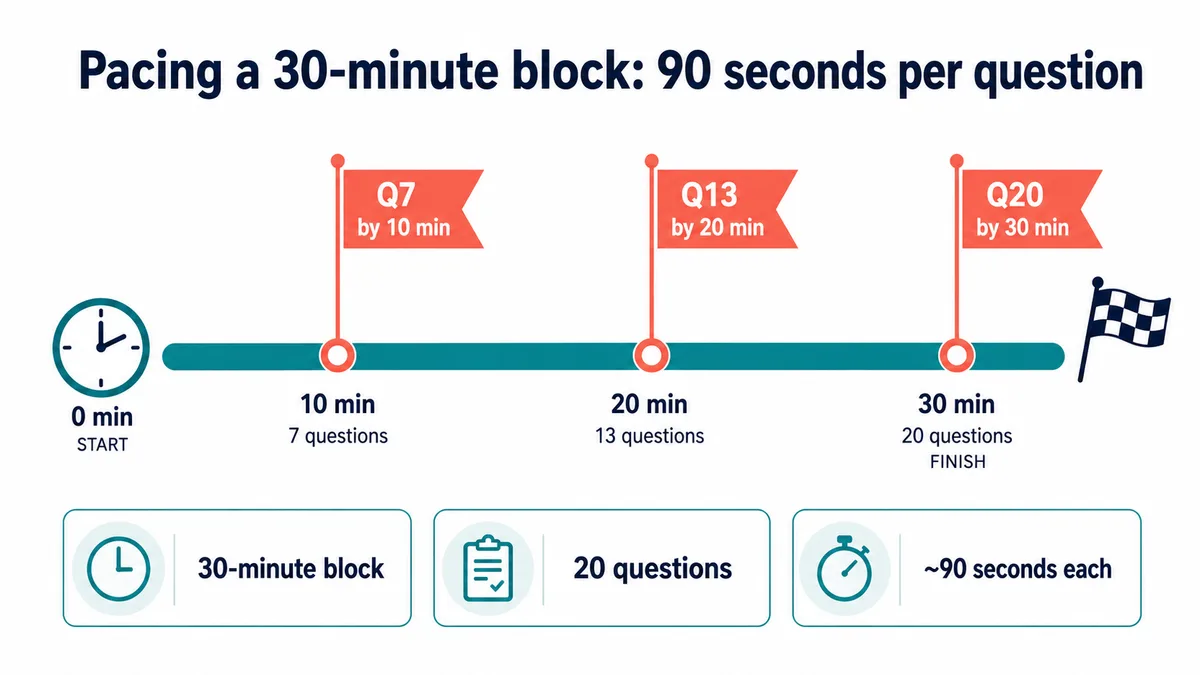
- Your pace is 90 seconds per question, with far less slack than the old 60-minute block gave you.
- 218 passes. 218 does not match. It sits near the 2nd percentile — the national mean is about 250.
- First-attempt pass rates: US MD 98%, DO 96%, IMG 68%. The IMG gap is the widest in the USMLE sequence.
- Change your answer when you find new evidence. The data on this is not close.
What Actually Changed in May 2026
The content outline did not move. The delivery software and the block structure did. Here is the before-and-after:
| Feature | Before May 2026 | Now |
|---|---|---|
| Number of blocks | 8 | 16 |
| Questions per block | 38–40 | 18–20 |
| Time per block | 60 minutes | 30 minutes |
| Total questions | Up to 318 | Up to 318 (unchanged) |
| Minimum break time | 45 minutes | 55 minutes |
| Total day length | ~9 hours | ~9 hours (unchanged) |
You also get a modernised interface: better keyboard navigation and per-image contrast adjustment, which genuinely helps on radiographs and dermatology photos. Confirm current specifics on the official USMLE Step 2 CK page before your test date.
Why 30-Minute Blocks Are Harder Than They Sound
On paper this looks like a kindness — shorter blocks, more breaks, less fatigue. In practice it removes two cushions you were probably relying on without knowing it.
You lose the warm-up window. In a 40-question block, the first five questions were where you settled down and shook off the first-question nerves. Those five questions were a rounding error across 40. Across 20, they are a quarter of the block.
You lose recovery time. Spend four minutes untangling a complex multi-system case in the old format and you had 39 other questions to win the time back. Now you have 19, and you are already behind.
And you now restart sixteen times instead of eight. Every transition means submitting, navigating, and spinning your attention back up from cold. That restart cost is small once and significant sixteen times over a nine-hour day — it lands hardest in the afternoon, exactly when your accuracy is already softening.
218 Passes. It Does Not Match.
The minimum passing score rose from 214 to 218 on 1 July 2025. Treat that number as a floor you clear early, not a destination. The mean for first-time US and Canadian MD examinees is roughly 250, with a standard deviation around 13–15 points.
| Score | Approx. percentile | What it opens |
|---|---|---|
| 270 | 94th | Top competitive specialties — dermatology, orthopaedics |
| 260 | 74th | Strong for essentially any specialty |
| 250 | 47th | Near the mean — solid for internal medicine, paediatrics |
| 240 | 24th | Workable, but narrows your options |
| 230 | 10th | Broad application strategy required |
| 218 | 2nd | Passing score only |
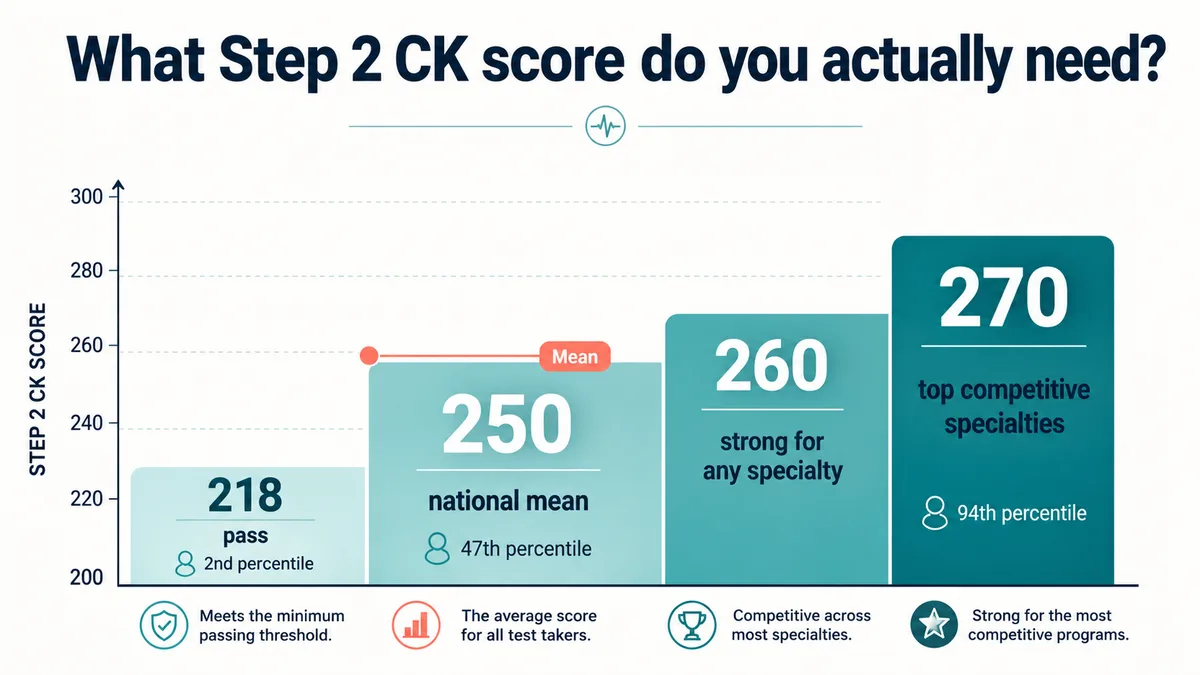
A 218 is more than two standard deviations below the national mean. It clears the licensing bar and almost nothing else. If your practice scores are sitting near the passing line, you are not close to ready — you are at the very bottom of the applicant pool. Build the gap now, not in September.
The margin at the top is unforgiving too: missing three or four extra questions per block can drop you across several percentile bands. Our 12-week Step 2 CK study plan is built around a 250+ target for exactly this reason.
Where IMGs Actually Stand
The 96–98% pass rate you see quoted everywhere describes US and Canadian MD students only. The full picture is far more divided:
| Cohort | Before 2022 | Now |
|---|---|---|
| US / Canadian MD graduates | ~98% | 98% |
| US DO graduates | ~96% | 96% |
| Non-US/Canadian IMGs (first attempt) | ~82% | 68% |
| IMG retakers | — | 61% |
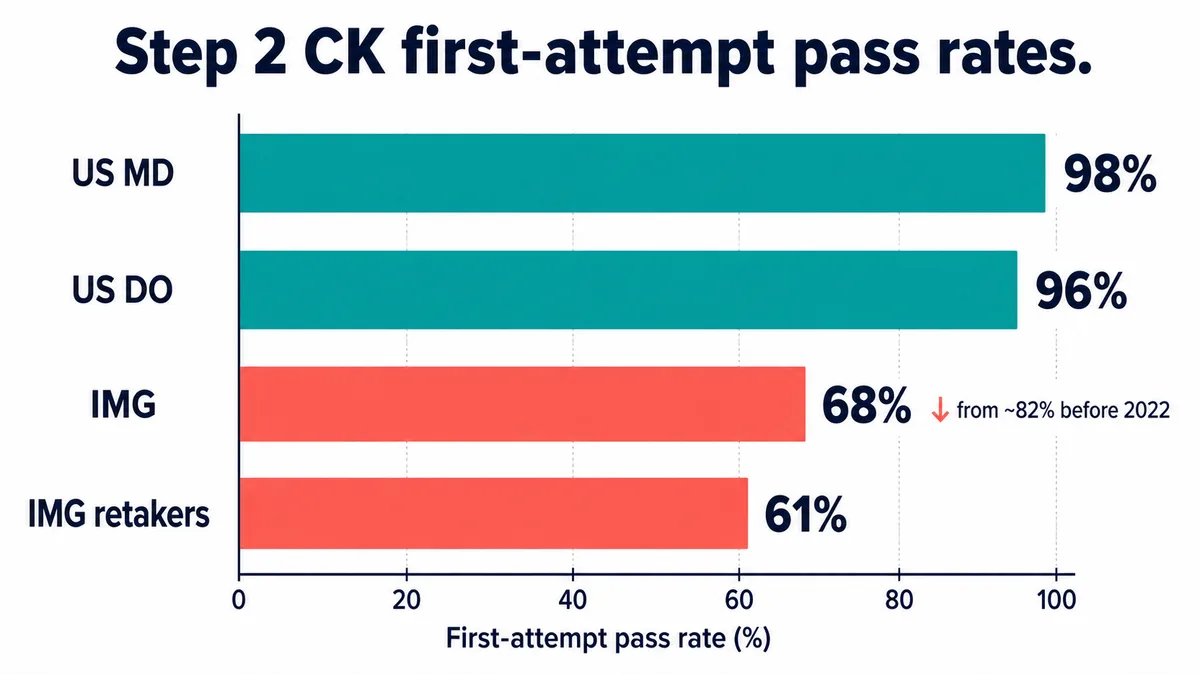
That IMG drop from roughly 82% to 68% is not because the exam got harder. When Step 1 went pass/fail in 2022, it stopped acting as a numerical filter — so more candidates now reach Step 2 CK with a shakier foundation than the old system would have allowed through.
Scoring matters even more once you pass. Matched US-citizen IMGs average around 242; unmatched average about 234.5. That is a gap of roughly seven and a half points deciding outcomes. Plan to target 5–15 points above the published average for your specialty, not level with it.
In our experience mentoring IMG applicants, the candidates who close this gap are rarely the ones who studied longest. They are the ones who started Qbank work during clinical rotations rather than treating Step 2 CK as a separate project that begins after graduation.
Pacing the New 30-Minute Block
Twenty questions in thirty minutes is 90 seconds each. That number is easy to say and hard to feel, so build checkpoints instead of watching the clock continuously.
Glance at the timer only three times per block:
- Q7 by the 10-minute mark
- Q13 by the 20-minute mark
- Q20 as the clock runs out
If you are behind at a checkpoint, do not sprint — pick your next two long-stem questions and answer them fast on best instinct. Recover deliberately, not in a panic.
Switch your Qbank to 20-question timed blocks today. If you have trained for months at a 40-question rhythm, your internal pacing is calibrated to an exam you will not sit. Also plan your breaks around 16 transitions rather than 8 — a two-minute reset at your desk every second block does more for your afternoon accuracy than one long break at midday.
Triage the Time Sinks: Drug Ads and Abstracts
Pharmaceutical advertisement questions and clinical abstract sets are the most expensive items on the exam. They hand you a dense mock trial summary or promotional flyer, then ask two or three linked questions about study design and validity — for exactly the same point value as a two-line pharmacology question.
So do not answer them in the order they appear. Flag them immediately and return in the last five minutes. Blocks containing these sets carry slightly fewer questions overall, which gives you a small buffer — but only if you bank the easy points first.
The failure mode this prevents is the real reason to do it. Spending four minutes on a drug ad at question six does not just cost four minutes; it triggers the panic that makes you rush the remaining fourteen questions and miss things you knew.
“Never Change Your Answer” Is Wrong
This is the most durable myth in test prep, and it has been measured directly. A study of 27,830 Step 2 CK examinees tracked what actually happened when candidates changed answers:
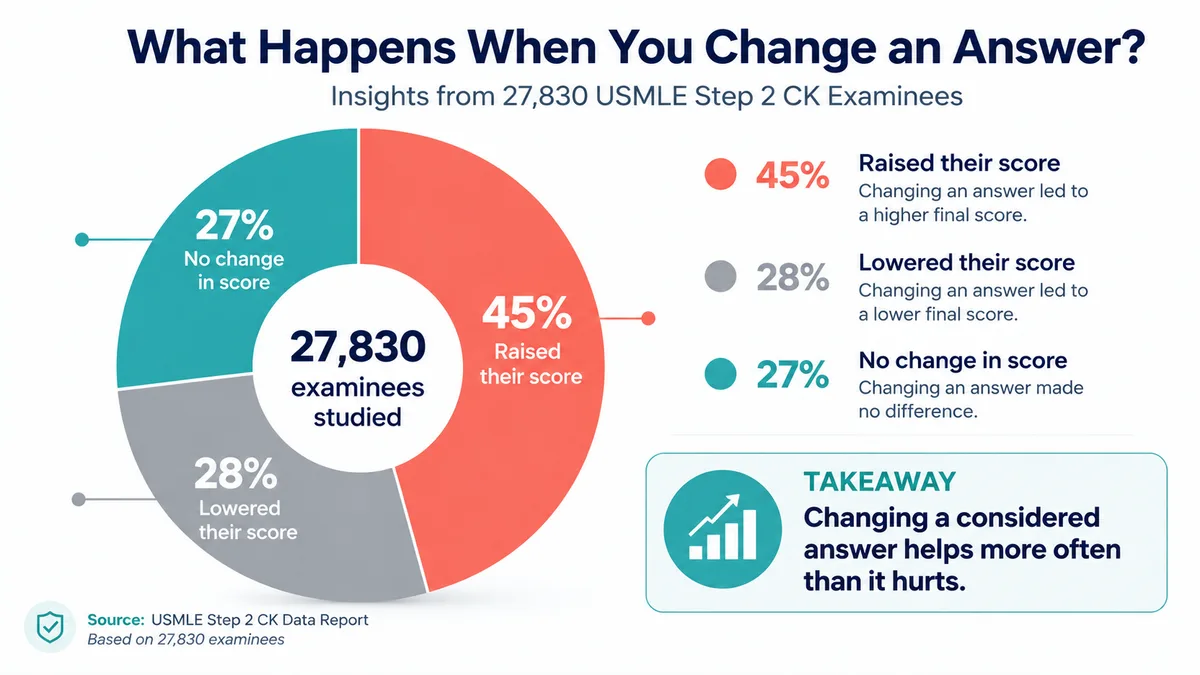
68% of examinees changed at least one answer. Of those, about 45% increased their score and only 28% decreased it. Changes ran wrong-to-right more often than right-to-wrong, and the fastest changes were the most likely to be corrections.
The distinction that matters: change your answer when you have new evidence — you re-read the stem and caught the creatinine, or realised what the question was actually asking. Do not change it because you feel uneasy. Anxiety is not evidence. But rigidly refusing to revise when you have genuinely spotted something new puts you at a measurable disadvantage.
Fix Your Mechanics Before Adding More Content
When a score plateaus, the cause is usually not missing medicine. Audits of retakers suggest 30–50% of errors are mechanical — misreading the final question, skimming past vital signs, or locking onto a diagnosis too early and reading the rest of the stem to confirm it.
The highest-value habit for long stems is simple: read the last sentence first. Scan the answer choices, then read the vignette knowing what you are looking for. “Which vaccine is indicated now?” and “What is the mechanism of this anaemia?” send you through the same paragraph hunting completely different things. Knowing which one you are answering lets you filter the deliberate distractors on the first pass instead of the third.
Review discipline matters just as much. Students who spend under two hours reviewing a 40-question block consistently outscore those spending three or more. Longer review usually means passively re-reading explanations. Name the specific error, make one card, move on — our guide on how to review a UWorld Qbank block breaks down the method.
Choose Resources Without Overloading
Question volume correlates strongly with score — students completing 4,000+ unique questions cluster at the top. Resource variety does the opposite. Using three or more commercial resources covering the same content shows a weak negative correlation with scores, and the same holds for stacking multiple video series.
The mechanism is straightforward: watching and re-reading feel productive but are passive. Switching resources is usually anxiety looking for a silver bullet, and it costs you the deep engagement a single Qbank rewards. Notably, the amount of money spent on materials shows no relationship to performance — a few resources used properly beats an expensive shelf of them.
Pick one primary Qbank, one reference library, and one spaced-repetition tool, then stop shopping. If you are still deciding, compare the options in our breakdown of the best USMLE question bank and our wider list of USMLE study resources. Whatever you choose, spacing your review beats cramming — that is one of the silent USMLE killers we see most often.
How to Read Your NBME Score
NBME practice forms reliably underpredict Step 2 CK. Comparing a real score against an NBME taken within the previous week:
| Real score vs your last NBME | How often |
|---|---|
| Equal or higher | 77% |
| At least 10 points higher | 50% |
| At least 20 points higher | 23% |
| Lower | 8% |
Half of all examinees beat their prediction by 10+ points, and nearly a quarter by 20+. Part of this is arithmetic: practice forms run about 200 questions against the real exam’s 318, so a handful of brutal questions distorts a practice score far more than a real one. More questions produce a fairer average.
Read your NBME as a floor, not a ceiling. A disappointing form two weeks out is not a verdict — but it is a signal to audit your mechanics and pacing rather than to panic-buy another resource.
A Short Word on Biostatistics
Biostatistics, epidemiology and patient safety generate anxiety wildly out of proportion to their weight — they are roughly 3–5% of the content outline, typically two or three standalone questions scattered across blocks. They are also the most predictable questions on the exam.
You need the 2×2 table cold (sensitivity, specificity, PPV, NPV), the rule that predictive values shift with prevalence while sensitivity and specificity do not, odds ratio for case-control versus relative risk for cohort studies, and absolute risk reduction with number needed to treat. The classic trap is a dramatic relative risk reduction hiding a trivial absolute one — a drug cutting stroke risk from 4% to 3% is a 25% RRR, a 1% ARR, and an NNT of 100. Learn those patterns and the section becomes free points rather than a source of dread.
Frequently Asked Questions
Did the May 2026 change make Step 2 CK harder?
The content and difficulty are unchanged — same outline, same 318 questions, same nine-hour day. What changed is pacing pressure: 30-minute blocks leave less room to recover from a slow start or a difficult question. Candidates who train at the new rhythm adapt quickly.
What is the Step 2 CK passing score in 2026?
The minimum passing score is 218, raised from 214 on 1 July 2025. Bear in mind that 218 sits near the 2nd percentile — it clears licensing requirements but is not a competitive Match score.
What score should an IMG aim for?
Target 5–15 points above the published average for your specialty. Matched US-citizen IMGs average around 242 versus about 234.5 for unmatched candidates, so every point carries weight. For most IMGs, 250+ is the goal worth building a plan around.
Should I change my answer if I am unsure?
Change it when you have found new evidence in the stem — not because you feel anxious. Across 27,830 examinees, changed answers improved scores 45% of the time and worsened them only 28% of the time.
How should I handle drug ad and abstract questions?
Flag them and come back at the end of the block. They take far longer than standard questions for identical point value, so secure the quick clinical vignettes first and spend whatever remains on the dense items.
My NBME score is lower than my target. Should I postpone?
Not automatically. NBME forms tend to underpredict — 77% of examinees score equal or higher on the real exam and half beat their prediction by 10+ points. Treat a weak form as a prompt to audit your pacing and error patterns rather than as a final verdict.
Conclusion
Step 2 CK now carries the numerical weight that Step 1 used to. The 2026 format did not change what you need to know — it changed how much slack you get while proving it. Train in 20-question blocks, treat 218 as a floor rather than a goal, triage the expensive questions, and trust the evidence over the folklore on exam day.
Want structured help turning study hours into a competitive score? Explore our USMLE Step 1 & Step 2 CK preparation program and see how our students have matched into US residency.
Next step
Step 1 & Step 2 CK Prep
Structured modules, 1-on-1 mentorship, and a 100-day plan to clear the boards.