How to Score 280+ on USMLE Step 2 CK

Academic Director & USMLE Educator, Dermatology Resident

If you have searched for the highest possible USMLE Step 2 CK score, you have probably found a lot of confident numbers and very little sourcing. So let us start with the actual data, straight from the USMLE score interpretation guidelines, and then get to what it takes to score near the top.
- Maximum reported score: 300. The Step 2 CK scale runs from 1 to 300.
- Nobody actually scores it. On the current norm table every score from 280 up is already at the 100th percentile.
- 280 = 100th percentile. 275 = 98th, 270 = 94th, 265 = 85th, 260 = 74th.
- Average is 250 (SD 15) for first-takers from LCME-accredited schools, 2024–2025.
- Passing is 218 for anyone testing on or after 1 July 2025.
What is the highest possible Step 2 CK score?
The official answer is 300. The USMLE reports Step 2 CK and Step 3 on a scale of 1 to 300, and small differences in difficulty between test forms are statistically equated so that scores stay comparable across years.
But 300 is a scale limit, not a realistic outcome. The more useful question is where the top of the actual distribution sits, and the norm table answers that clearly. Once you pass 280, the percentile stops moving. There is no measurable population above it.
What each Step 2 CK score actually means
This is the official norm table for first-takers from LCME-accredited medical schools who tested between 1 July 2022 and 30 June 2025, a cohort of 67,934 examinees. The percentile tells you what share of that group scored below each score.
| Step 2 CK score | Percentile | What it means |
|---|---|---|
| 280 and above | 100 | Effectively the ceiling |
| 275 | 98 | Roughly 1 in 50 |
| 270 | 94 | Very competitive for any specialty |
| 265 | 85 | Strong across competitive specialties |
| 260 | 74 | Comfortably above average |
| 255 | 60 | Slightly above average |
| 250 | 47 | Right around the mean |
| 245 | 34 | Below average |
| 240 | 24 | Bottom quartile of this cohort |
| 230 | 10 | Well below average |
| 218 | N/A | Minimum passing score from 1 July 2025 |
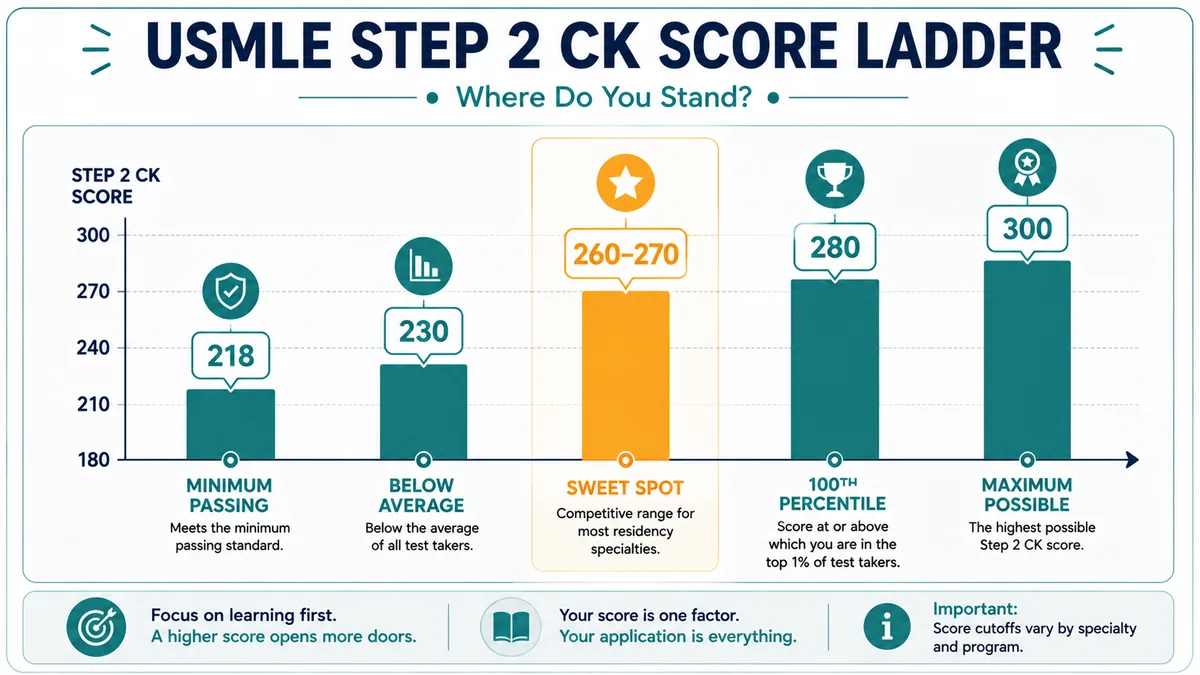
Note how compressed the top is. Moving from 260 to 270 gains you 20 percentile points; moving from 270 to 280 gains you six. The marginal return on each additional point collapses as you climb.
One caveat worth internalising: the standard error of measurement on Step 2 CK is about 6 points. Your reported score is a sample of your true ability, not a fixed value. A 264 and a 270 are not meaningfully different performances.
How Step 2 CK Scores Are Calculated
A lot of score anxiety comes from misunderstanding what the number actually is. Step 2 CK is reported as a single three-digit scaled score, and it is not a percentage of questions you answered correctly.
- It is equated, not curved. Your score is statistically adjusted for the difficulty of the specific form you sat, so it stays comparable across test dates and years. You are not being ranked against the people who tested the same day as you.
- Every question counts the same. There is no weighting by topic or difficulty, and no penalty for a wrong answer — so never leave an item blank.
- Some items don’t count at all. Each form carries unscored pretest questions being trialled for future exams. You cannot identify them, which is another reason not to spiral over one strange-looking stem.
- The number has a margin of error. The standard error of measurement is roughly 6 points. A 252 and a 258 are not meaningfully different performances.
Scaled 1–300 · equated across forms · no negative marking · ±6 points of measurement noise · passing is 218 for anyone testing on or after 1 July 2025.
The Average Step 2 CK Score, by Applicant Type
“What’s a good score?” only means something relative to the applicants you are actually being compared with. Here is what the NRMP’s 2024 Match data shows for applicants who matched to their preferred specialty:
| Applicant group | Mean Step 2 CK (matched) |
|---|---|
| U.S. MD seniors | 250.4 (s.d. 13.2) |
| Non-U.S. IMGs | 244.8 (s.d. 15.4) |
| U.S. DO seniors | 243.9 |
| U.S. IMGs | 235.6 (s.d. 14.2) |
| Minimum passing score | 214 in 2024 · 218 from 1 July 2025 |
Read the non-U.S. IMG row carefully, because it is the one that applies to most readers of this blog: 244.8. That is the mean for IMGs who succeeded. It sits comfortably below the 260–270 band this article argues is the real sweet spot, and a very long way below 280.
NRMP publishes Step 2 CK by specialty as median-and-interquartile-range charts rather than a table of means, so any site quoting a precise “mean score for dermatology” is estimating. For real specialty numbers, use NRMP’s own interactive Charting Outcomes: Step 2 CK baseline report and filter to your specialty.
Has anyone ever scored a 280, or a perfect 300?
The USMLE program does not publish individual record scores. There is no official “highest ever” figure, and there never has been. Any specific number you see quoted in a forum thread or a coaching advertisement is unverified by definition.
What the published data does tell us is that scores of 280 and above exist but are vanishingly rare. They round to the 100th percentile against a cohort of nearly 68,000 examinees. A perfect 300 has never been credibly documented.
Screenshots of extraordinary scores circulate widely and are trivially faked. Programs do not see a percentile on your transcript either. They see the three-digit score and interpret it against their own historical applicant pool.
An important caveat if you are an IMG
Every percentile on that norm table is calculated against first-takers from LCME-accredited medical schools, meaning US students. International medical graduates are not in that cohort at all, so the percentiles are a reference point rather than your placement.
The published pass rates make the difference concrete. In 2024–2025, first-time examinees from US MD schools passed Step 2 CK at 98% across 22,249 candidates, while first-time examinees from non-US schools passed at 90% across 16,186. The distributions are genuinely different.
What this means in practice: do not read “260 is the 74th percentile” as your standing among applicants. Programs compare you against their own historical pool, and for IMGs a strong Step 2 CK score carries proportionally more weight because there are fewer other signals: no US clinical grades, often no home-institution letters. That is an argument for aiming at the upper end of the realistic band, not the ceiling.
So is 280 a realistic target?
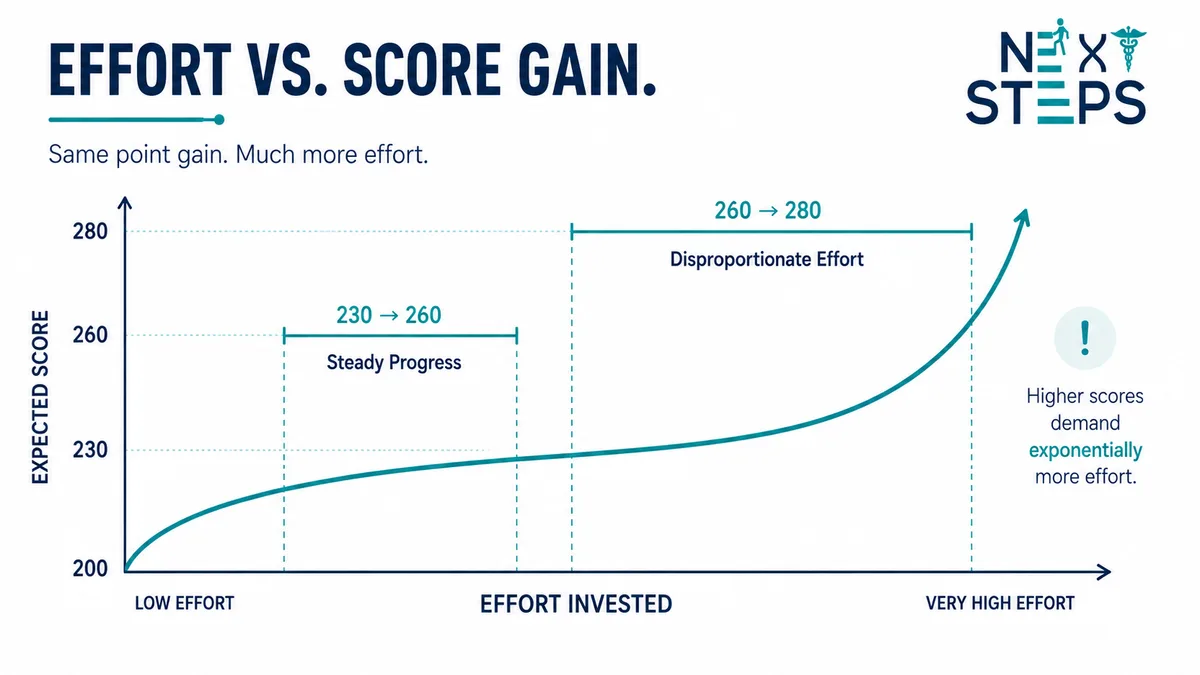
Honestly: no, and treating it as your goal is more likely to hurt your preparation than help it. A 280 is not a study plan you can execute. It is the tail of a distribution, reached by a handful of people whose circumstances you cannot replicate on demand.
The target that actually rewards effort is 260 to 270. That band takes you from the 74th to the 94th percentile, it clears the bar for every competitive specialty, and unlike 280 it responds predictably to disciplined work. Aim there, and if you overshoot, excellent.
What actually separates a 265 from a 250
The gap between an average score and a top-decile score is rarely about volume. Students at both ends usually complete the same question bank. What differs is how they use it.
Treat the Qbank as a reasoning tool, not a checklist
Completing UWorld twice means nothing on its own. What matters is whether you can articulate, for every question you got wrong, which step in your reasoning failed: misread stem, missed a discriminating finding, knew the diagnosis but not the next step in management. Log the failure mode, not the fact. If you want a structured method for this, see our guide on how to review a UWorld Qbank block.
Build pattern recognition, not fact recall
Step 2 CK rewards clinical judgement under time pressure. High scorers read a vignette and immediately recognise the shape of the case before parsing every detail. That comes from volume of varied exposure: timed, random blocks that force you to switch specialties mid-stream, not subject-blocked practice that lets you coast on context.
Calibrate with NBMEs, and trust the trend
Self-assessments are your only honest feedback loop. Take them on a schedule, spaced far enough apart to allow real change, and read the trend across several rather than reacting to one bad form. Given the 6-point standard error, a single dip is noise.
Protect exam-day execution
A nine-hour exam is an endurance event. Students lose more points to fatigue, pacing collapse in later blocks, and second-guessing than to genuine knowledge gaps. Practise full-length under realistic conditions, plan your break schedule in advance, and understand the 2026 Step 2 CK format before test day.
This page is about what the scores mean and what the top of the range requires. For the week-by-week plan, covering phases, Qbank pacing and NBME timing, use our 12-week USMLE Step 2 CK study plan.
What about scoring 280 on Step 1?
You cannot. Step 1 has been reported as pass/fail only since January 2022, so there is no three-digit score to chase. This is precisely why Step 2 CK now carries so much weight: it is the only numerical USMLE score most residency programs see when they screen applications.
If you are still deciding how to sequence the two exams, our comparison of Step 1 vs Step 2 CK covers the strategic differences.
Frequently Asked Questions
What is the highest score you can get on USMLE Step 2 CK?
Reported Step 2 CK scores run from 1 to 300, so 300 is the theoretical maximum. In practice nobody reaches it. On the current USMLE norm table, every score from 280 upward already sits at the 100th percentile, so 280 is effectively the top of the real distribution.
What percentile is a 280 on Step 2 CK?
The 100th percentile. Per the USMLE norm table for first-takers from LCME-accredited schools tested between July 2022 and June 2025, 280 and above round to 100, meaning essentially the entire cohort of 67,934 examinees scored below it.
What is the highest Step 2 CK score ever recorded?
The USMLE program does not publish individual record scores, so any specific “highest ever” figure you see online is unverified. What is published is the norm table, and it shows the distribution flattening at 100th percentile from 280 up.
Is a 270 on Step 2 CK good?
Yes. A 270 is the 94th percentile, meaning 94% of first-takers scored below it. It is competitive for essentially any specialty, and it is a far more realistic target than 280.
What is the average Step 2 CK score?
For first-takers from LCME-accredited schools the mean was 250 with a standard deviation of 15 in the 2024–2025 academic year, up from 248 in 2022–2023. A 250 sits at roughly the 47th percentile.
Can you score 280 on USMLE Step 1?
No. Step 1 has been reported as pass/fail only since January 2022, so there is no three-digit Step 1 score to aim for. Step 2 CK is now the numerical score programs screen on.
The takeaway
The highest possible Step 2 CK score is 300, the highest meaningful one is around 280, and the highest useful target for almost everyone is 260 to 270. Chasing the ceiling is a good way to burn out; building the reasoning habits that reliably produce a 265 is how people actually end up with scores they are proud of.
For a fuller picture of how programs read these numbers, see the score benchmarks above, then build the schedule to hit them with our 12-week Step 2 CK study plan.
Score scale, norm table, means and measurement error: USMLE Score Interpretation Guidelines (updated 29 April 2026). Pass rates and cohort sizes: USMLE Performance Data. Matched-applicant means by applicant type: NRMP Charting Outcomes in the Match, 2024 Main Residency Match (published August 2024).
Next step
Step 1 & Step 2 CK Prep
Structured modules, 1-on-1 mentorship, and a 100-day plan to clear the boards.