How to Prepare for the USMLE from 1st Year MBBS (2026 Roadmap)
Academic Director & USMLE Educator, Dermatology Resident
The short answer
Starting in first year is a real advantage, but not because you study more. It is because the same material gets covered twice, spaced months apart, which is one of the most effective learning structures there is. Do not open a question bank yet. That comes in third year.
The mistake first year students make is treating the USMLE as a second degree to run in parallel. It is not. For the first two years it should be a different way of studying the subjects you already have.
Year by year
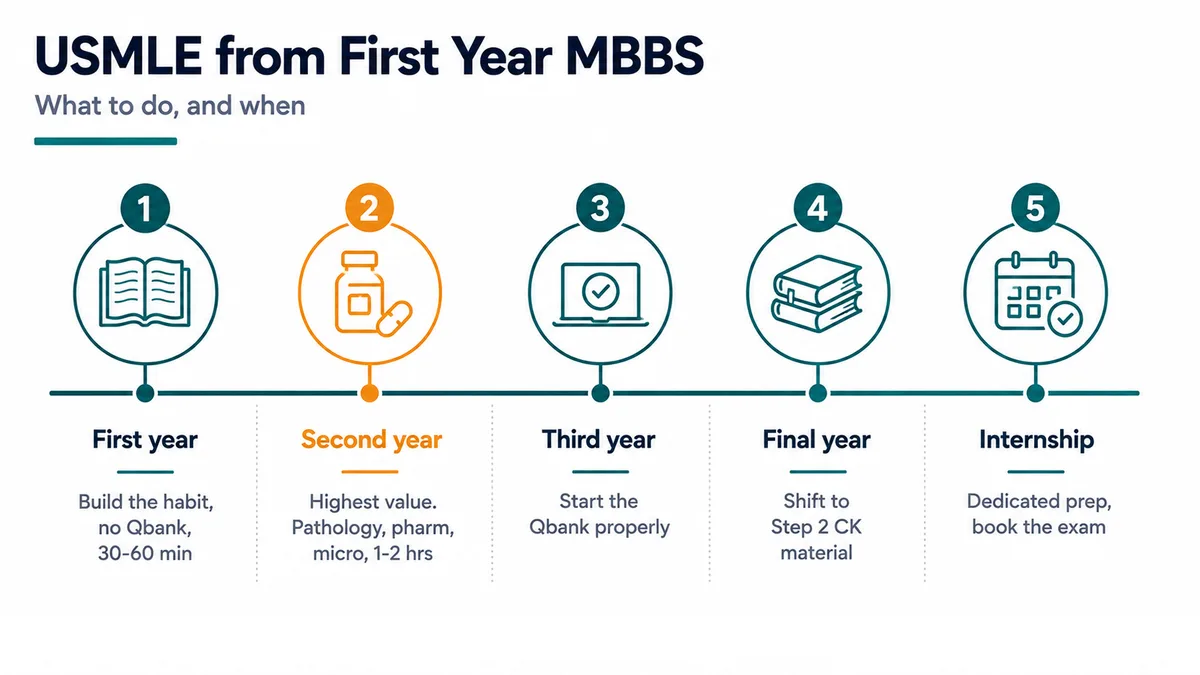
| Year | Focus | Daily time |
|---|---|---|
| First | Build the habit. Physiology and biochemistry, mechanism first. No question bank | 30 to 60 min |
| Second | The highest value year. Pathology, pharmacology, microbiology map almost directly onto Step 1 | 1 to 2 hrs |
| Third | Start a question bank properly. Begin spaced repetition seriously | 1 to 2 hrs |
| Final | Shift towards Step 2 CK material, which overlaps your clinical postings | 1 to 2 hrs |
| Internship | Dedicated preparation, self assessments, schedule the exam | Full time in blocks |
Why second year matters most
Step 1 is dominated by two subjects, and both are taught in second year MBBS:
- Pathology, 45 to 55% of the exam
- Physiology, 30 to 40%
- Pharmacology and microbiology, 10 to 20% each
The whole method in one line
When your college teaches a system, cover the same system in your USMLE resource that week. You are not adding a subject. You are taking a second, deeper pass at the subject you are already sitting in lectures for.
What first year should actually look like
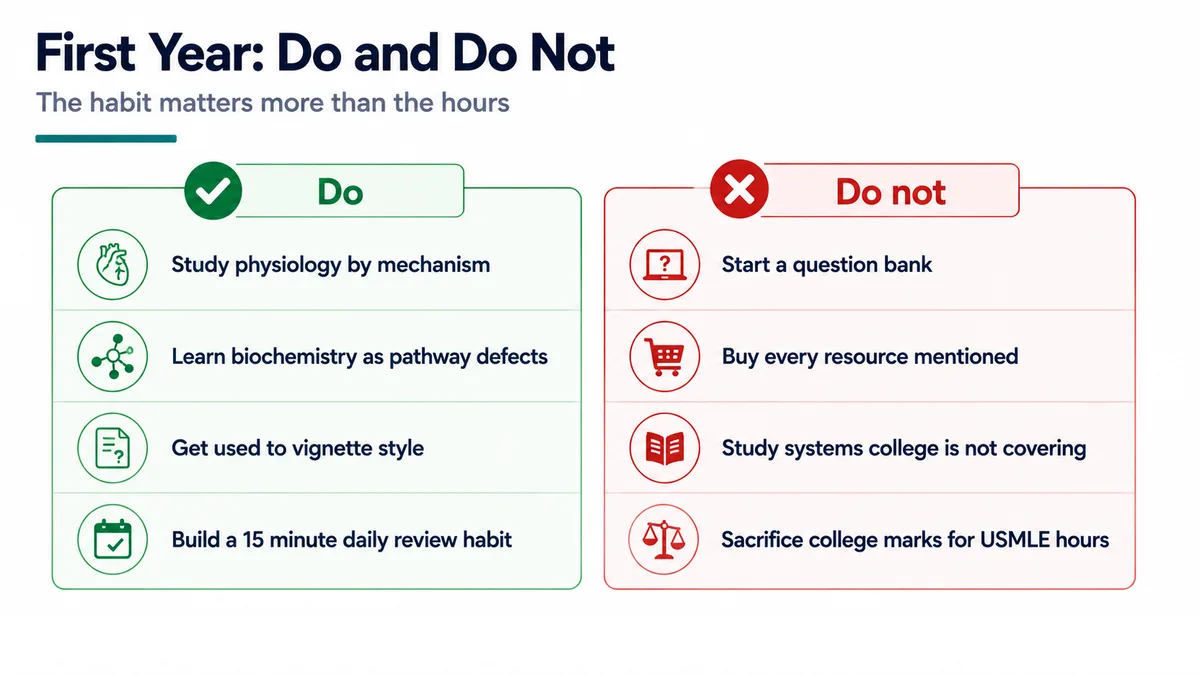
First year is for building a habit that survives four more years, not for racing ahead.
| Do | Do not |
|---|---|
| Study physiology by mechanism, not definition | Start a question bank |
| Learn biochemistry as pathway defects | Buy every resource other people mention |
| Get comfortable with clinical vignette style | Study systems your college is not covering |
| Build a daily review habit, even 15 minutes | Sacrifice college marks for USMLE hours |
| Improve medical English and note taking | Book or plan an exam date |
Why the Qbank has to wait
Questions teach you through their explanations, and explanations only land if you have the foundation to attach them to. Starting in first year produces demoralising scores and burns through a finite question pool before you can learn from it. Third year is the right point.
The clock most early starters forget
Seven years, starting from your first pass
Most state boards require all three Steps within seven years of passing your first one. Passing Step 1 in second year, then taking three years to graduate, plus internship, plus possibly two application cycles, can consume most of that window before Step 3.
The practical rule: prepare early, but sit Step 1 when your timeline to application is realistic, usually late in the course or during internship. Early preparation is free. Early passing is not.
What to protect
- Your MBBS results. A backlog delays your degree, internship, ECFMG certification and application cycle. There is no USMLE gain that offsets losing a year.
- Your clinical postings. They are Step 2 CK preparation and degree progress simultaneously.
- Sleep. Retention collapses without it, and this is a multi year effort rather than a sprint.
What the head start is actually worth
Twenty questions a day through third and final year is roughly 14,000 questions before dedicated preparation even begins. That is not a small advantage over someone starting after internship, it is a different starting line.
A weekly structure that survives college
The plan has to assume bad weeks, because there will be many. This one does.
| When | USMLE work |
|---|---|
| Weekday evenings | 20 to 30 minutes on the system your college is currently teaching |
| Daily | 15 minutes of spaced repetition review, non negotiable |
| Saturday | Consolidate the week, add cards only for what you got wrong |
| Sunday | Rest, or catch up if the week collapsed |
| College exam month | Review only. Protect the MBBS result |
Why the catch up day matters
Every term has weeks destroyed by postings, tests or illness. A plan with no slack turns one bad week into abandoning the system. A plan with a built in buffer absorbs it, which is the difference between a habit that lasts four years and one that lasts four weeks.
Resources, and when to add each
Resource collecting is a form of procrastination. Add each one only when the previous is genuinely in use.
| Stage | Add | Why then |
|---|---|---|
| First year | One lecture or video resource | Mechanisms, taught properly, alongside college |
| Second year | A review book as a consolidation index | Only useful once you understand the material |
| Second year | Spaced repetition system | Volume is now large enough to forget |
| Third year | Question bank | Foundation exists, so explanations land |
| Third or final year | Self assessments | Calibration once you have real coverage |
The English and note taking gap
This is rarely mentioned and matters more than expected. Indian MBBS is taught in English, which is a genuine advantage, but USMLE vignettes use American clinical phrasing, drug naming and unit conventions that differ from Indian practice.
- Generic drug names only. The exam never uses brand names, and Indian practice often does.
- US lab units and reference ranges. Different from what you will see on the wards at home.
- American terminology. Paracetamol is acetaminophen, adrenaline is epinephrine, and there are dozens more.
- Vignette structure. The last line carries the actual question. Reading it first saves time.
Fix this early and cheaply
Starting in first year, use the American term whenever you meet a drug or lab value in college. It costs nothing, and it removes a translation step that otherwise burns seconds per question on exam day, at 90 seconds per question.
What to expect at each stage
| Point | Realistic expectation |
|---|---|
| End of first year | A habit, some physiology depth, no scores yet |
| End of second year | Solid pathology and pharmacology, ready for questions |
| Mid third year | Low question bank accuracy. Normal, not predictive |
| End of third year | Noticeable improvement on systems you have completed |
| Final year | First self assessment, purely to calibrate |
| Internship | Dedicated preparation, then book on the evidence |
The trap of comparing yourself
Someone in your batch will claim a very high question bank score in third year. Ignore it. Early accuracy on a partially covered syllabus predicts almost nothing, and chasing it pushes people into booking too early, which is the single most expensive mistake available.
Sources
- USMLE Step 1 content outline, discipline weightings.
- USMLE Bulletin of Information, eligibility and completion requirements.
Verified July 2026.
Next step
Step 1 & Step 2 CK Prep
Structured modules, 1-on-1 mentorship, and a 100-day plan to clear the boards.