How to Find Research Opportunities for Your USMLE CV (2026)
Academic Director & USMLE Educator, Dermatology Resident
Research is one of the highest-leverage lines on an IMG’s residency CV — a few real publications can lift an application from competitive to standout, especially as program directors sift record volumes in 2026. Yet most MBBS students have no idea how to actually find research, so they reach their application year with a blank research section and scramble.
The good news: you do not need a fancy lab or a US address to start. With the right approach you can build a genuine research record from your MBBS years — case reports, reviews, and publications that strengthen your USMLE CV. This guide shows you exactly where to look, how to approach mentors (with a cold-email template that works), and the fastest routes to a publication.
- Research strengthens your CV and matters most for competitive specialties.
- Case reports and systematic reviews are the fastest routes to a publication.
- Find mentors via your own faculty, cold emails, and online boards.
- A specific, well-written cold email beats a mass-blasted generic one.
- Start early — research takes months to reach publication.
Why Research Matters for Your USMLE CV
For IMGs, research does double duty: it demonstrates academic ability and gives program directors evidence you can contribute beyond clinical work. Competitive specialties effectively expect it, and even non-competitive programs view it favorably. Crucially, quality and specificity beat a long list of half-finished projects — a couple of real publications with your name on them outweigh ten vague “assisted with research” lines. Pair a strong research section with strong letters of recommendation for maximum effect.
What Kinds of Research Actually Count
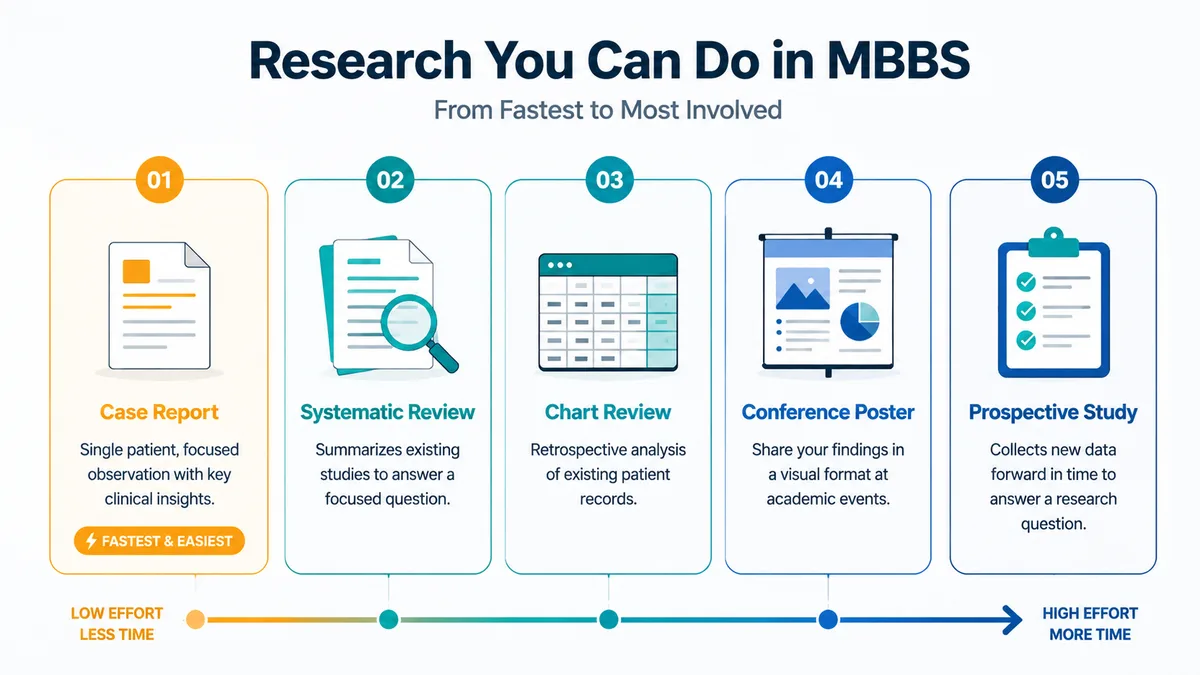
Not all research takes years. Some formats are realistic for a busy MBBS student and still earn a publication:
| Type | Effort | Why it counts |
|---|---|---|
| Case report | Low–moderate | Fastest path to a first publication |
| Systematic review / meta-analysis | Moderate | No lab needed; high academic value |
| Retrospective chart review | Moderate | Real data analysis; strong CV line |
| Poster / conference abstract | Low | Quick, presentable, networking |
| Original prospective study | High | Highest value, longest timeline |
Where to Find Research Opportunities During MBBS
You have more access than you think — you just have to ask in the right places:
- Your own faculty: approach professors in your department who are already publishing; offer to help on an existing project.
- Cold emailing US/international mentors: the single most effective route for IMGs — covered below.
- Online platforms: find recently published authors on PubMed and ResearchGate in your area of interest and reach out.
- Referrals: ask seniors, alumni, and mentors who match the year before — many opportunities pass by word of mouth.
- Ongoing projects: joining a project already in progress is the fastest way onto a paper.
How to Cold-Email a Research Mentor
Cold emailing works — if you are specific. A generic mass email gets ignored; a short, tailored note that shows you read their work gets replies.

“Dear Dr. ___, I am an MBBS student interested in [their research area]. I read your recent paper on [specific title/topic] and found [specific detail] compelling. I have experience with [skill: literature review, data entry, statistics] and would be glad to contribute to an ongoing or upcoming project — including case reports or reviews I could help draft. My CV is attached. Thank you for considering it.”
What makes a cold email work
Reference one specific paper, state a concrete skill you bring, keep it under a few short lines, and follow up once after a week if you hear nothing.
The Fastest Routes to a Publication
If your application timeline is tight, prioritize the formats that publish quickly.
Case reports — the classic first publication
You spot an unusual presentation, write it up with a mentor, and submit. Case reports need no funding or lengthy ethics approval, so they are the most realistic first paper for a busy MBBS student — and a concrete, credible line on your USMLE research CV.
Systematic reviews and meta-analyses — no lab required
These need no patients or lab, only rigorous literature work, and they carry strong academic weight. Both are achievable alongside MBBS coursework and exam prep, which is why they are the go-to routes for IMGs building a publication record from home.
When to Start
Start early — research has a long lead time from idea to published paper (often many months), and you want completed work, not “in progress” lines, by application season. Beginning in your earlier MBBS years gives projects time to mature and lets you build a relationship with a mentor who can also write you a strong letter. This dovetails with planning your overall USMLE timeline.
Choosing the Right Mentor: Red Flags
- A mentor who is not actively publishing — check their recent track record.
- Vague promises with no defined project or timeline.
- Unclear authorship expectations — clarify your role up front.
- Someone who cannot supervise you to completion.
Common Mistakes to Avoid
- Starting too late — nothing reaches publication by application season.
- Mass-blasting generic emails instead of tailored ones.
- Collecting unfinished projects — one published paper beats five abandoned ones.
- Listing vaguely on your CV — quantify your exact role and output.
- Ignoring authorship terms until it is too late to fix.
Frequently Asked Questions
Do I need research to match into US residency?
It depends on the specialty. Competitive fields effectively expect research; others value it without requiring it. For IMGs, a few real publications meaningfully strengthen the application — quality over quantity.
What is the fastest way to get published as a medical student?
A case report is usually the fastest first publication, followed by a systematic review or meta-analysis, which needs no lab or patients — only rigorous literature work. Both are realistic alongside MBBS.
How do I find a research mentor as an IMG?
Start with publishing faculty at your own institution, then cold-email authors of recent papers in your area of interest (found on PubMed/ResearchGate) with a short, specific message. Referrals from seniors and alumni are also highly effective.
Can I do research for my USMLE CV during MBBS, from abroad?
Yes. Case reports, systematic reviews, and retrospective work can all be done remotely and from your home country during MBBS. You do not need a US lab to build a publication record — only a mentor and a defined project.
What type of research do residency programs value most?
Peer-reviewed publications carry the most weight, especially in your target specialty, followed by posters and presentations. A completed, published project beats a long list of ongoing or vaguely described ones.
Conclusion
A strong research line is within reach for any MBBS student willing to start early and ask in the right places. Target the fast formats — case reports and systematic reviews — find a mentor through your faculty, tailored cold emails, or referrals, and turn that work into completed publications by application season. Done right, research becomes one of the most persuasive sections of your USMLE CV.
Want guidance building a residency-ready application? Explore our USMLE Step 1 & Step 2 CK preparation program and see how our students have matched into U.S. residency.
Next step
USMLE CV Building
Research, publications, and a match-ready CV tuned to your target specialty.