USMLE LOR Mistakes That Cost IMGs the Match (2026 Guide)
Academic Director & USMLE Educator, Dermatology Resident
For International Medical Graduates (IMGs), your USMLE scores get you read — but your Letters of Recommendation (LORs) get you believed. In the 2027 Match, Program Directors (PDs) are sifting record application volumes, and after Step 2 CK and US Clinical Experience, a strong, specific letter of recommendation from a US physician is one of the clearest signals that you can function on a real American team. A generic letter, by contrast, can quietly sink an otherwise competitive file.
The problem is that nobody teaches you the mechanics: how many letters, who to ask, when to ask, what to hand your writer, and — for IMGs especially — how to earn US letters in the first place. Treat this as part of your wider USMLE preparation strategy, not an afterthought. This guide walks through all of it, with the exact scripts, checklists, and the strong-vs-weak phrasing that PDs read between the lines.
- Most applicants need 3–4 letters; many specialties want at least one from their own specialty.
- US letters outweigh home-country letters — earn them through observerships, externships, and clinical rotations.
- Pick the writer who knows your work, not the most famous name.
- Ask early (ideally at the start of a rotation), hand over a CV + personal statement, and waive your right to view the letter.
- Strong letters give specific examples; generic praise reads as a red flag.
What Is a Residency Letter of Recommendation?
A letter of recommendation (LOR) for residency is a formal letter written by a physician — usually an attending who supervised your clinical work — that vouches for your clinical skills, work ethic, and readiness for US residency training. Program directors weigh LORs alongside your USMLE scores and clinical performance when deciding whom to interview. For IMGs, at least one letter from a US physician carries the most weight.
How Much Do LORs Actually Matter?
In the NRMP Program Director Survey, letters of recommendation consistently rank among the top factors for offering interviews — frequently in the top five, alongside USMLE Step 2 CK scores and clinical performance. For IMGs the stakes are higher: PDs have no shared frame of reference for your home medical school, so a credible US letter of recommendation does double duty, vouching for both your clinical skill and your ability to adapt to the US system. If you are still mapping the bigger picture, see how IMGs should approach the USMLE Match process.
In our experience mentoring IMG applicants, the single biggest avoidable mistake is treating letters as a last-minute formality. The candidates who match strongest line up at least one US clinical letter months in advance — and they choose the attending who watched them work, not the one with the most impressive title.
How Many Letters of Recommendation Do You Need?
ERAS lets you upload several letters and assign a specific subset to each program. The safe default:
| Scenario | How many | Mix |
|---|---|---|
| Standard application | 3–4 letters | 2–3 clinical + (optional) 1 research |
| Specialty-specific programs | 3–4 (assign per program) | At least 1 from that specialty |
| Research-heavy applicant | 4 letters | 3 clinical + 1 research mentor |
You can upload more letters than you assign and tailor which ones each program sees. Never assign a weak letter just to hit a number — one specific, enthusiastic letter beats two lukewarm ones.
Who Should Write Your Letters of Recommendation?
The best letter comes from the physician who can describe what you actually did — not the biggest title who barely remembers you.
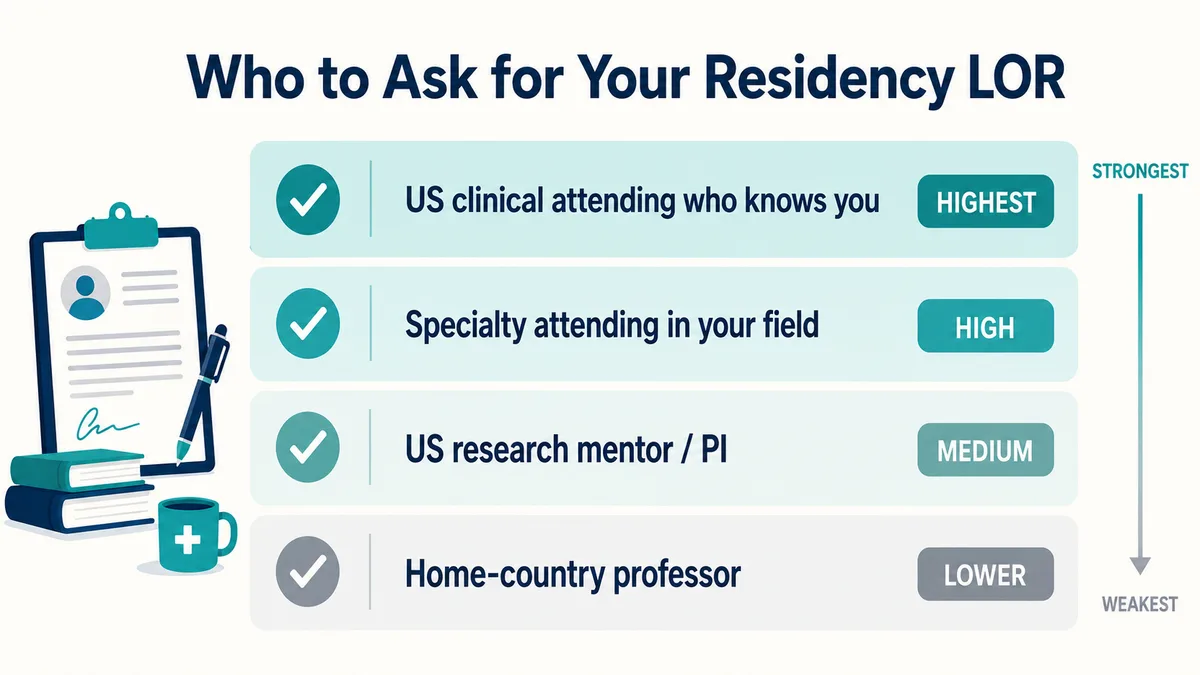
| Author | Weight for IMGs | Why |
|---|---|---|
| US clinical attending who knows you | Highest | First-hand US clinical judgment of your skills |
| Specialty attending (your target field) | High | Speaks your specialty’s language to the PD |
| US research mentor / PI | Medium | Strong if research-focused; backs up your CV |
| Home-country professor | Lower | Useful for context, but cannot vouch for US readiness |
Who NOT to ask
Avoid a famous name who can only write two generic lines, a family friend, or anyone who supervised you so briefly they cannot cite a single example. Your performance during rotations is what earns the good ones — learn how to stand out in USMLE clinical rotations.
How Do IMGs Get US Letters of Recommendation?
This is where most IMGs get stuck. You cannot ask for a US letter of recommendation until you have done US clinical work. The realistic routes are observerships, externships, and hands-on clinical rotations — and they are not equal in the eyes of a PD.
| USCE type | Hands-on? | Letter strength |
|---|---|---|
| Observership / shadowing | No (observe only) | Weakest — writer can only comment on attitude |
| Externship | Partial / supervised tasks | Moderate — some clinical interaction to cite |
| Hands-on clinical rotation | Yes (patient care) | Strongest — writer sees your reasoning and skills |
Prioritize hands-on experiences
A writer who watched you take a history, present a patient, and adjust a plan can write a far stronger letter than one who only watched you observe. Choose rotations strategically and work closely with one attending who can evaluate you over enough weeks to remember you. Start with how to find the best US clinical experience for IMGs and what program directors seek from USCE.
“I’d meet patients, take full histories, examine them, and present them — first to the residents, then to the attendings. I rounded with the program director five or six times; she asked me lots of questions and had me prepare cases to present on rounds.”
— Mazon, an IMG who completed Internal Medicine & Cardiology rotations through Next Steps at Garden City Hospital, Michigan
That hands-on involvement — presenting to attendings and a program director who see your reasoning first-hand — is exactly what lets a writer produce a specific, strong letter.
Strong vs Weak Letters: What PDs Read Between the Lines
PDs are expert at decoding letters. Words like “adequate,” “satisfactory,” or “attended my service” signal lukewarm support. Specific, comparative language signals a genuine advocate.
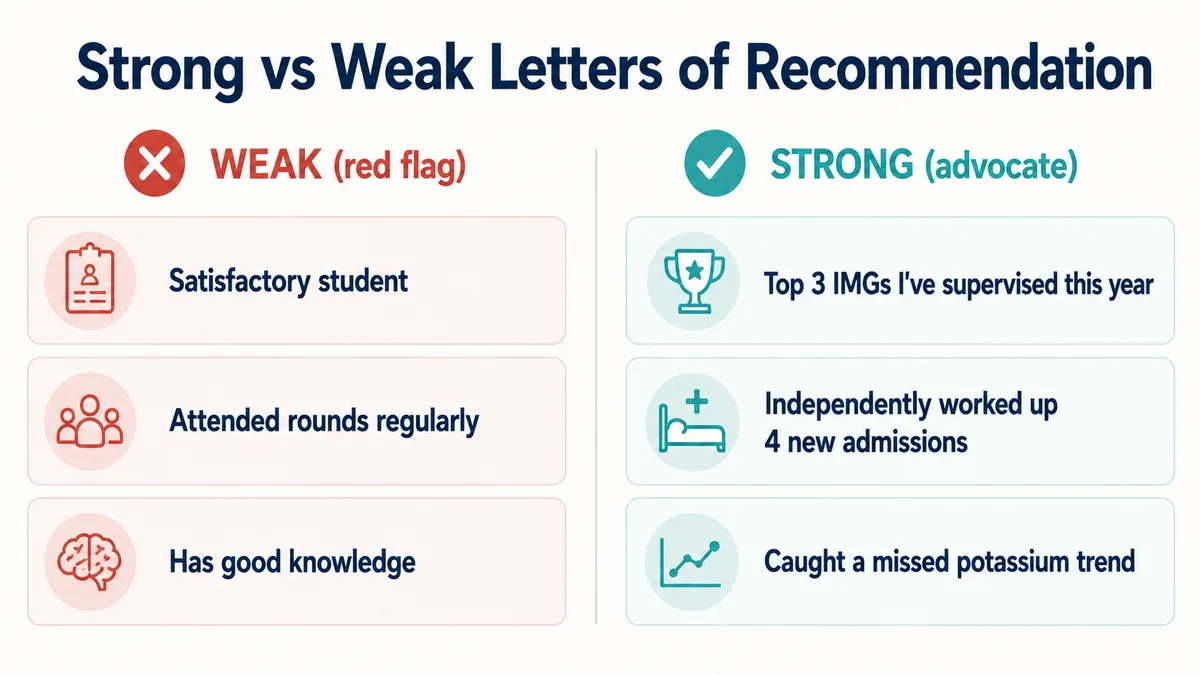
| Weak (red flag) | Strong (advocate) |
|---|---|
| “Dr. X was a satisfactory student.” | “Among the top 3 IMGs I have supervised this year.” |
| “Attended rounds regularly.” | “Independently worked up 4 new admissions and presented them flawlessly.” |
| “Has good knowledge.” | “Reasoned through a complex DKA case and caught a missed potassium trend.” |
| “Would do well in residency.” | “I would rank Dr. X to my own program without hesitation.” |
How to Ask — The Right Way
When to ask
Ask early — ideally at the start of a rotation, so the attending knows to watch your work, and again formally about a month before you need it submitted.
| When | Do this |
|---|---|
| Start of rotation | Tell the attending you hope to request a letter; then exceed expectations |
| End of rotation | Ask while the experience is fresh |
| ~1 month before submission | Send a formal request + your CV, personal statement, and deadlines |
| ~1 week before deadline | Send a polite reminder with the ERAS letter ID details |
The exact words to use
Ask in person (or by a warm email), and ask the key question directly: “Do you feel you know my work well enough to write me a strong letter of recommendation?” That phrasing gives a hesitant writer a graceful exit — which protects you from a weak letter.
“Dear Dr. ___, thank you again for your guidance during my [rotation] in [month]. I am applying for [specialty] residency in the 2027 Match and would be grateful if you feel able to write me a strong letter of recommendation. I have attached my CV and personal statement, and the letter would need to be uploaded to ERAS by [date]. Happy to share specific cases we worked on together if useful. Thank you for considering it.”
What to Give Your Letter Writer
Make it effortless for them to write a specific letter. Hand over a packet:
- Your updated USMLE CV
- Your personal statement (or a draft)
- The specialty you are applying to and why
- 2–3 specific cases or moments you worked on together
- The ERAS submission deadline and exact upload steps
Specialty Nuances You Should Not Ignore
The more competitive the specialty, the more PDs expect a letter of recommendation from within that field — and sometimes a specific department letter or chair’s letter. A balanced set usually pairs broad clinical letters with one specialty-specific letter:
| Applying to | Letter expectation |
|---|---|
| Internal Medicine / Family Medicine | 3–4 clinical letters; specialty letter helpful, not mandatory |
| Competitive fields (e.g. surgery, derm) | At least 1–2 letters from that specialty; often a chair/PD letter |
| Research-track / academic programs | Add a strong research mentor letter to the clinical set |
Waive Your Right to View — Always
When ERAS asks whether you waive your right to see the letter, say yes. Waived letters are assumed more candid, so PDs trust them more. Not waiving raises a quiet red flag — unless there is an extraordinary reason, always waive.
How Letters Get Submitted in ERAS
You generate a Letter Request Form in ERAS for each writer, share it with them, and they (or their designee) upload the letter directly — you never handle the file yourself. You then assign specific letters to specific programs. Confirm each letter shows as received well before deadlines. For the official process, see the AAMC ERAS and ECFMG resources, and the NRMP Match overview.
Common LOR Mistakes IMGs Make
- Asking too late — rushed letters are generic letters.
- Chasing famous names over writers who actually know you.
- Relying only on home-country letters with no US clinical letter.
- Handing over nothing — no CV, no examples, no deadline.
- Not waiving the right to view.
- Forgetting to confirm the letter was uploaded and assigned.
Your letters do not stand alone — they work together with your scores, CV, and interview performance as part of your overall USMLE preparation and Match strategy. Strengthen the whole file: dial in your Step 2 CK score, then prepare for what program directors expect in the Match interview. Want structured help across USMLE prep, USCE, and the Match? Explore our Step 1 & Step 2 CK program and see real success stories from IMGs we have guided.
Next step
Step 1 & Step 2 CK Prep
Structured modules, 1-on-1 mentorship, and a 100-day plan to clear the boards.