USMLE CV: How to Build a Strong Residency CV (2026)
Academic Director & USMLE Educator, Dermatology Resident

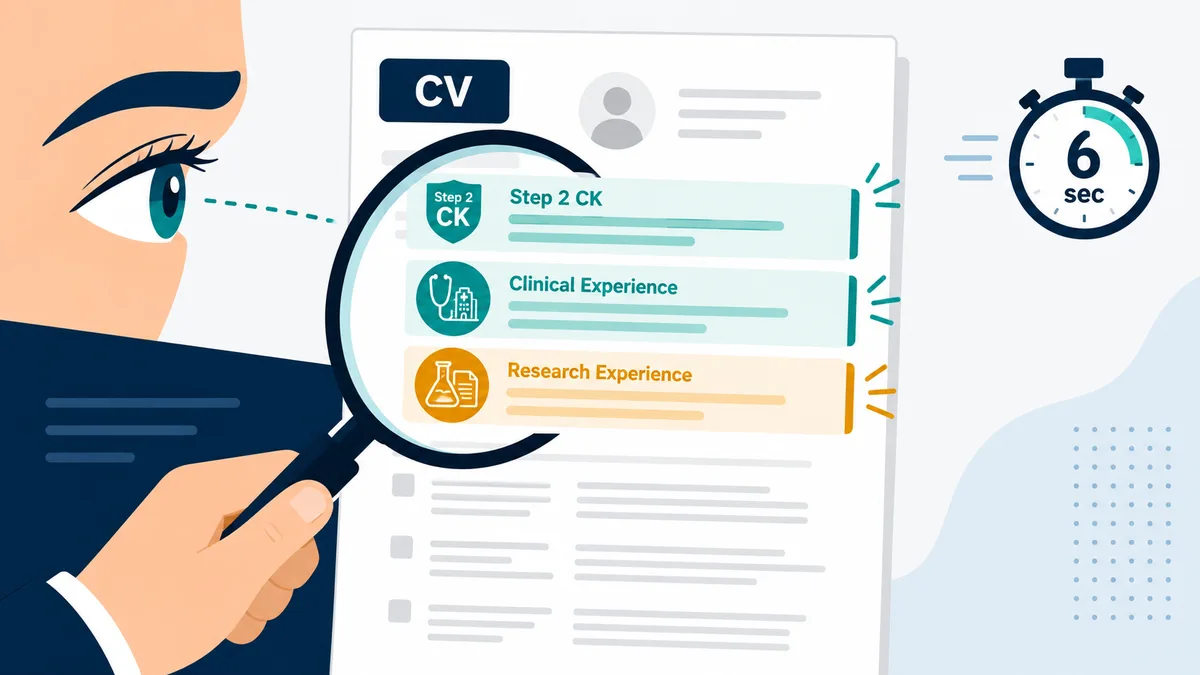
Your USMLE scores get your application opened. But your CV is the first thing a program director actually reads. In the 2026 Match, PDs are skimming record application volumes, and your curriculum vitae has roughly six seconds to signal that you are worth a closer look. A clean, evidence-backed CV gets you that closer look; a cluttered one buries your strengths no matter how strong they are.
For International Medical Graduates (IMGs) especially, a well-built CV does double duty. It vouches for your clinical ability and shows you can present yourself to US standards. This guide walks through exactly how to build one: the sections every CV needs, where to put your scores, how to phrase each entry so it lands, and the mistakes that quietly sink otherwise competitive applicants. Treat it as a core part of your wider USMLE preparation, not a last-minute formality. And because a strong CV reflects experiences you build over years (research, rotations, publications) start it early and keep it updated as you go, rather than assembling it the week before ERAS.
- Your CV gets a 6-second scan first. Structure it to be skimmed.
- Lead with education, then your strongest selling points.
- Put Step 2 CK (and Step 1 pass) where they are easy to find.
- Quantify every entry: numbers beat adjectives.
- IMGs: line up US clinical experience, strong LORs, and ECFMG certification.
- Tailor to your target specialty; cut anything that does not support it.
Why Your CV Matters: The 6-Second Scan
Program directors do not read your CV top to bottom on the first pass. They scan it. In those first seconds they are hunting for a handful of signals: your USMLE scores, your US clinical experience, your research output, and any red flags (gaps, exam attempts). If those are easy to find, you earn a real read; if they are buried under dense paragraphs and inconsistent formatting, you do not. Everything below is about making the right signals jump out fast. For what PDs weigh beyond the CV, see how strong letters of recommendation shape the Match.
Your CV vs the ERAS Application: What Goes Where
Many applicants confuse the two. ERAS (the Electronic Residency Application Service) is the structured online application programs actually review; the CV is your own one-document summary of the same career. You build the CV first. It becomes the master source you transcribe into the ERAS fields.
| Content | Your CV | ERAS application |
|---|---|---|
| Education, experiences, research | Summarized, one place | Entered field by field |
| USMLE scores | Listed prominently | Pulled from official transcript |
| Personal statement | Not included | Uploaded separately (per specialty) |
| Letters of recommendation | Not included | Uploaded by your letter writers |
The Sections Every Residency CV Needs
Use a clean, predictable order so a skimming PD always knows where to look. Lead with education and let your strongest material sit near the top.
| Section | What to include |
|---|---|
| Contact / personal info | Name, email, phone, location, ECFMG ID (IMGs) |
| Education | Medical school + dates, degrees, in reverse-chronological order |
| USMLE scores | Step 1 (Pass), Step 2 CK score, Step 3 if taken |
| US clinical experience | Rotations, externships, observerships, with what you did |
| Research & publications | Papers, posters, presentations, ongoing projects |
| Honors & awards | Distinctions, scholarships, class rank if strong |
| Professional memberships | Specialty societies, ECFMG, relevant organizations |
| Volunteer & leadership | Roles with real responsibility, quantified |
| Skills & languages | Certifications (BLS/ACLS), languages spoken |
Where to Put Your USMLE Scores
Since Step 1 is now pass/fail, simply list “Step 1: Pass.” Your Step 2 CK three-digit score is the number PDs screen on. Place it near the top, in its own clearly labeled line, where the 6-second scan will catch it. If your score is a genuine strength, do not bury it on page two. Building that score is the whole job of our 12-week Step 2 CK study plan.
Make Every Entry Count: Quantify the Impact
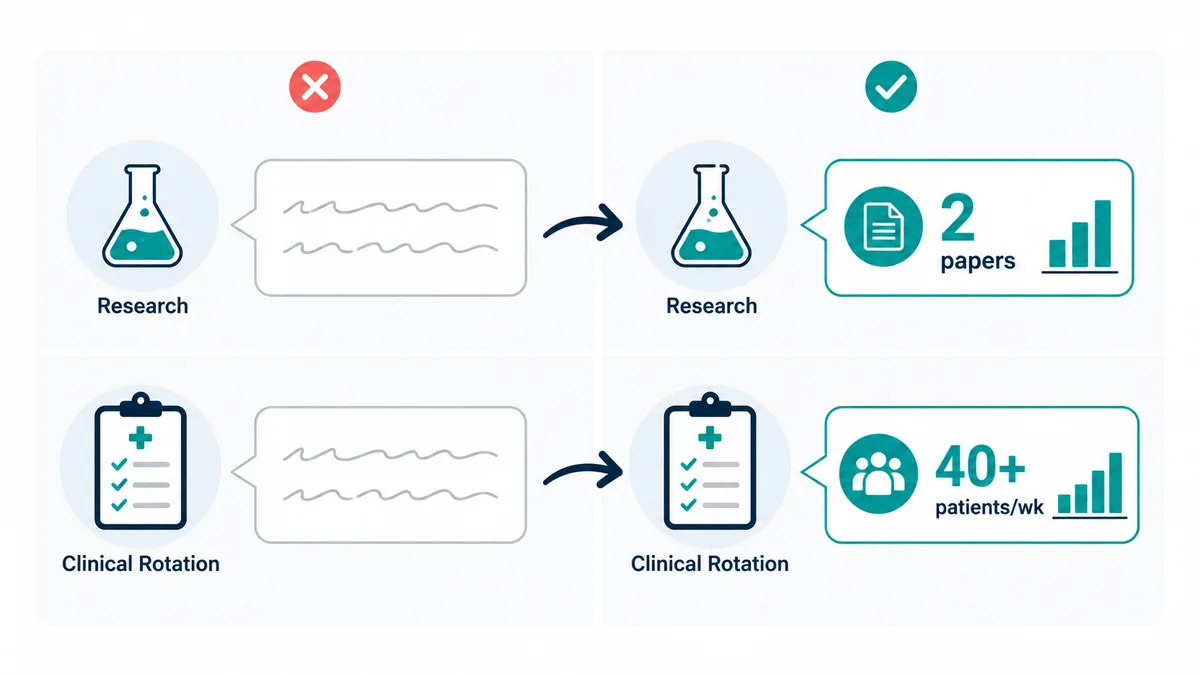
The single biggest upgrade you can make is to replace adjectives with evidence. PDs gloss over “participated in research”; they stop on “co-authored 2 publications and presented at a national conference.” For every line, ask: how many, how often, what was the result?
| Weak (vague) | Strong (quantified) |
|---|---|
| “Did research in cardiology.” | “Co-authored 2 peer-reviewed papers; presented 1 poster at ACC 2025.” |
| “Completed a clinical rotation.” | “4-week IM rotation; worked up 5–6 new admissions weekly, presented on rounds.” |
| “Volunteered at a clinic.” | “Ran intake for 40+ patients/week at a free community clinic for 6 months.” |
| “Member of student council.” | “Led a 12-member committee; organized 3 campus health drives.” |
Strengthening the Research Line
Research is one of the highest-leverage lines on an IMG CV, but quality and specificity beat a long list of half-finished projects. List publications, posters, and presentations with their venue and your exact role, and keep ongoing work labeled honestly as “in progress.” If your research section is thin, our guide on finding research opportunities for your USMLE CV during MBBS shows how to build it from scratch.
Tailoring Your CV to Each Specialty
A CV is not one fixed document. The strongest applicants reorder and trim it for their target field. Applying to a competitive specialty? Surface the rotations, research, and letters from that field and cut unrelated filler. The goal is that within the 6-second scan, a PD sees evidence you are serious about their specialty, not a generic applicant. Pair this with what program directors expect in the Match interview.
IMGs: The Extra Documents and Handling Gaps
IMGs carry a few documents US grads do not, and PDs expect to see them lined up:
- ECFMG certification: the baseline credential; list your ECFMG ID.
- MSPE (Dean’s Letter) and medical school transcript.
- US clinical experience: rotations/externships outweigh observerships.
- 3–4 letters of recommendation, ideally with US authors.
- Visa status, if relevant to the programs you target.
On gaps and red flags: do not hide them. PDs notice the missing time anyway. A gap filled with research, clinical work, or a clear explanation reads far better than an unexplained hole. Address it briefly and factually rather than leaving it to imagination.
Common CV Mistakes to Avoid
- A single typo: on a medical CV it signals carelessness; proofread and get a second reader.
- Listing without describing: a title with no context teaches the PD nothing.
- Burying your scores on page two instead of up top.
- One generic CV for every specialty.
- Unexplained gaps or inconsistent dates.
- Fancy formatting, photos, or graphics: keep it clean and ATS-readable.
These are exactly the kind of silent mistakes that cost strong applicants interviews.
Frequently Asked Questions
How long should a USMLE residency CV be?
For most students and recent graduates, 1–2 pages. Length should reflect real experience, not padding. A focused 2-page CV beats a bloated 4-page one. Cut anything that does not support your application to your target specialty.
Where do I put my Step 1 and Step 2 scores?
Near the top, in a clearly labeled line. List “Step 1: Pass” (it is pass/fail now) and your Step 2 CK three-digit score, which is the number program directors screen on. Make it catchable in the first few seconds.
Do I need research to match into residency?
It depends on the specialty. Competitive fields effectively expect research; less competitive ones value it but do not require it. A few specific, well-described projects beat a long list of vague ones. Quality over quantity.
Should I list every observership I have done?
List the ones where you can describe what you did and that support your target specialty. Hands-on rotations and externships carry more weight than passive observerships. Lead with those and don’t pad the section with brief shadowing.
Is a CV the same as the ERAS application?
No. The CV is your own one-document summary; ERAS is the structured online application programs review. Build the CV first. It becomes the master source you transcribe into the ERAS fields.
How do I explain a gap year on my CV?
Account for it honestly and briefly. Show what you did: research, clinical experience, exam preparation, or a personal reason stated plainly. An explained gap is far less of a red flag than an unexplained one.
Conclusion
A strong USMLE CV is not about doing more. It is about presenting what you have done so a busy program director sees your strengths in seconds. Lead with education, surface your scores, quantify every entry, line up your IMG documents, and tailor the whole thing to your specialty. Get those right and your CV stops being a formality and starts opening doors.
Want expert eyes on your application? Explore our USMLE Step 1 & Step 2 CK preparation program and see how our students have matched into U.S. residency.
Next step
Step 1 & Step 2 CK Prep
Structured modules, 1-on-1 mentorship, and a 100-day plan to clear the boards.