Dos and Don’ts for Crafting an USMLE Personal Statement
Academic Director & USMLE Educator, Dermatology Resident
Your personal statement has one job the rest of ERAS cannot do: let a program director hear your voice. But most advice online stops at “be authentic,” with no actual structure to work from, and no honest number for how long is too long.
This guide gives you the exact ERAS character limit versus what programs actually expect, a repeatable structure with an example for each part, how to handle specialty tailoring, the IMG-specific “why US residency” framing, whether to address gaps, and the clichés worth cutting before you submit.
- ERAS allows 28,000 characters, but PDs expect roughly one page (750–850 words).
- Use a hook → specialty connection → evidence → fit → close structure.
- Write one statement per specialty, lightly tailored for top-choice programs.
- Frame “why the US” as an asset, never as escaping your home country.
- Address gaps in 2–3 sentences max, then pivot forward.
The Real ERAS Character Limit
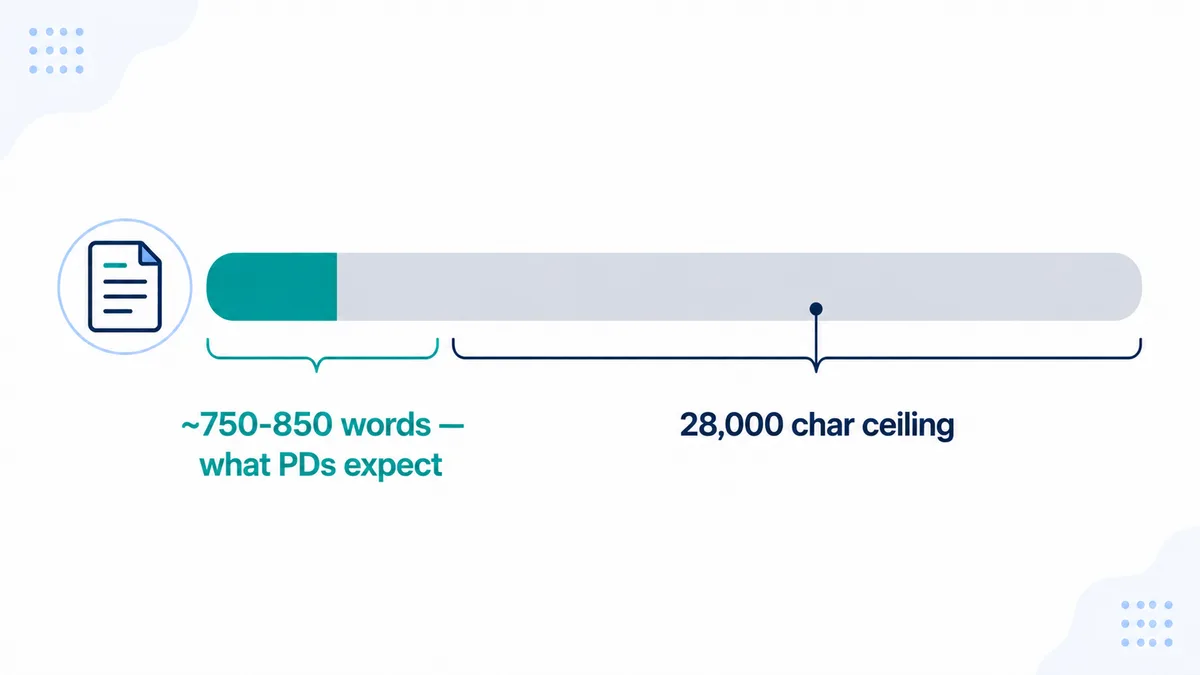
MyERAS technically allows up to 28,000 characters including spaces and punctuation, roughly seven pages of raw text. Almost nobody should use that much room. The practical target program directors actually expect is about one page when formatted: 4,000–5,300 characters, or 750–850 words. Treat the cap as a ceiling, not a goal.
A Structure That Works
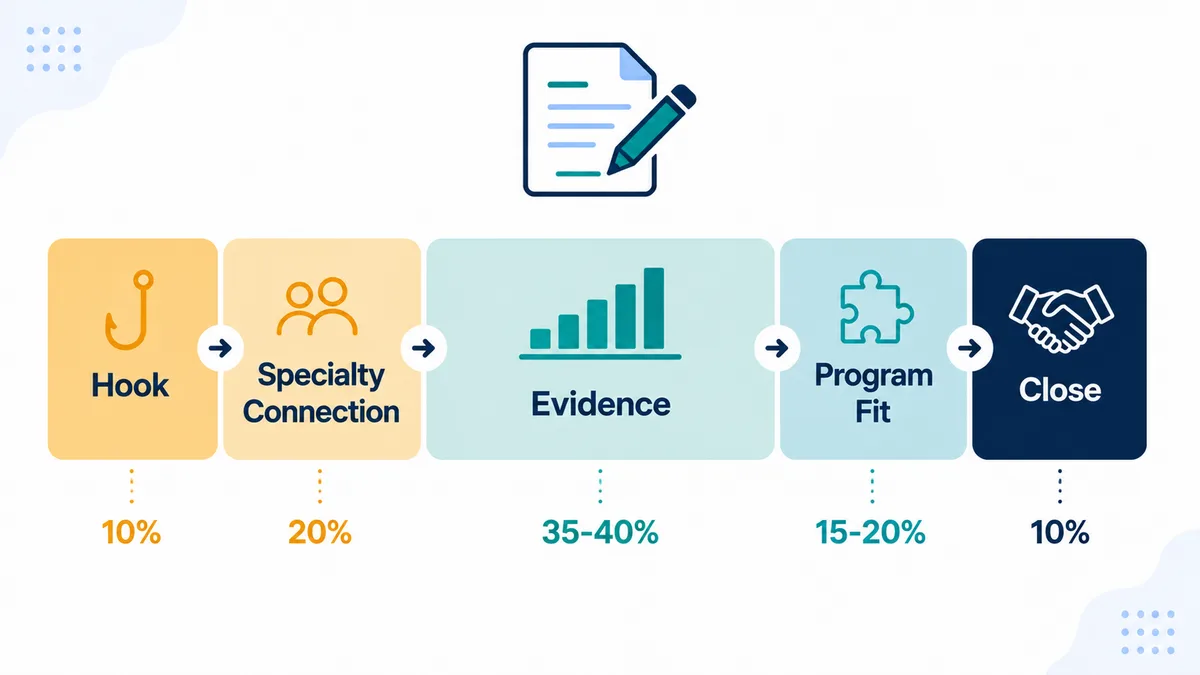
Rather than “tell a story” with no further guidance, use a five-part structure with a rough share of the essay for each:
| Part | Share | What it does |
|---|---|---|
| Hook | ~10% | One concrete sensory moment, no throat-clearing |
| Specialty connection | ~20% | Name the specialty; connect the hook to a real reason you chose it |
| Evidence | ~35–40% | Two or three qualities, each backed by one specific example |
| Program fit | ~15–20% | The type of training environment you want, tailored for top choices |
| Close | ~10% | Forward-looking, confident, no résumé restated |
Not: “Ever since I was a child, I wanted to be a doctor.” Instead: a single concrete moment with a specific detail: the alarm that kept sounding, the family watching you instead of the monitor, that earns its place in the first two sentences because it is genuinely yours, not generic.
One Statement or Many? Tailoring by Specialty
Write a distinct personal statement for each specialty you apply to. Reviewers notice when specialty reasoning has been generically stretched to cover two fields. You do not need a unique version for every program, but lightly tailoring the closing paragraph for your top 1–3 target programs can strengthen fit signals without the error risk of customizing dozens of versions.
Framing “Why US Residency” as an IMG
This is the section most IMGs get wrong. Do not contrast resource limitations at home with US superiority; it reads as running from something, not toward something. Instead, name a specific skill your background gave you: managing complex cases with limited resources, working across languages, adapting fast in high-volume settings, and connect it directly to what you will bring as a resident. Pair this with a well-built USMLE CV so the two documents tell a consistent story.
Should You Address Gaps or Red Flags?
Only if the gap meaningfully shaped your path and is not already explained elsewhere in ERAS. If you do address it, keep it to 2–3 sentences: state the fact plainly, then pivot quickly to what it taught you. Do not let it dominate the essay, and see our companion guide on letters of recommendation for how the same gap should be handled by your recommenders.
Clichés and Openings to Cut on Sight
- “Ever since I was a child/young, I always wanted to be a doctor.”
- A dictionary definition as an opening (“Webster’s defines ‘compassion’ as…”)
- Famous quotes (Hippocrates, Osler, Gandhi) used as an opening line
- A clinical case narrated like a chart note (“A 65-year-old male presented with…”)
- “Medicine is not just a profession, it is a calling.”
- A humble-beginnings origin story used as a substitute for real specialty reasoning
- Paragraphs that just re-list your CV in sentence form
Do Programs Check for AI-Generated Statements?
Programs do not run automated AI scans on ERAS submissions. The AAMC’s policy relies on applicant certification that the statement is your own work, not detection software, though a program director who notices a tone mismatch can still run your statement through a checker themselves. Worth noting: self-reported AI use in personal statements has actually been declining, from roughly 65% in the 2022–23 cycle to about 43.5% in 2024–25; write it yourself and it will read that way.
Frequently Asked Questions
What is the ERAS personal statement character limit for the 2026-2027 cycle?
MyERAS allows up to 28,000 characters, including spaces and punctuation, roughly seven pages of text. In practice, program directors expect a personal statement of about one page, or 4,000–5,300 characters (750–850 words). The 28,000 cap is a technical ceiling, not a writing goal.
Should IMGs write one personal statement or a different one for each specialty?
Write a distinct personal statement for each specialty you apply to; reviewers can tell when an essay’s specialty reasoning has been generically stretched across two fields. You generally do not need a separate version for every individual program, but light tailoring of the closing paragraph for your top 1–3 target programs can strengthen fit signals.
How do I explain “why US residency” without sounding like I'm running from my home country?
Frame your international training as an asset, not an escape. Instead of contrasting resource limitations abroad with US superiority, describe specific skills your background gave you, such as managing complex cases with limited resources or adapting quickly in high-volume settings, and connect them directly to what you will contribute as a resident.
Should I mention gaps or red flags in my personal statement?
Only if the gap significantly shaped your path and is not already explained elsewhere in ERAS. If you address it, keep it to 2–3 sentences, state the fact plainly, and pivot quickly to what it taught you; do not let it dominate the essay.
Do residency programs check personal statements for AI-generated content?
Programs do not run automated AI scans on ERAS submissions; the AAMC’s policy relies on applicant certification that the statement is your own work, not detection software. Program directors can still run a statement through an AI checker if the tone feels inconsistent with the rest of the application.
Conclusion
A strong personal statement is not about finding the perfect opening line. It is a structure: one real moment, a clear specialty connection, evidence instead of adjectives, honest fit, and a confident close, all inside about a page. Skip the clichés, frame your background as an asset, and let the rest of your application do the parts a personal statement was never meant to carry.
Want expert eyes on your application? Explore our USMLE Step 1 & Step 2 CK preparation program and see how our students have matched into U.S. residency.
Next step
Residency Match Strategy
Specialty selection, application strategy, and interview prep for the Match.