USMLE Step 1 Passing Standard 2026: Pass or Fail Explained

Academic Director & USMLE Educator, Dermatology Resident
The short answer
Step 1 has been reported as pass or fail since January 2022. There is no three digit score and no number to aim at. The only outcomes are pass, which is neutral, and fail, which is permanent and heavily filtered on.
Most articles on the Step 1 passing score still discuss 194 and 196, numbers that no longer appear on a score report. Here is what the standard means in 2026.
What replaced the score
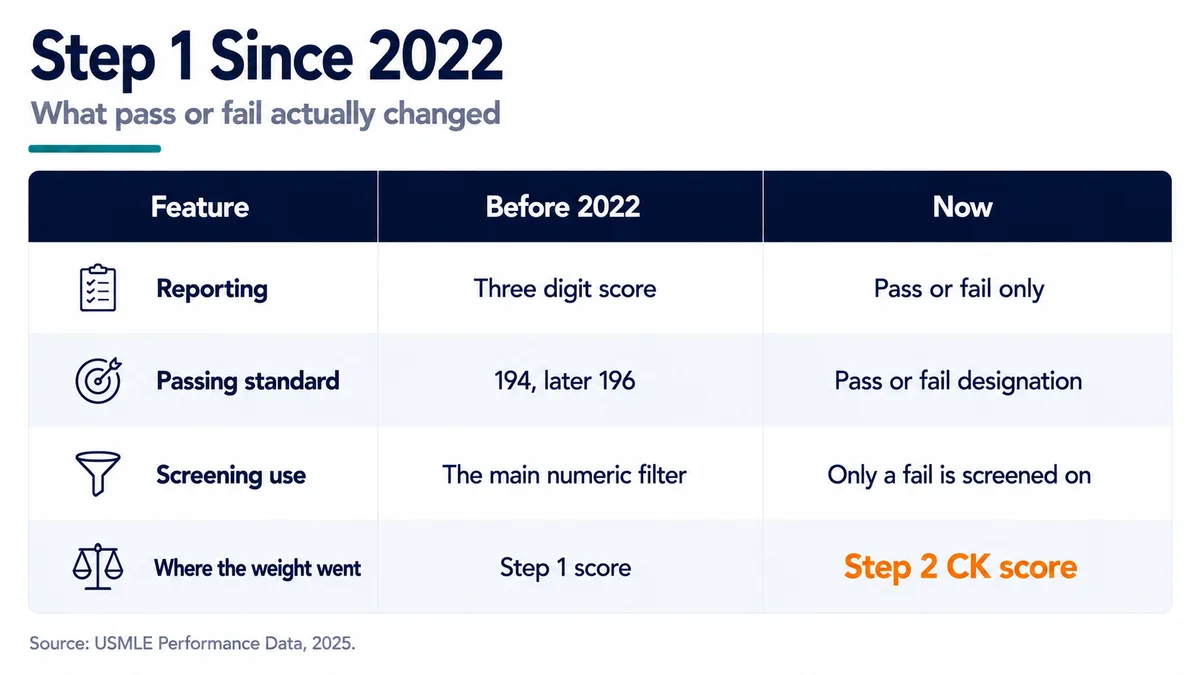
| Before 2022 | Now | |
|---|---|---|
| Reporting | Three digit score | Pass or fail only |
| Passing standard | 194, later 196 | Pass or fail designation |
| Screening use | The main numeric filter | Only a fail is screened on |
| Where the weight went | Step 1 score | Step 2 CK score |
What this means in practice
You cannot make Step 1 work for you any more. A comfortable pass and a marginal pass look identical to every programme. All the remaining value is in not failing, and every hour beyond a safe pass is better spent on Step 2 CK.
Why a fail costs more than it used to
When Step 1 was scored, a modest score was a weak signal among many. Now the exam can send only two signals, and one of them is negative.
- It is permanent. The attempt and result stay on your transcript. Passing later does not remove it.
- It is filtered automatically. Many programmes screen out any failed attempt before a human reads the application.
- The odds get worse. IMG first time takers passed at 75% in 2025; repeaters at 54%.
- Attempts are limited. Four per Step, in total.
The attempt rules
| Rule | Detail |
|---|---|
| Attempt limit | Four per Step, ever (was six before July 2021) |
| Within 12 months | No more than three attempts at the same Step |
| Fourth attempt timing | 12+ months after your first, 6+ months after your most recent |
| If exhausted | Permanently ineligible for that Step, and so for ECFMG certification |
How to know you will clear it
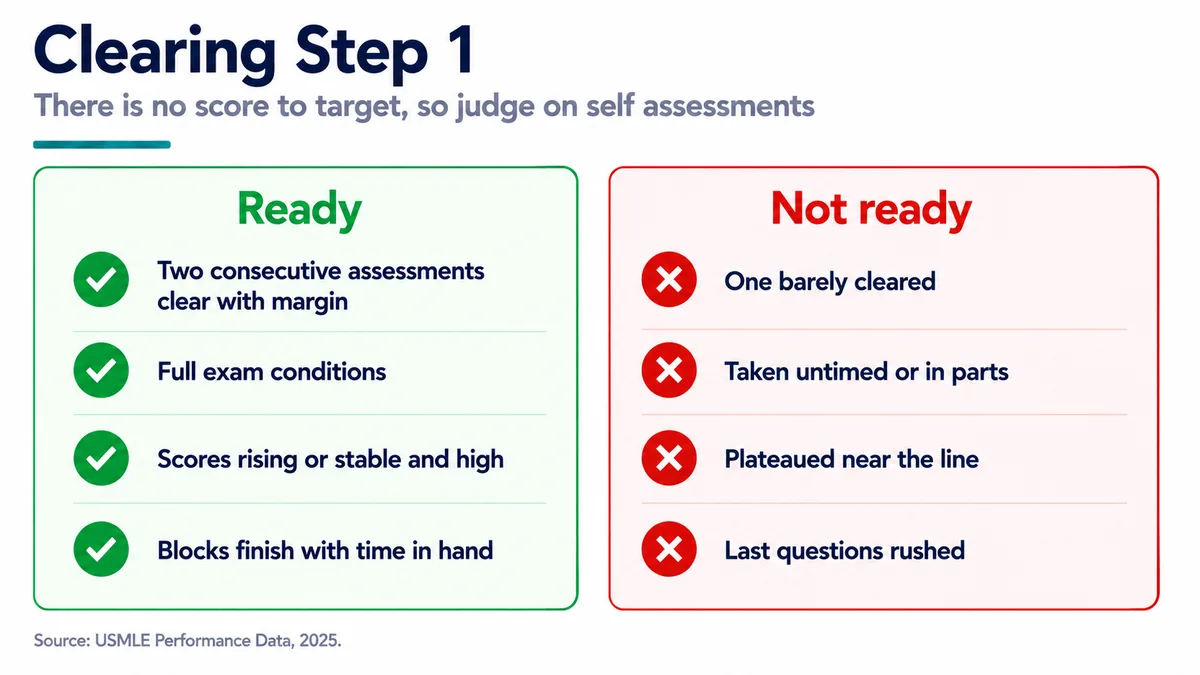
Since there is no score to aim for, readiness is judged entirely on self assessments.
| Ready | Not ready |
|---|---|
| Two consecutive self assessments clear with margin | One barely cleared |
| Taken under full exam conditions | Taken untimed or in parts |
| Scores rising or stable and high | Plateaued near the line |
| Blocks finish with time in hand | Last questions routinely rushed |
Margin is the whole point
A self assessment that scrapes the line predicts a result that scrapes the line, and the exam has natural variation. Because a pass carries no bonus for being comfortable but a fail is permanent, you want the largest margin you can reasonably reach, then stop.
The exam changed in May 2026
From 14 May 2026 Step 1 runs as 14 blocks of 30 minutes with up to 20 questions each, replacing 7 blocks of 60 minutes. Total questions remain capped at 280 and the day is still 8 hours, with minimum break time up from 45 to 55 minutes. Content and scoring are unchanged. Practise timed blocks at the new length.
The one sentence version
Pass safely, do not optimise, and move your surplus effort to Step 2 CK, which is the number that programmes actually screen and rank on.
Why the change happened
Step 1 was never designed as a ranking tool. It is a licensing examination, built to establish whether a candidate has the foundational knowledge to practise safely. Programmes used the score as a convenient screen because it was the only standardised number available for every applicant.
That produced known problems: applicants optimising for a licensing exam rather than for clinical learning, well documented score gaps between applicant groups, and mounting pressure on students during the pre-clinical years. Moving to pass or fail removed the screen and returned the exam to its stated purpose.
The consequence nobody advertised
Removing one numeric screen did not remove the need to screen. The weight moved to Step 2 CK and to softer signals such as letters, US clinical experience and school reputation. For IMGs this is a mixed outcome: one disadvantage disappeared, and the factors that replaced it are ones where IMGs often start further behind.
What to do with the time you are not spending on a score
- Reach a safe pass, then stop. There is no visible reward for a comfortable margin, only for the pass itself.
- Move surplus effort to Step 2 CK. It is now the number every filter uses.
- Start US clinical experience planning earlier. It rose in weight when Step 1 fell.
- Build relationships that produce letters. Specialty specific letters are cited by 84% of programme directors.
Preparing for a pass or fail exam
The change alters strategy more than most candidates realise.
| When it was scored | Now |
|---|---|
| Push for every extra point | Reach a safe margin and move on |
| Long dedicated periods paid off | Excessive dedicated time has no visible return |
| Score predicted Match outcomes | Only a fail affects Match outcomes |
| Delay to improve the number | Delay only until you will pass safely |
A useful reframe
Step 1 is now a hurdle rather than a race. You do not get credit for clearing it by a wide margin, but you must clear it. Train until clearing is not in doubt, then stop training for it.
If you are worried about failing
- Take a self assessment now, under real conditions, even if you feel unready. You cannot plan without knowing where you stand.
- Do not book on a plateau. Scores stuck near the line mean the method needs changing, not that more hours are needed.
- Diagnose before adding hours. Knowledge gaps, pacing and question technique each need a different fix.
- Get an outside opinion on your readiness. Self assessment of readiness is where most people are least accurate.
The asymmetry, once more
Postponing costs weeks. Failing costs a permanent transcript entry, a retake at 54% odds against 75% for first timers, and automated screening at many programmes. There is almost no situation where sitting a borderline exam is the better bet.
Sources
- USMLE Performance Data, 2025 pass rates and 2026 exam format.
- USMLE Bulletin of Information, attempt limits and retake timing.
Verified July 2026.
Next step
Step 1 & Step 2 CK Prep
Structured modules, 1-on-1 mentorship, and a 100-day plan to clear the boards.