Failing USMLE Step 1: What Happens Next and How to Recover (2026)

Academic Director & USMLE Educator, Dermatology Resident
The short answer
You can retake Step 1, but the rules are tight and the odds get worse. The limit is four attempts per Step. Among IMGs in 2025, first time takers passed at 75% while repeaters passed at only 54%. The attempt stays on your record permanently, and many programmes filter on it.
Failing Step 1 is not the end of a US residency career. Plenty of matched residents failed an attempt. But the recovery only works if you understand exactly what changed, and most people waste months by treating a retake like a repeat of the same preparation.
The rules, precisely
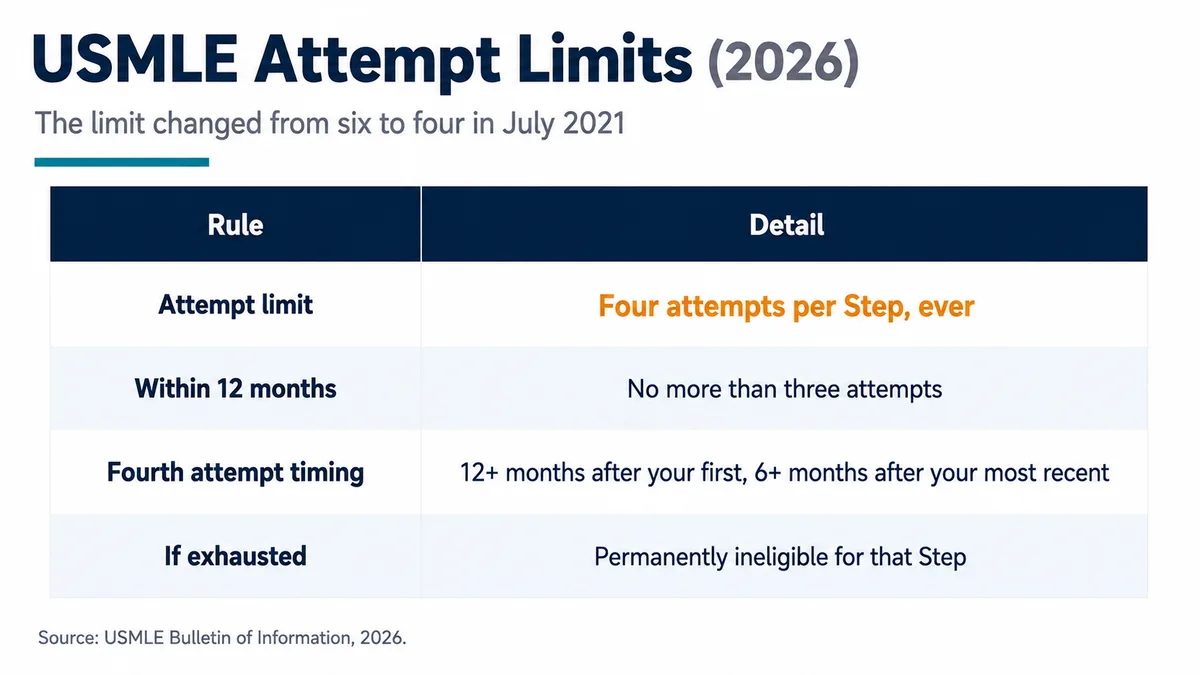
| Rule | Detail |
|---|---|
| Attempt limit | Four attempts per Step, in total, ever |
| Within 12 months | No more than three attempts at the same Step |
| Fourth attempt timing | At least 12 months after your first attempt and at least 6 months after your most recent |
| If you exhaust attempts | You become permanently ineligible for that Step, and therefore for ECFMG certification |
This limit used to be six
Before July 2021 the USMLE allowed six attempts. It is now four. Older advice online, and older seniors, may still be working from the six attempt assumption. They are wrong, and the difference matters enormously when you are planning a retake.
What programmes actually see
Step 1 has been reported as pass or fail since 2022, so there is no score to soften a fail. Your transcript shows the attempt and the result. Two consequences follow:
- It is permanent. Passing on a later attempt does not remove the earlier fail from your record.
- Many programmes filter on it. A significant share of programmes screen out applicants with any failed attempt before a human reads the application. This is a filter, not a judgement, and no amount of explaining gets you past a filter.
What this changes about your plan
After a fail, your list of realistic programmes shrinks. The correct response is not to apply more broadly to the same tier. It is to build the parts of your application that filters do not screen on, chiefly a strong Step 2 CK score and hands on US clinical experience, and to target programmes known to be IMG friendly.
Why repeaters pass at 54%
The gap between 75% and 54% is not because repeaters are less capable. It is because most repeats fail for the same reason as the first attempt, and that reason usually is not knowledge volume.
- They never diagnosed the actual failure. Running out of time, misreading question stems and genuine knowledge gaps need completely different fixes.
- They repeat the same passive method. Rereading First Aid a third time produces recognition, not recall.
- They retake too early. Applicants under financial or visa pressure book before their self assessments support it.
- They ignore self assessment scores. An NBME taken under real conditions is the only honest predictor available.
A recovery plan that works
Step 1: diagnose before you study
Take an NBME under full exam conditions before opening a single book. You need to know whether the problem is knowledge, timing, or test technique. Studying before you know which is guesswork.
Then, depending on what the diagnosis shows:
| If the problem was | Do this |
|---|---|
| Knowledge gaps in specific systems | Targeted review of those systems only, with a lecture resource, not a rereading of everything |
| Running out of time | Timed blocks exclusively. From 14 May 2026 Step 1 uses 14 blocks of 30 minutes, so practise at that rhythm |
| Careless errors on known material | Question technique work: read the last line first, predict before looking at options |
| Score plateau near the pass line | Do not book. A borderline self assessment predicts a borderline result |
Book on evidence, not on hope
The single highest value decision after a fail is refusing to schedule until two consecutive self assessments, taken under real conditions, clear the pass line with margin. A second fail costs far more than three extra months.
The exam changed in May 2026
If your first attempt was before 14 May 2026, the test you are retaking is structurally different:
| Before 14 May 2026 | From 14 May 2026 | |
|---|---|---|
| Blocks | 7 blocks of 60 minutes | 14 blocks of 30 minutes |
| Questions per block | Up to 40 | Up to 20 |
| Total questions | No more than 280 | |
| Break time | Minimum 45 minutes | Minimum 55 minutes |
The content and difficulty are unchanged. The pacing pressure is different, and anyone who failed on timing should train specifically at the new rhythm.
What to do in the first week
The week after a fail is when most of the damage is done, because people make permanent decisions in a temporary emotional state. A useful sequence:
- Do not book anything. Not the retake, not a course, not a coaching package. Nothing decided this week will be decided well.
- Read the performance feedback properly. Your report shows relative performance across content areas. It is imperfect, but it is real evidence about where you stood.
- Write down what actually happened on exam day. Did you run out of time in specific blocks? Did you second guess answers? Did whole topics feel unfamiliar? Memory fades fast and this is diagnostic material.
- Tell whoever needs to know. Concealing it from a mentor or family usually produces worse decisions under more pressure.
Diagnosing the actual cause
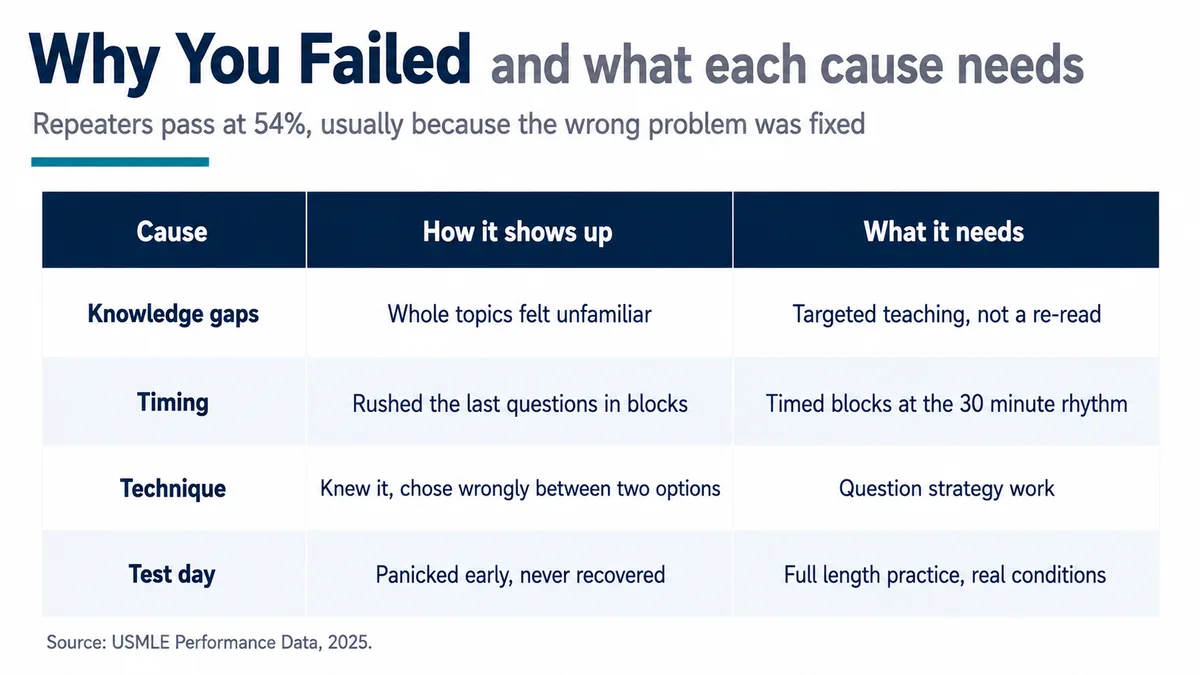
Repeaters pass at 54% largely because the second attempt addresses the wrong problem. There are four common causes and they need completely different responses.
| Cause | How it shows up | What it needs |
|---|---|---|
| Knowledge gaps | Whole topics felt unfamiliar; feedback shows weak areas clustered | Targeted teaching on those systems, not a general re-read |
| Timing | Rushed or guessed the last several questions in blocks | Timed blocks only, at the new 30 minute rhythm |
| Technique | Recognised the material but chose wrongly between two options | Question strategy work and disciplined review of near misses |
| Test day conditions | Slept badly, panicked early, never recovered | Full length practice under real conditions, several times |
The diagnostic that costs nothing
Go back through your last few hundred practice questions and sort every wrong answer into those four buckets. The distribution usually makes the cause obvious within an hour, and it is far more reliable than how the exam felt.
Rebuilding the application around the fail
Since a failed attempt is permanent and many programmes filter on it, the recovery is partly academic and partly strategic.
- Step 2 CK becomes the centrepiece. It is the only remaining number, and a strong score is the most effective counterweight available. Among IMGs, 90% of first time takers pass it.
- Hands on US clinical experience matters more, not less. Programmes that look past a fail are usually those that know you personally or trust the person writing your letter.
- Target deliberately. Programmes with a history of taking IMGs, and those that do not use hard screening filters, are where your application can actually be read.
- Address it briefly and without drama. If there is a genuine explanation such as documented illness, state it plainly once. Long justifications draw attention rather than deflect it.
What programmes are actually assessing
Not whether you failed, but whether you have shown it will not happen again. A fail followed by a strong Step 2 CK and solid clinical performance tells a recovery story. A fail followed by a marginal Step 2 CK tells a different one.
How long recovery realistically takes
Most candidates need three to six months of genuinely different preparation before a retake, not the four to six weeks people hope for. If your self assessments sat well below the pass line, plan for the longer end.
Budget for the application cycle too. A retake that pushes your ECFMG certification past a programme deadline costs you an entire year, so map the retake date against the application timeline before you book it.
Sources
- USMLE Bulletin of Information, attempt limits and retake timing rules.
- USMLE Performance Data, 2025 first time and repeat pass rates.
Figures verified July 2026.
Next step
Step 1 & Step 2 CK Prep
Structured modules, 1-on-1 mentorship, and a 100-day plan to clear the boards.