Salary After USMLE: What Doctors Actually Earn in the US (Monthly & Yearly)

Academic Director & USMLE Educator, Dermatology Resident

Most people searching this want one number. The honest answer is that there are two, and they are years apart: what you earn as a resident, and what you earn as an attending. Here is both, in monthly and annual terms, with sources.
- Residency (your first US income): $68,166 a year in PGY-1, or about $5,680 a month before tax and roughly $4,000–$4,300 in hand.
- Attending (after training): all-specialty average $386,000 a year, about $32,000 a month gross.
- The wait: 3 to 7 years of residency, longer with fellowship.
- Passing the USMLE does not pay anything by itself. It makes you eligible to match.
Resident salary: what you earn during training
Your first paycheque as a doctor in the US is a resident stipend. These are published annually by the AAMC, whose 2025 survey covers 350 accredited institutions and 114,361 residents and fellows.
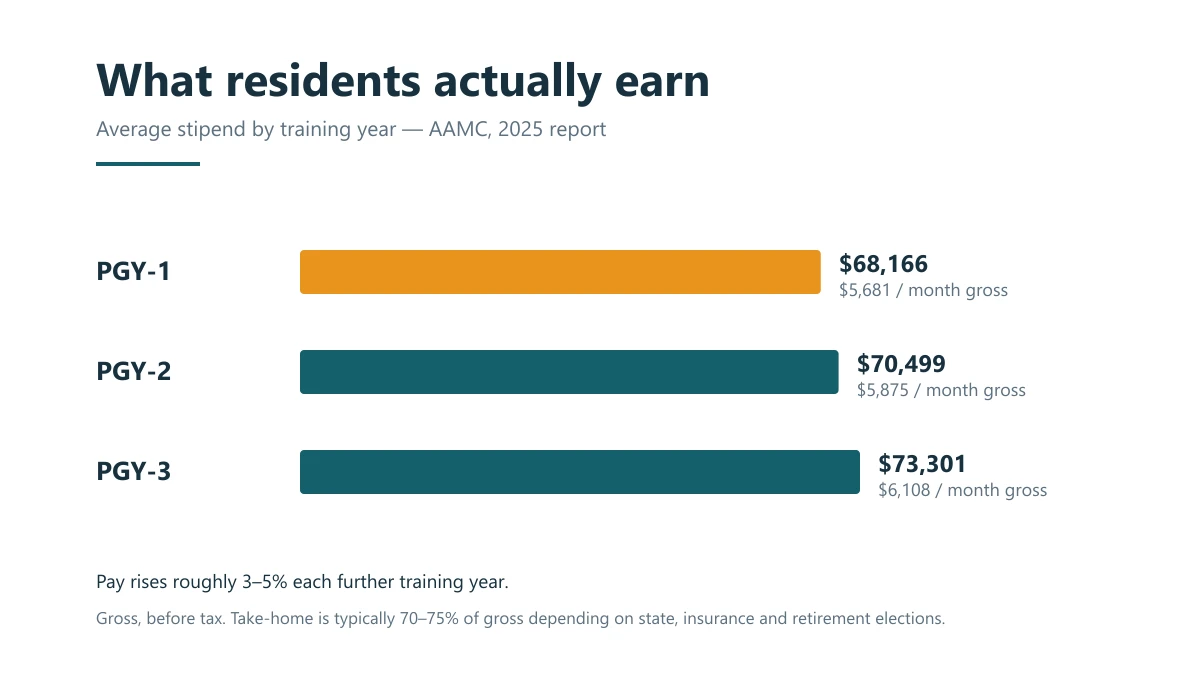
| Training year | Average annual stipend | Monthly, before tax | Roughly, in hand |
|---|---|---|---|
| PGY-1 | $68,166 | $5,680 | $4,000–$4,300 |
| PGY-2 | $70,499 | $5,875 | $4,100–$4,400 |
| PGY-3 | $73,301 | $6,108 | $4,300–$4,600 |
| PGY-4 and beyond | Rises roughly 3–5% per further year of training | ||
The AAMC publishes verified figures for PGY-1 to PGY-3. Later years are not broken out in the summary data, so treat the 3–5% annual increment as a guide rather than a promise, since it varies by institution. The "in hand" column is an estimate, not a quote: see the next section.
One thing that reliably reassures IMGs: resident pay is set by the programme and your PGY year, not by where you went to medical school. Every PGY-1 in a given programme is paid the same, whether they trained in Delhi or Detroit.
What actually lands in your account
This is where most salary articles stop being useful. A stated salary is not money you receive.
Federal tax, state tax, FICA, health insurance and retirement contributions all come out before you see anything. Physicians commonly report take-home in the range of 55 to 70% of gross, depending heavily on state and on how much they choose to put into retirement accounts.
A widely-shared example: a physician on a $228,000 academic salary reported around $8,600 a month reaching their account while deliberately maxing retirement contributions. Another on a similar figure reported closer to $10,400. Same nominal salary, very different monthly cash.
So the honest version of "a $300,000 salary" is somewhere between $14,000 and $17,000 a month in hand, and the difference is not lost money. A large part of it is retirement savings you are choosing to defer. Anyone quoting you a monthly figure without saying which they mean is not telling you much.
Attending salary by specialty
Once you complete residency you move to attending compensation, and the jump is abrupt rather than gradual. These are Medscape's 2026 averages.
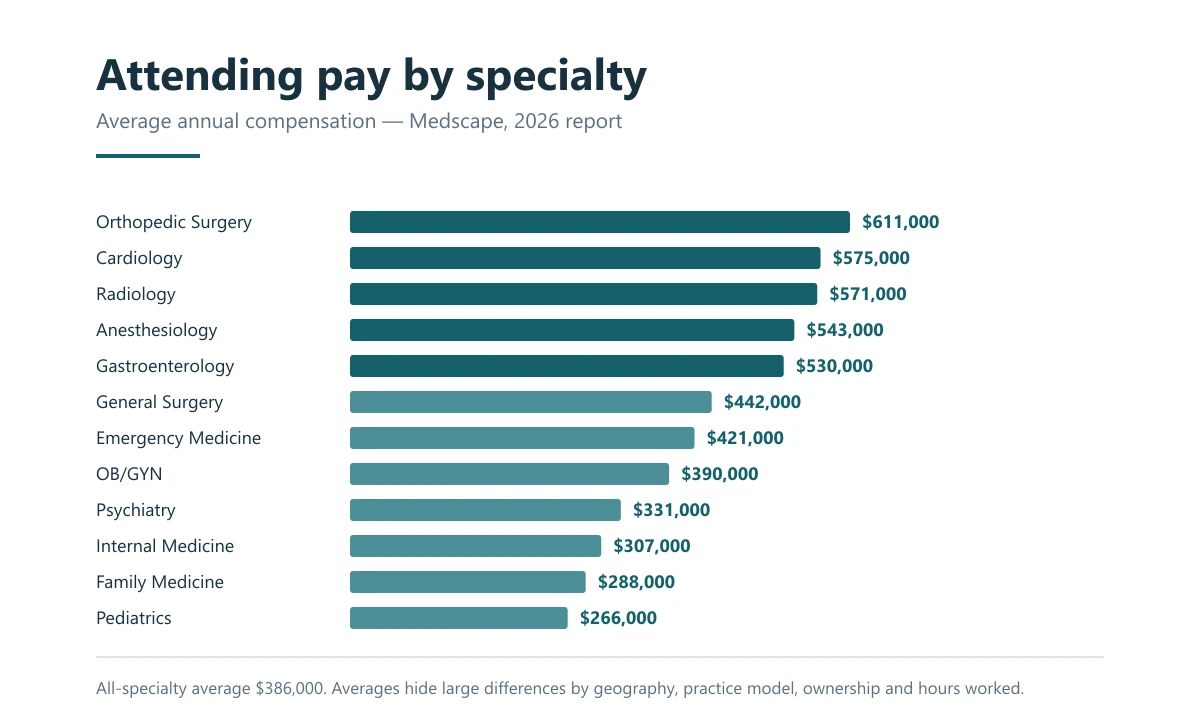
| Specialty | Average annual compensation |
|---|---|
| Orthopedic Surgery | $611,000 |
| Cardiology | $575,000 |
| Radiology | $571,000 |
| Plastic Surgery | $554,000 |
| Anesthesiology | $543,000 |
| Urology | $535,000 |
| Gastroenterology | $530,000 |
| Dermatology | $448,000 |
| General Surgery | $442,000 |
| Emergency Medicine | $421,000 |
| Pathology | $394,000 |
| OB/GYN | $390,000 |
| Neurology | $341,000 |
| Psychiatry | $331,000 |
| Internal Medicine | $307,000 |
| Family Medicine | $288,000 |
| Infectious Disease | $282,000 |
| Pediatrics | $266,000 |
| All specialties | $386,000 |
Why that table is more misleading than it looks
Specialty averages are the most-quoted and least-useful physician salary statistic. Two doctors in the same specialty can have completely different financial lives, because compensation depends on far more than the label.
- Geography routinely beats specialty. A family physician in an underserved region with productivity incentives and a partnership track can out-earn a subspecialist in a saturated coastal city. Desirable cities attract more applicants, which weakens your bargaining position.
- Employment structure changes everything. W-2 employee, contractor, partner, practice owner and productivity-based roles produce very different numbers from the same clinical work.
- Academic roles usually pay less. This surprises people who assume prestigious university hospitals pay best. They frequently trade compensation for research time, teaching and institutional support.
- Hours are invisible in the table. $500,000 with heavy call and 65-hour weeks is a different job from $400,000 with predictable four-day weeks. Ranked by pay per hour worked, specialty league tables reshuffle considerably.
Why residency pay feels lower than the number suggests
A $68,000 salary is not poverty by general standards, and people outside medicine often say so. The complaint is not really about the annual figure. It is about the hourly one.
Residents work far more than a standard working week, carry significant clinical responsibility, and have usually spent years accumulating debt and forgone earnings to get there. Divide the stipend by actual hours and the comparison changes character entirely.
There is also an opportunity cost that salary tables never show. While you are training, a peer who left university at 22 has been earning, investing and possibly buying property for a decade. Attending pay eventually overtakes that comfortably, but "eventually" is doing a lot of work in that sentence.
Can you actually live on a resident salary?
Usually yes, but location changes the answer more than anything else.
The same stipend that is comfortable in a low-cost city can feel tight in an expensive one, and the pay adjustment for high-cost areas rarely closes the gap fully. Dependents, debt repayments and visa-related constraints on a spouse working all shift the maths.
Applicants carefully compare a US resident salary against what they would earn at home, then never compare $68,000 in one US city against $68,000 in another. The second comparison frequently matters more to your daily life during training.
Moonlighting and the J-1 visa trap
Some residents boost their income substantially with extra clinical shifts, at rates that can add tens of thousands a year. It is a real option, with a real cost: you are selling the limited free time you have, during the years you most need recovery.
ECFMG prohibits moonlighting for J-1 physicians. Any employment outside the training programme listed on your DS-2019 is unauthorised employment, whether paid or unpaid and whether at your institution or elsewhere. ECFMG states there are no exceptions.
The consequences are not administrative footnotes: non-compliance can result in SEVIS termination and can affect your eligibility for future US visas.
Limited supplemental clinical activity within your own training site may be permitted with your programme director's approval and the required form submitted to Intealth. Confirm anything in this area with ECFMG and your GME office directly. Online forums give confidently wrong answers about this constantly.
Is fellowship worth the delay?
Not automatically. Choosing a fellowship means several more years on trainee pay before reaching specialist income, and the higher final salary has to make up both the lost attending earnings and the investment returns those earnings would have produced.
Depending on the numbers, the break-even point can sit many years after fellowship ends. That is an argument for doing the arithmetic, not an argument against fellowship, since choosing a thirty-year career purely from a spreadsheet has obvious problems of its own. The genuine financial risk is ending up in work you dislike enough to cut back or leave, which costs far more than any specialty differential.
When the money actually changes
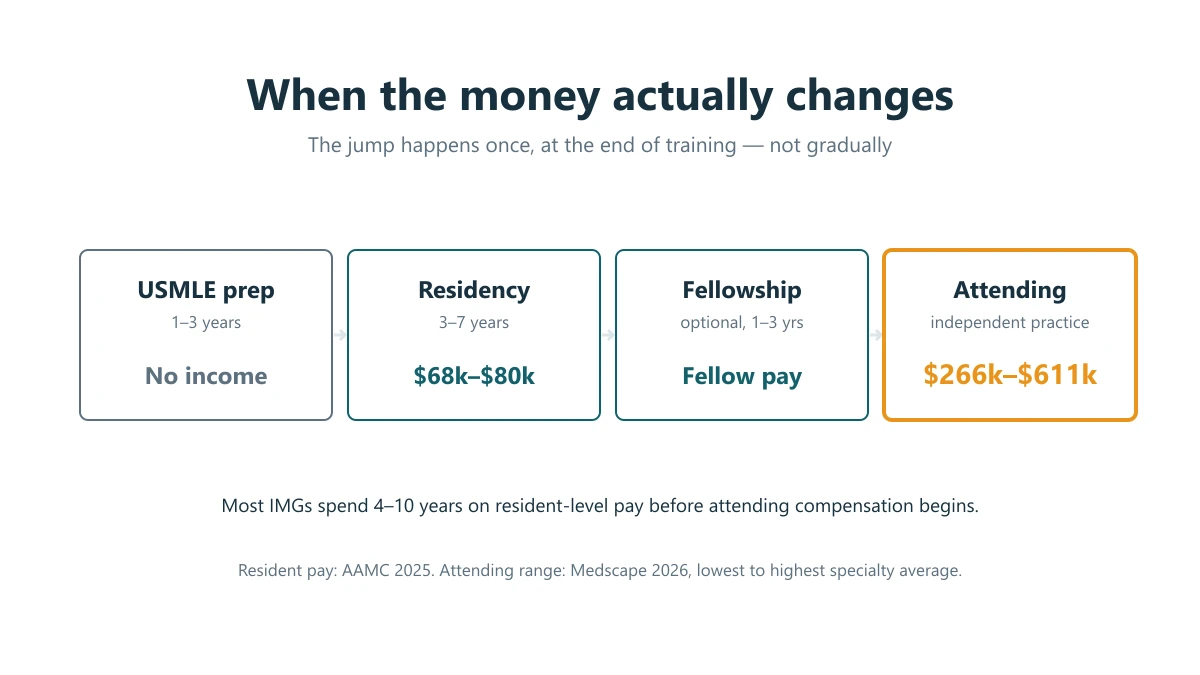
The financial shape of this career is not a gradual climb. It is a long flat stretch followed by one large step at the end of training. Planning around that, rather than around the attending figure you will eventually reach, is what makes the training years manageable.
After passing the USMLE, what comes next?
Nothing about your income changes when you pass. What changes is eligibility: you can pursue ECFMG certification and apply to residency through the Match. The pay follows the training position, not the exam. If you are working out sequencing, start with the Step 2 CK study plan and how IMGs should approach the Match.
Worth knowing too that USMLE scores do not last indefinitely, so the timeline between passing and matching matters.
Frequently Asked Questions
How much do doctors earn per month in the US after USMLE?
During residency, roughly $5,700 to $6,100 per month before tax, or about $4,000 to $4,600 after deductions. Once you finish training and work as an attending, the all-specialty average is $386,000 a year, which is about $32,000 a month gross. The gap between those two numbers is the single most important thing to understand about physician pay.
What is the salary after USMLE?
Passing the USMLE does not by itself produce a salary. It makes you eligible for residency. Your first US medical income is a resident stipend, averaging $68,166 in PGY-1 (AAMC, 2025). Attending pay begins only after you complete residency, 3 to 7 years later.
Does a $300,000 salary mean $25,000 lands in my account each month?
No. Federal and state tax, FICA, health insurance and retirement contributions come out first. Physicians commonly report take-home of roughly 55 to 70% of gross, so a $300,000 salary might mean $14,000 to $17,000 a month in hand. Higher retirement contributions lower the monthly figure further while increasing your total compensation.
Do IMGs get paid less than US graduates during residency?
No. Resident stipends are set by the program and your PGY year, not by where you went to medical school. Every PGY-1 in a given program is paid the same. Differences appear later, in attending roles, where specialty, geography, practice model and visa status shape your options.
Can I moonlight during residency on a J-1 visa?
No. ECFMG prohibits moonlighting for J-1 physicians. Any work outside your approved training programme as listed on your DS-2019, paid or unpaid, is unauthorised employment, with no exceptions. Violations can lead to SEVIS termination and affect future US visa eligibility. Limited supplemental clinical activity at your own training site may be possible with programme-director approval and the required form submitted to Intealth.
Which specialty pays the most?
Orthopedic surgery leads Medscape's 2026 report at $611,000, followed by cardiology at $575,000 and radiology at $571,000. Pediatrics is lowest among major specialties at $266,000. But geography, practice model and ownership routinely matter more than specialty choice. A well-structured job in an underserved market can out-earn a prestigious one in a saturated city.
Resident stipends: AAMC Survey of Resident/Fellow Stipends and Benefits, 2025 report (data as of 1 July 2025; 350 institutions, 114,361 trainees). Attending compensation: Medscape Physician Compensation Report 2026. J-1 employment rules: ECFMG Exchange Visitor Sponsorship Program. Figures are averages and date quickly, so check the current reports before making decisions.
Getting from exam to Match to a job that pays well is a sequencing problem as much as a scores problem. Explore our mentorship program, or read how other IMGs have made the move.
Next step
Step 1 & Step 2 CK Prep
Structured modules, 1-on-1 mentorship, and a 100-day plan to clear the boards.