The Ultimate 6-Month USMLE Step 1 Blueprint: From Foundation to Exam-Ready

Academic Director & USMLE Educator, Dermatology Resident
For medical students and International Medical Graduates (IMGs) across the globe, the USMLE Step 1 remains one of the most significant milestones on the road to a U.S. residency. It is a marathon that tests not just your medical knowledge, but your endurance, clinical reasoning, and ability to perform under pressure.
While the move to a pass/fail system changed the optics, the intensity of the material has not. Navigating the sheer volume of high-yield concepts takes more than hard work—it takes a clear plan with no guesswork. Drawing on a methodology trusted by 1,000+ Step 1 achievers, we’ve distilled preparation into a comprehensive, month-by-month USMLE Step 1 study plan that takes you from “0 to ready” in exactly six months.
The 6-Month Step 1 Study Plan at a Glance
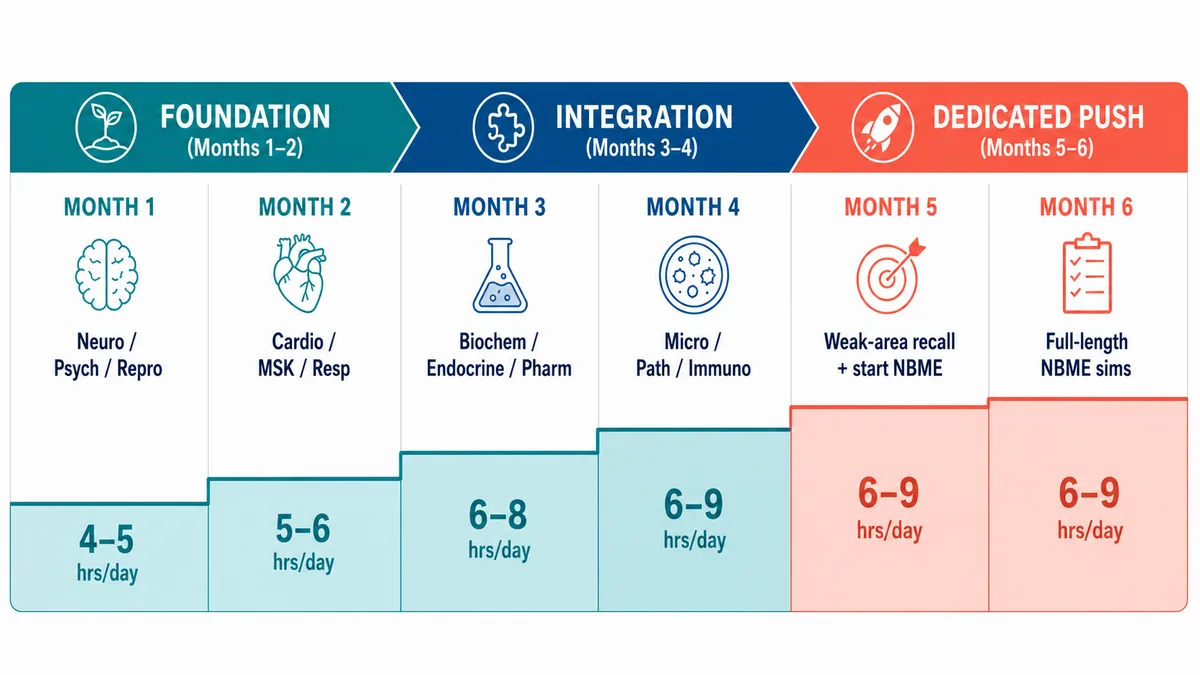
| Month | Phase | Hours/day | Focus systems | Practice volume |
|---|---|---|---|---|
| 1 | Build the foundation | 4–5 | Neurology, Psychiatry, Reproduction | 1–3 test blocks |
| 2 | Build momentum | 5–6 | Cardiology, MSK & Dermatology, Respiratory | 2–4 test blocks |
| 3 | Deepen & integrate | 6–8 | Biochemistry, Endocrine, Pharmacology | 3–4 test blocks |
| 4 | Apply & advance | 6–9 | Microbiology, Pathology, Immunology | 4–6 test blocks |
| 5 | Refine & master | 6–9 | Weak-area integration + recall | Begin NBME self-assessments |
| 6 | Final review | 6–9 | Full-length simulations | Most-predictive NBME forms (timed) |
Phase 1: Building the Medical Foundation (Months 1–2)

The biggest mistake students make is jumping into practice questions before they understand the “language” of the exam. The first two months build a base strong enough to support complex clinical reasoning later.
Month 1 — Learn the Language
Spend the first 30 days building the base at roughly 4–5 hours a day, using foundational resources—First Aid, video lectures, and a QBank. Prioritize Neurology (pathways and lesion localization), Psychiatry (DSM-5 criteria and psychopharmacology), and Reproduction (embryology, anatomy, and pathology). Close the month with 1–3 test blocks to gauge retention.
Month 2 — Build Momentum
Now turn knowledge into understanding. Nudge the load to 5–6 hours a day and make active recall a daily habit to fight the forgetting curve. Tackle the heavy hitters: Cardiology (hemodynamics and ECG interpretation), Musculoskeletal & Dermatology (high-yield visual recognition), and Respiratory (acid–base balance and pulmonary mechanics). Build to 2–4 test blocks.
Phase 2: Deepening Integration and Clinical Reasoning (Months 3–4)
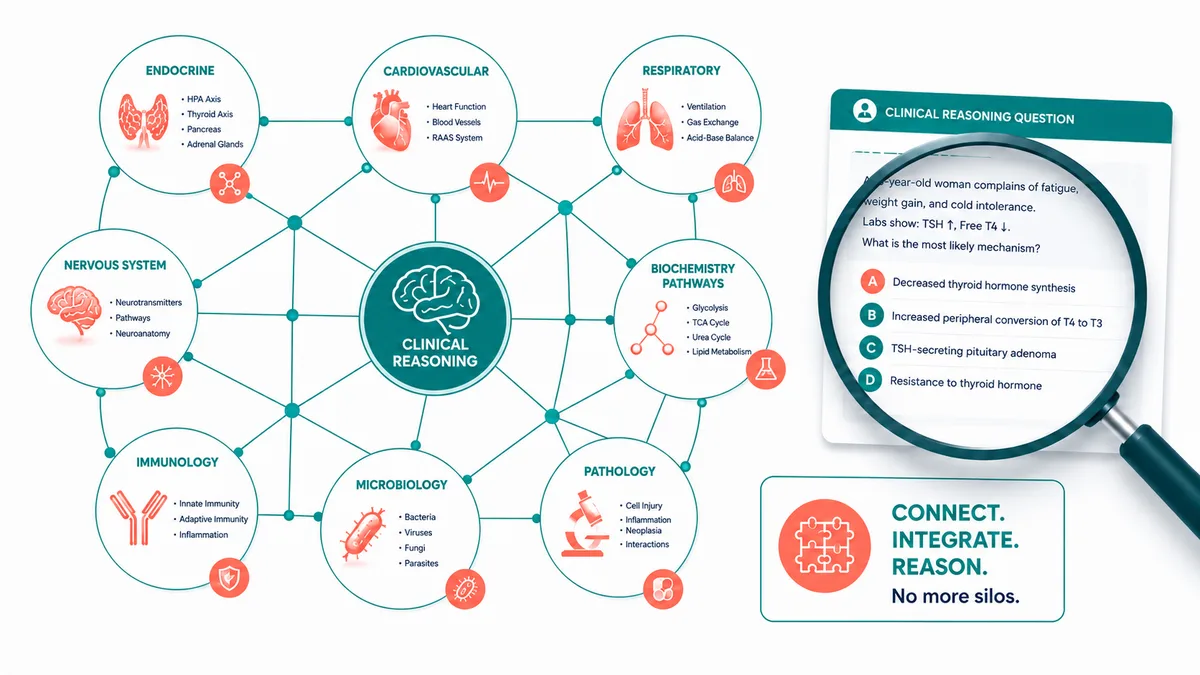
By month three, siloed studying must end. Step 1 questions are rarely about a single fact—they reward you for connecting systems.
Month 3 — Deepen and Integrate
Master the “why” behind every answer. Raise the commitment to 6–8 hours a day and connect concepts across disciplines: Biochemistry (metabolic pathways and genetic disorders), the Endocrine system (feedback loops and hormonal imbalances), and general pharmacology (pharmacokinetics and pharmacodynamics). Aim for 3–4 test blocks.
Month 4 — Apply and Advance
This is the bridge to the dedicated period—improve accuracy and stamina at 6–9 hours a day. Add Anki / spaced-repetition flashcards to keep the enormous volume of Microbiology and Pathology fresh. Cover Microbiology (the bugs and their hallmarks), general Pathology (the cellular response to injury), and Immunology. Push to 4–6 test blocks to build endurance, and treat every question as a learning opportunity—not just an assessment. (That single shift avoids one of the 5 silent USMLE killers.)
Phase 3: The Dedicated Push and Mastery (Months 5–6)

The final two months separate those who pass from those who excel. This is where consistency compounds and progress truly shows.
Month 5 — Refine and Master
At 6–9 hours a day, hunt down and destroy weak areas while reinforcing recall through constant repetition. This is also your first real reality check: begin the NBME self-assessments (CBSSAs), starting with the older forms—they are excellent for surfacing knowledge gaps and getting comfortable with the NBME’s style of questioning.
Month 6 — Final Review and Exam Simulation
In the final stretch, simulate the exam. Stay in the 6–9 hour range, balancing active review with full-length, timed practice. Move on to the newer, most-predictive NBME forms under exam-like conditions—they are the best gauge of where you actually stand and build the mental stamina you need for a full testing day.
The Essential Resource Toolkit: The “Golden Five”
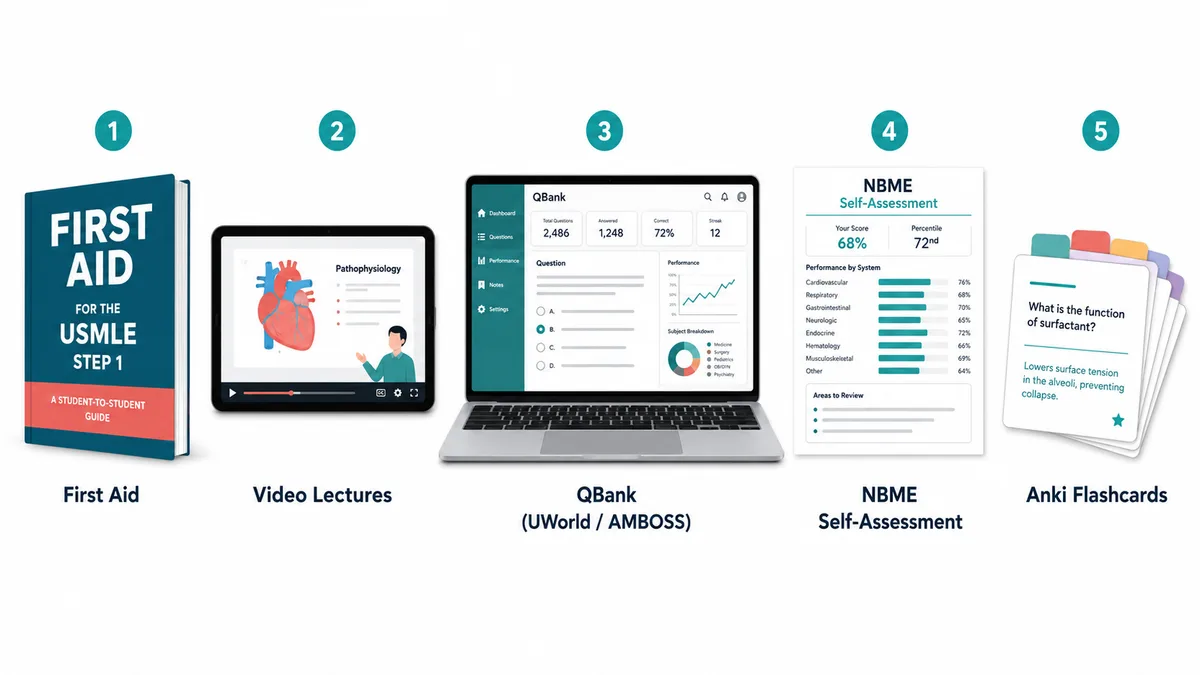
Over-resourcing is a classic trap that leads to burnout and shallow learning. Stay disciplined with a streamlined set:
- First Aid for the USMLE Step 1 — your “bible.” Every note you take should eventually find a home here.
- Video lectures — for the foundation phase, to clarify tough Physiology and Biochemistry.
- A QBank (UWorld or AMBOSS) — the engine of the apply-and-advance phase. Learn from every question, whether you get it right or wrong.
- NBME self-assessments — non-negotiable for tracking progress and confirming you are exam-ready.
- Anki / flashcards — introduced around month 3–4 to lock in high-yield facts for the long haul.
Why This Blueprint Works: The Psychology of Success
Most students who never reach exam-ready confidence don’t lack intelligence—they lack structure. This plan rests on three pillars:
- No guesswork. You know exactly what to study and when, removing the decision fatigue that fuels procrastination.
- Consistency compounds. Starting at 4 hours and scaling to 9 avoids early burnout while still reaching the peak intensity the final review demands.
- Mastery of the “why.” Focusing on clinical reasoning and integration in the middle months lets you reason through unfamiliar, curveball questions from first principles.
Frequently Asked Questions
Is 6 months enough to prepare for USMLE Step 1?
For most students studying consistently, yes. Six months is enough to build a foundation, integrate systems, and complete a dedicated review period—provided you start active questions early and scale your hours gradually instead of cramming at the end.
How many hours a day should I study for Step 1?
Begin at about 4–5 hours a day in month 1 and build toward 6–9 hours during the dedicated period (months 4–6). Ramping up gradually protects you from early burnout.
When should I start NBME self-assessments?
Around month 5. Use the older forms first to surface knowledge gaps, then move to the newer, most-predictive forms under timed conditions in month 6.
UWorld or AMBOSS — which QBank is better?
Both are excellent. Most students pick one as their primary QBank and treat every question as a learning tool. What matters most is reviewing the explanations deeply, not the brand on the box.
Final Thoughts for the Step 1 Candidate
The journey from “0 to ready” is not easy, but with a month-by-month roadmap it is entirely achievable. Whether you are a USMD, a DO, or an IMG, the principles—active recall, spaced repetition, and systematic integration—stay the same. Depth today leads to confidence tomorrow.
Working with a shorter runway? See our 8-week Step 1 study schedule for a dedicated-period plan, and use how long to study for Step 1 to choose the right timeline for you.
Ready to follow a structured plan with faculty guidance? Explore our USMLE Step 1 & Step 2 CK preparation program and see how our students have matched into U.S. residency. Stay consistent, stay confident—and we’ll see you on Exam Day.
Next step
Step 1 & Step 2 CK Prep
Structured modules, 1-on-1 mentorship, and a 100-day plan to clear the boards.