IMG Match Rate 2026: Specialties, Step 2 CK Scores & Interviews

Academic Director & USMLE Educator, Dermatology Resident
If you are an international medical graduate working towards the U.S. residency Match, you have heard the rules. You need a very high Step 2 CK score. You need a long publication list. Internal Medicine is the safe choice. One more year strengthening your CV is always worth it. And if too many years have passed, the door has closed. And if you are a strong applicant, it will work out eventually.
The trouble is that almost all of that comes from individual stories. Somebody matched Internal Medicine with a 245, so 245 becomes the magic number. Somebody else had nine publications and went unmatched, so research apparently does not matter. Neither tells you what happened across thousands of applicants — which is the only thing that should be shaping your USMLE preparation and your Match plan. The 2026 NRMP data does tell you that, and read together rather than one table at a time, it points somewhere fairly specific: for most non-U.S. IMGs, the Match is not won by maximising every part of the application. It is won by finding the one thing currently stopping you from generating interviews, and fixing that first.
- 56.4% of non-U.S.-citizen IMGs who submitted a rank list matched to a PGY-1 position in 2026 — 6,733 of 11,944 — against 70.0% for U.S.-citizen IMGs.
- The widest gap in the whole dataset is not a score gap. It is visa status: 54.4% for applicants needing sponsorship vs 67.9% for those who did not.
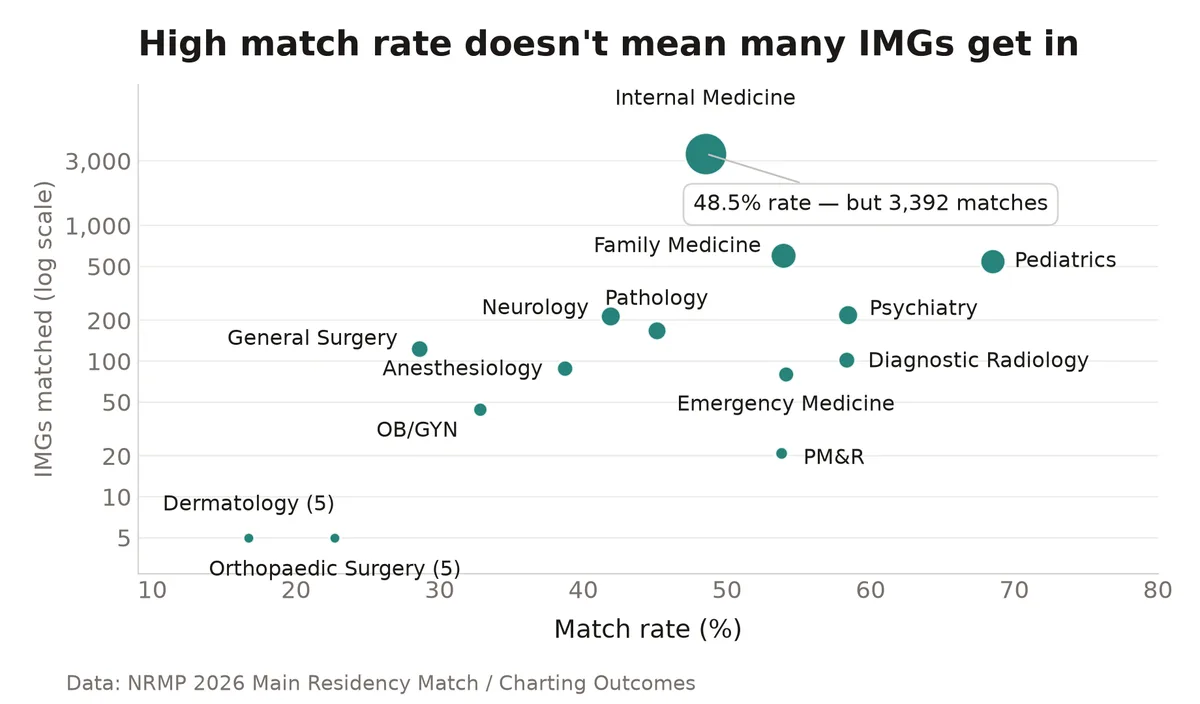
- “IMG-friendly” needs two answers — rate and volume. Internal Medicine sits mid-table at 48.5% but produced 3,392 matched IMGs.
- In every specialty, matched applicants had a run of programs to rank and unmatched applicants had one or two. Interviews, not the algorithm, decide most outcomes.
- The Step 2 CK gap between matched and unmatched is modest — about 8 points in Internal Medicine, and zero or reversed in Family Medicine, PM&R and Diagnostic Radiology.
- Median publications for a matched Internal Medicine IMG: three. Not ten. Not twenty.
On that last point: the year on your diploma is not a published NRMP screening criterion — we traced where that belief comes from in is it too late to start the USMLE.
The 2026 IMG Match Numbers at a Glance
Start with the headline figures. In 2026, 11,944 non-U.S.-citizen IMGs submitted a rank order list and 6,733 matched to a PGY-1 position — a 56.4% match rate, against 70.0% for U.S.-citizen IMGs applying for the first time. Meanwhile the non-U.S. IMG applicant pool had grown 51.9% since 2022.
| 2026 Main Residency Match | Figure |
|---|---|
| Non-U.S.-citizen IMGs who submitted a rank list | 11,944 |
| Non-U.S.-citizen IMGs matched to PGY-1 | 6,733 (56.4%) |
| U.S.-citizen IMGs, first-time applicants | 70.0% |
| Non-U.S. IMGs needing visa sponsorship | 54.4% |
| Non-U.S. IMGs not needing sponsorship | 67.9% |
| All positions offered / filled | 44,344 offered, 41,482 filled |
| Growth in the non-U.S. IMG applicant pool since 2022 | +51.9% (7,864 → 11,944) |
Here is the part people find counterintuitive. The 2026 Match was the largest in NRMP history — 44,344 positions offered and 41,482 filled. More residency positions existed than ever before, and the non-U.S. IMG match rate fell anyway.
The explanation is mostly arithmetic. Non-U.S. IMG applicants went from 7,864 in 2022 to 11,944 in 2026. The pool has been growing considerably faster than the residency market it is competing for.
Which means your timeline is not only an administrative question. It is a competitive one. This is not an argument for rushing in before you are ready — that fails for its own reasons. It is an argument that an extra year should buy something specific and identifiable, because the field you will be applying against next cycle is likely to be larger than this one. If you are still mapping out when each piece has to happen, our month-by-month residency Match timeline lays out the calendar.
Visa Sponsorship Is the First Filter, Before Any Score
For the first time, NRMP split non-U.S. IMG outcomes by visa status, and the result deserves more attention than it has had. Applicants who needed sponsorship matched at 54.4%. Applicants who already held permanent work authorisation matched at 67.9%. That is a 13.5-point gap inside the same applicant category — wider than any Step 2 CK gap anywhere in this article.
You cannot change your citizenship for this cycle, so the useful response is not despair. It is to treat sponsorship as a filter that runs before a human reads your file, and to build your program list accordingly. A program that has never sponsored your visa type is not a long shot. It is a closed door, and an application fee spent there is an application fee not spent somewhere real.
| J-1 (ECFMG-sponsored) | H-1B (program-sponsored) | |
|---|---|---|
| Who sponsors | ECFMG, for almost every training program that takes IMGs | The institution itself — legal cost and paperwork sit with them |
| Availability | Very wide — the default route for most non-U.S. IMGs | A minority of programs, concentrated in larger systems |
| USMLE requirement | Step 1 and Step 2 CK plus ECFMG certification | Usually Step 3 passed before the petition is filed |
| After training | Two-year home-country requirement unless waived (e.g. Conrad 30) | Dual intent — a cleaner route towards permanent residency |
| Practical read | Widest possible program list | Smaller list, but plan Step 3 early if you want it open |
- Check each program’s stated sponsorship policy, then sanity-check it against who is actually on their current resident roster.
- If H-1B matters to you, get Step 3 done in time to be filed on — deciding in March is deciding too late.
- Keep your ECFMG certification pathway on schedule; a certification delay closes doors that a score never would.
- Treat “we sponsor J-1 only” as useful information, not rejection — most non-U.S. IMGs match on a J-1.
Which Specialties Are Actually IMG-Friendly?
This is the most common question we get, and it is usually asked in a way that cannot be answered, because “IMG-friendly” hides two different questions. What share of IMGs who wanted this specialty got it? And how many IMGs did it actually absorb? You need both, because a specialty can post a healthy percentage while taking almost nobody, and another can look mediocre while accounting for thousands of matches.
Here is the 2026 picture for non-U.S.-citizen IMGs, ordered by match rate. Each row reads: IMGs who preferred it → matched → rate.
| Specialty | Preferred it | Matched | Rate |
|---|---|---|---|
| Pediatrics | 791 | 542 | 68.5% |
| Psychiatry | 375 | 219 | 58.4% |
| Diagnostic Radiology | 175 | 102 | 58.3% |
| Emergency Medicine | 148 | 80 | 54.1% |
| Family Medicine | 1,112 | 599 | 53.9% |
| PM&R | 39 | 21 | 53.8% |
| Internal Medicine | 6,992 | 3,392 | 48.5% |
| Pathology | 375 | 169 | 45.1% |
| Neurology | 513 | 215 | 41.9% |
| Anesthesiology | 230 | 89 | 38.7% |
| OB/GYN | 134 | 44 | 32.8% |
| General Surgery | 433 | 124 | 28.6% |
| Orthopaedic Surgery | 22 | 5 | 22.7% |
| Dermatology | 30 | 5 | 16.7% |
One warning before you read the bottom of that list. The 30 in Dermatology are not IMGs who applied to Dermatology — they are IMGs who got far enough to rank a Dermatology program first. Everyone who wanted it and never got an interview is counted in whatever specialty they ranked first instead, usually Internal Medicine. So 16.7% is not your chance of matching Dermatology. It is the chance for someone who had already cleared every hurdle before February.
Match Rate and Opportunity Are Not the Same Thing
Internal Medicine sits at 48.5%, which reads as unimpressive until you notice it produced 3,392 matched IMGs — more than every other specialty on that list combined. Pediatrics, Family Medicine, Psychiatry and Neurology absorbed serious numbers too. Between them, those five specialties account for roughly 88% of the preferred-specialty IMG matches among the specialties listed here. That concentration is the single most important structural fact about the IMG Match, and it is why those five keep coming up in any honest strategy conversation.
Now look at the other end. Orthopaedic Surgery offered 963 positions overall; 5 non-U.S. IMGs in this dataset matched after preferring it. Dermatology: 602 positions, 5 such matches. Not impossible — five people did it — but be clear-eyed that you would be planning around an outcome that happened five times in a national cycle.
So do not pick on percentage alone. Ask how many IMGs the specialty genuinely takes, how your profile compares to the people who got those spots, and whether you can build one coherent application around it — rotations, letters, research and story all pointing the same direction. Specialty choice is the highest-leverage decision in this whole process and it is usually made too late. If you are working out what order these decisions go in, we have written separately about how IMGs should approach the Match process.
The Warning Sign That Is Not Your Step 2 Score
This is the finding we would most like people to take away, and it gets the least attention.
NRMP reports median contiguous ranks — roughly, how many programs in your preferred specialty sat in the unbroken run at the top of your rank list. It is a decent proxy for how many real options you had generated by the time rank lists closed. Split by outcome, matched vs did not match:
| Specialty | Matched (median ranks) | Did not match |
|---|---|---|
| Pathology | 7 | 3 |
| Neurology | 6 | 2 |
| Pediatrics | 6 | 1 |
| Internal Medicine | 5 | 2 |
| Psychiatry | 5 | 2 |
| Diagnostic Radiology | 5 | 1.5 |
| Anesthesiology | 4 | 2 |
| Emergency Medicine | 4 | 1 |
| Family Medicine | 3 | 1 |
| General Surgery | 3 | 1 |
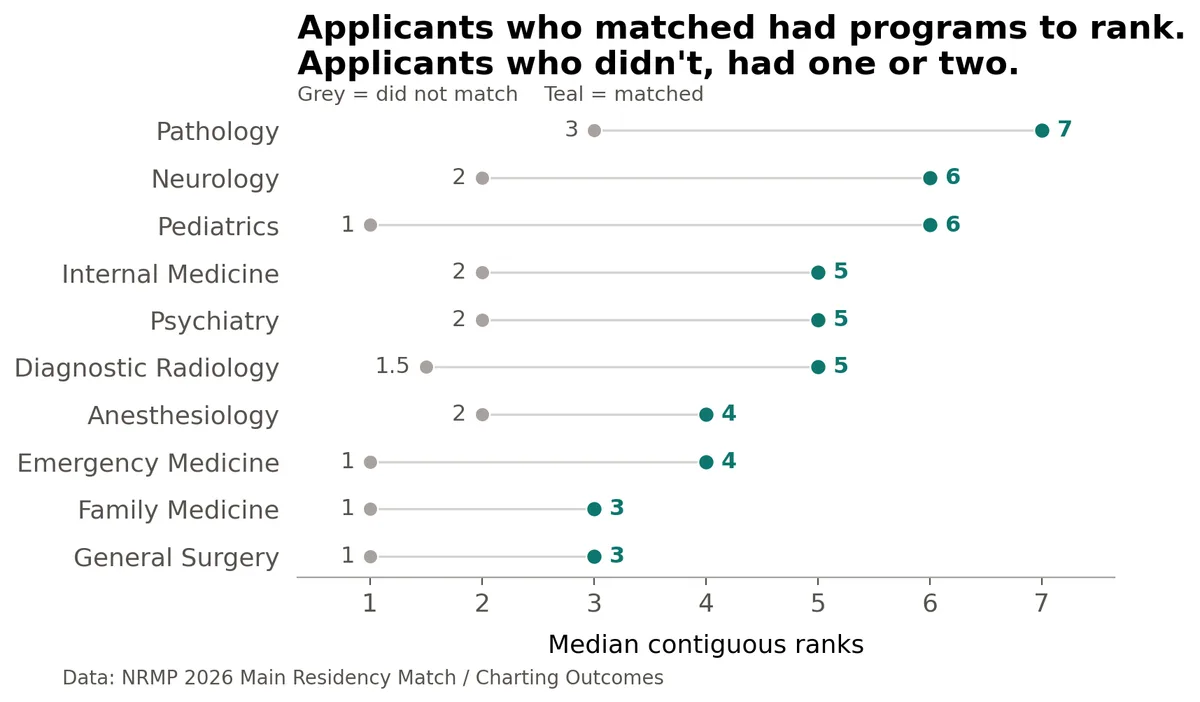
Every single specialty, the same shape. Pediatrics is the starkest version: the median unmatched applicant had one Pediatrics program at the top of their list. The median matched applicant had six.
Read that carefully and it reframes what “not matching” even is. The algorithm cannot manufacture options nobody gave you. By the time rank lists are submitted, the outcome for a large share of unmatched applicants was already close to determined — not by the algorithm, and not by bad luck in March, but by an application that did not generate interviews back in the autumn.
The causes are usually specific and findable rather than mysterious, which is why we wrote a whole piece on why IMGs do not get residency interviews.
The practical upshot: your interview count in November is a live readout of application health, and it is available to you months before Match Week. Use it. If the invitations are not coming, that is data, not a mood — and it is worth knowing how many interviews you should be getting to match so you are measuring against something real instead of against your own anxiety. There is still time in December to widen your program list, rethink signalling, or put a contingency plan in place. There is none in March.
What Step 2 CK Score Does an IMG Need?
Probably the most-searched question in this whole space, and the data refuses to give the clean answer everyone wants. There is no cutoff in it. What there is, though, is more useful than a cutoff.
| Specialty | Matched (median Step 2 CK) | Did not match | Gap |
|---|---|---|---|
| General Surgery | 256 | 247 | +9 |
| Anesthesiology | 255 | 247 | +8 |
| Neurology | 252 | 244 | +8 |
| Internal Medicine | 251 | 243 | +8 |
| Diagnostic Radiology | 250 | 251 | −1 |
| Pathology | 244 | 235 | +9 |
| Emergency Medicine | 243 | 236 | +7 |
| Psychiatry | 241 | 237 | +4 |
| Pediatrics | 240 | 233 | +7 |
| PM&R | 240 | 240 | 0 |
| Family Medicine | 230 | 231 | −1 |
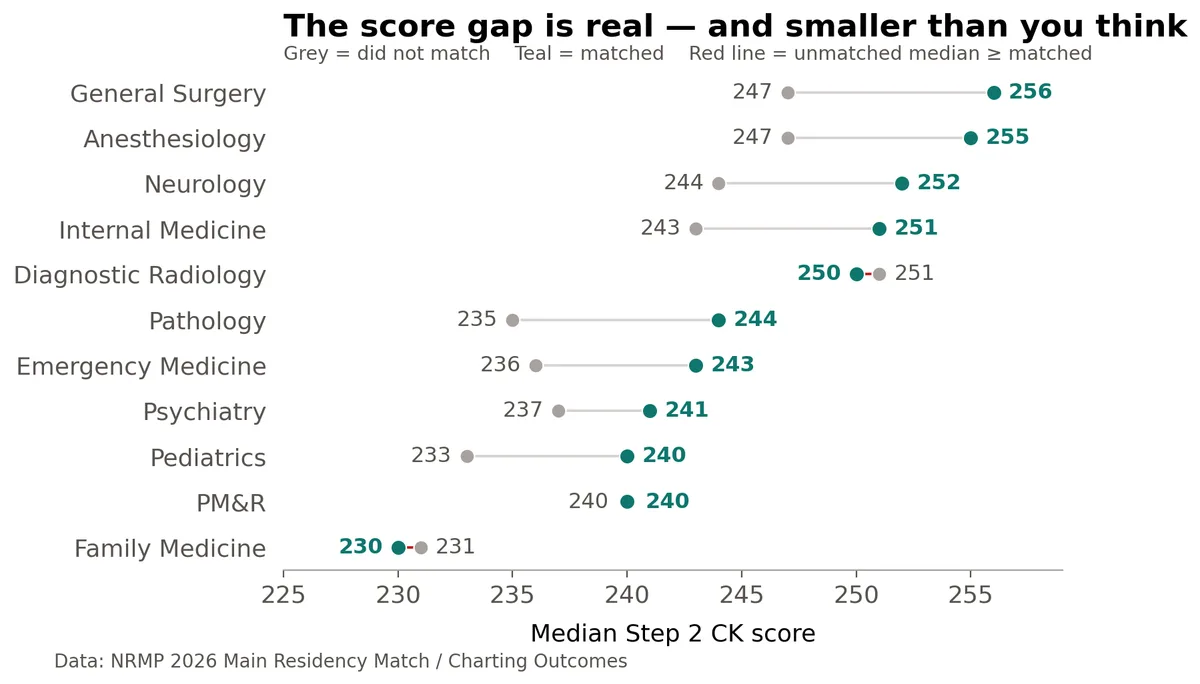
In the big IMG specialties the gap is real but modest — eight points in Internal Medicine, eight in Neurology, seven in Pediatrics. And in three specialties it vanishes or goes backwards: Family Medicine, 230 matched against 231 unmatched; PM&R, 240 against 240; Diagnostic Radiology, 250 against 251.
Those inversions do not mean the exam is unimportant — a weak score will quietly remove programs from your list before a human ever reads your file. What they mean is that among applicants who have cleared the screen, the score stops being the thing that separates outcomes. Two people at 248 can have completely different cycles, and the reason will not be found in the score report.
NRMP’s probability data shows the same curve. Here is Internal Medicine, read from the bottom up, with what each band gains over the one below it:
- 210–219 → 46%
- 220–229 → 60% (+14)
- 230–239 → 71% (+11)
- 240–249 → 79% (+8)
- 250+ → 86% (+7)
Pediatrics sits far higher at every level — 71% at the bottom band, then 85, 91, 96 and 98% at 250+ — but the shape is identical. Steep at the bottom, flattening as you climb. These bands cover all applicant types, not non-U.S. IMGs alone, so read them for the shape of the curve rather than as your personal odds.
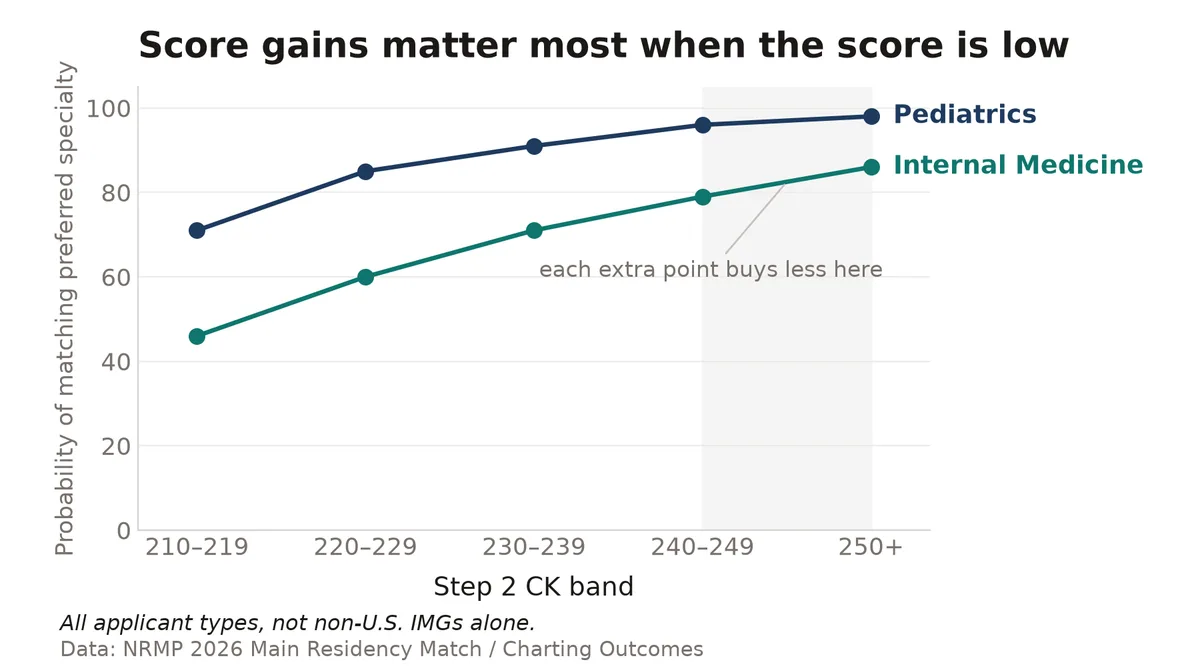
The exam repays effort most when your score is low, and it flattens out exactly where most people start grinding hardest. If you are deciding how much more time to give it, it helps to know where the Step 2 CK passing score sits and what “competitive” actually looks like.
How Many Publications Does an IMG Really Need?
Somewhere along the way it became common knowledge that IMGs need a stack of publications to be taken seriously. The medians say otherwise, and they say it loudly.
| Specialty | Matched (median publications) | Did not match |
|---|---|---|
| Internal Medicine | 3 | 2 |
| Family Medicine | 2 | 2 |
| Pediatrics | 2 | 3 |
| Psychiatry | 3 | 2 |
| Anesthesiology | 4 | 2 |
| Neurology | 5 | 3 |
| Diagnostic Radiology | 6 | 4 |
| Pathology | 7 | 4 |
| General Surgery | 8 | 5 |
| Radiation Oncology | 19 | 3 |
| Neurological Surgery | 70 | 28 |
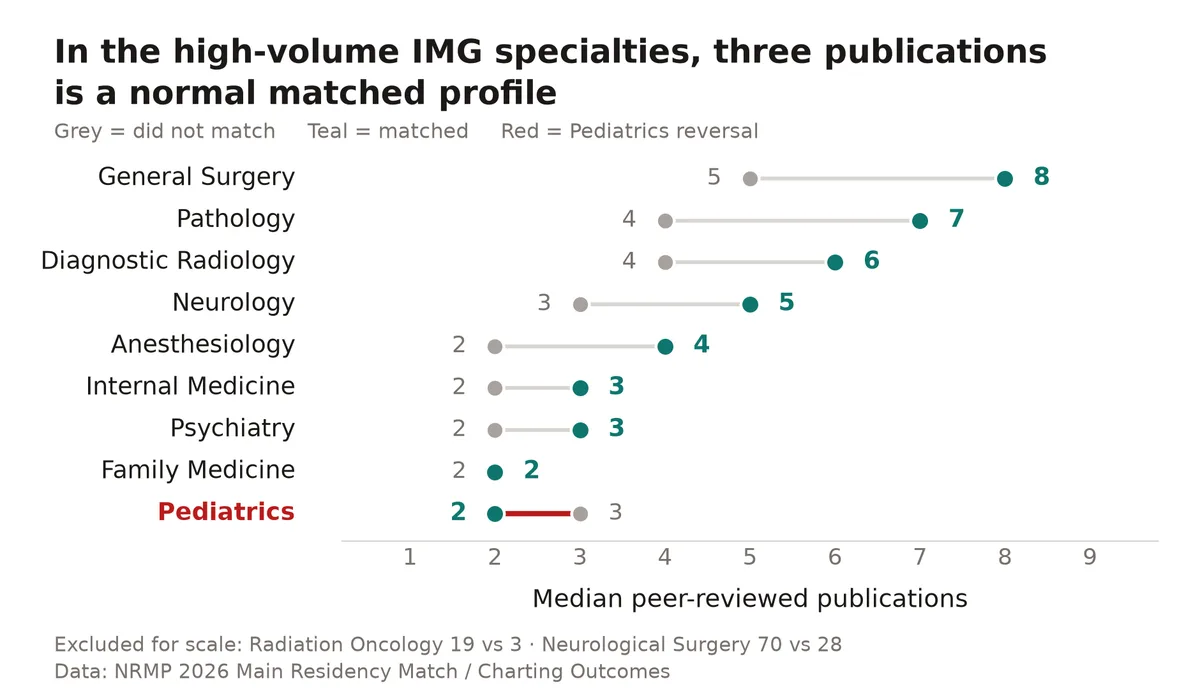
Three publications for the median matched Internal Medicine IMG. Two for Family Medicine. Two for Pediatrics. Three for Psychiatry. That is a long way from the ten-to-twenty figure that circulates in Telegram groups every application season.
And Pediatrics is worth sitting with for a second: the unmatched median was 3 and the matched median was 2. The people who did not match had published more. That is not an argument against research — it is a reminder that applicants stacking up publications are often the ones compensating for something else, and that a number on a CV does not fix the thing it is compensating for.
The table really describes two different worlds. In the high-volume IMG specialties, a modest, genuine research record is the norm among people who match. In Neurosurgery and Radiation Oncology, research saturation is the entry condition — and note how few non-U.S. IMGs are in those cells at all.
So “how many publications do I need” has no general answer. Enough for the specialty you are actually targeting, and after that the next manuscript is competing against every other use of your time. For someone with three papers and no U.S. clinical experience, publication number ten is not the bottleneck. If you are early enough to build the base properly, there are workable ways to find research opportunities for your USMLE CV during MBBS that do not swallow the rest of your application.
So What Actually Matters?
Four things, roughly in this order.
1. Pick your specialty early and deliberately. The probability structure differs so much between fields that this one choice reshapes everything downstream. Decide early and your rotations, letters, research, personal statement and program list can all tell one story. Decide late and you will spend ERAS season retrofitting a narrative onto six unrelated things, which readers can always tell.
2. Track your interview pipeline like a metric, not a mood. Matched applicants had programs to rank; unmatched ones did not. You can see which way yours is going months in advance. Telling yourself your CV is strong does not change what is in your inbox.
3. Attack Step 2 hard when it is genuinely the bottleneck. There is a real difference between taking 220 to 245 and grinding 252 into 257 while everything else stays weak. The first changes which programs will look at you. The second mostly changes how you feel. If the exam really is your limiting factor, it is worth studying how top scorers actually work — this account of scoring 280 on Step 2 CK is a useful contrast with average preparation habits.
4. Do enough research for your field, then stop optimising it. Research is easy to count, which is precisely why people over-invest in it. Three becomes five, five becomes eight, and none of it addresses the reason interviews are not arriving. Build something credible, understand your own projects well enough to defend them in an interview, and put the remaining hours where they are needed more.
The Question Worth Asking Instead
Most applicants ask how to make their CV stronger. It is the wrong question, because “stronger” has no direction. The better one:
What is currently stopping me from getting interviews in my target specialty?
The answer differs enormously from person to person. Sometimes it is Step 2. Sometimes it is a specialty choice that was never realistic. Sometimes it is thin U.S. clinical experience — and not all of it counts equally, which is worth understanding before you pay for a rotation; what program directors look for in USCE is more specific than most people assume. Sometimes it is letters — and the problem is usually that nobody writing them knows the applicant well, which is a different problem from having too few, as this guide to letters of recommendation for the IMG Match gets into. And sometimes the application is fine and the program list was simply too short and too optimistic.
You are not trying to maximise every variable. You are trying to find the binding constraint and remove it. Then find the next one.
A Short Version of the Strategy
- Before Step 2: get the best score you realistically can, particularly if your practice scores sit somewhere that would quietly cut programs from your list. Step 1 is pass/fail now, so this number carries weight it did not used to.
- Before electives and research: decide what you are actually targeting. Six unrelated CV items do not become a narrative later.
- Before ERAS: ask whether this application will generate interviews — not whether it looks impressive laid out on a page. Those are different tests, and only one of them counts.
- During interview season: count your real opportunities honestly, and know the difference between the Match and SOAP before you need it. Nobody should be learning how SOAP works during SOAP week.
- Choosing a specialty on match rate alone and ignoring how many IMGs it actually absorbs.
- Reading a small-specialty percentage as your odds — Dermatology’s 16.7% describes people who already had interviews.
- Grinding a 252 towards 257 while USCE, letters and program list stay untouched.
- Collecting publications as a substitute for the thing that is actually blocking interviews.
- Applying to programs that do not sponsor your visa type and calling it a long shot.
- Waiting until March to react to an empty interview inbox that was already empty in November.
- Adding another year without a specific target — the applicant pool grows faster than the positions do.
Frequently Asked Questions
What was the non-U.S. IMG match rate in 2026?
56.4% for PGY-1 positions, against 70.0% for U.S.-citizen IMGs. In raw numbers, 6,733 of 11,944 non-U.S.-citizen IMGs who submitted a rank order list matched.
Which specialties are most IMG-friendly?
It depends whether you mean rate or volume, and the two give different answers. By volume, which is what actually determines your odds of finding a home, it is Internal Medicine, Family Medicine, Pediatrics, Psychiatry and Neurology, together making up around 88% of the preferred-specialty IMG matches among the specialties listed here. Internal Medicine alone produced 3,392 of them.
How much does needing a visa affect my chances?
In 2026, non-U.S. IMGs needing sponsorship matched at 54.4% against 67.9% for those who did not: a 13.5-point gap, wider than any Step 2 CK gap in this data. It does not make matching unlikely; it makes program selection matter more, because a program that has never sponsored your visa type is a closed door rather than a long shot.
J-1 or H-1B: which should I aim for?
Most non-U.S. IMGs train on a J-1, sponsored by ECFMG and accepted by almost every program that takes IMGs; it carries a two-year home-country requirement that can be waived. H-1B is sponsored by the institution, is offered by a minority of programs, and generally requires Step 3 passed before the petition is filed. If H-1B matters to you, plan Step 3 into your timeline early rather than deciding in Match season.
Is Internal Medicine still worth it for IMGs?
Its 48.5% preferred-specialty rate is not spectacular, and it is not an easy match. But it remains the single largest destination for non-U.S. IMGs by an enormous margin (3,392 matches in 2026), and any realistic strategy conversation has to account for that.
What Step 2 CK score do I need for Internal Medicine?
The matched median was 251 and the unmatched median was 243 , an eight-point gap with heavy overlap on both sides of it. Plenty of people matched below 251 and plenty did not match above it. Treat 251 as a landmark, not a line.
Is 250 a good Step 2 CK score for an IMG?
For the high-volume IMG specialties, yes, comfortably. For Anesthesiology or General Surgery, where matched medians sit in the mid-250s, it is ordinary. Family Medicine’s matched median was 230. Same number, three different meanings.
How many publications do I need for Internal Medicine?
The matched median was three. Not a requirement and not a guarantee, but a long way from the double-digit figure people assume.
Do publications guarantee a match?
No, and Pediatrics is the proof: matched applicants had a median of 2 publications, unmatched applicants had 3.
How many interviews do I need to match?
There is no guaranteed number, and anyone quoting you one is guessing. What the contiguous-rank data shows is a consistent association: Internal Medicine 5 vs 2, Pediatrics 6 vs 1, Neurology 6 vs 2, Psychiatry 5 vs 2. The lesson is not “five is safe”. It is that arriving at rank-list season with one or two options is a signal you should have acted on months earlier.
Why did the IMG match rate fall when the Match got bigger?
Because the applicant pool grew faster than the positions did. 2026 was the largest Match in NRMP history, at 44,344 positions offered, but non-U.S. IMG applicants rose from 7,864 in 2022 to 11,944 in 2026, a 51.9% increase. More seats, far more people competing for them.
The Bottom Line
IMGs get told to improve everything. Higher score, more research, another rotation, another year, apply more broadly, network harder. Some of that will be right for you. Most of it will not be right at the same time.
What the 2026 data suggests is a sequence rather than a pile. Get competitive enough to clear the filters in your target specialty. Convert that into interviews. Arrive at rank-list season with enough real options that the algorithm has something to work with. Each stage depends on the one before it, and effort spent out of order mostly disappears.
So the useful question is not how strong your CV is. It is which single link between where you are now and enough interviews is the weakest. Find it, fix it, then look again — because it will have moved.
- None of this predicts an individual outcome, and you should not read your own odds off these tables.
- “Preferred specialty” means the specialty of the first program on someone’s rank list — so an applicant who preferred General Surgery and matched Internal Medicine counts as unsuccessful in a preferred-specialty analysis despite having matched.
- Charting Outcomes only includes applicants who consented to research use of their data, and small cells are suppressed, so the tiny samples in competitive surgical fields deserve real caution.
- It is all observational. A higher score, another publication or more ranks are associated with matching; that is not the same as causing it. Programs select on things these tables cannot see.
Sources: National Resident Matching Program, 2026 Main Residency Match — Results and Data and Charting Outcomes: Non-U.S. Citizen IMGs, 2026 Appointment Year. All underlying NRMP material remains the property of the National Resident Matching Program. Next Steps USMLE is not affiliated with, endorsed by, or sponsored by the NRMP. AI assistance was used to organise and cross-check the NRMP datasets behind this piece; the interpretation and the strategy are ours.
Next Steps USMLE mentors international medical graduates through Step preparation, U.S. clinical experience, CV building and the residency Match. If you want help working out which part of your own application is the bottleneck, explore our Step 1 & Step 2 CK program and read the success stories of IMGs we have guided through this exact process.
Next step
Step 1 & Step 2 CK Prep
Structured modules, 1-on-1 mentorship, and a 100-day plan to clear the boards.